
The Egyptian flag raised over Sinai, marking the end of a long journey from war to full sovereignty.




CAIRO - 23 APRIL 2026
On April 25 each year, Egypt marks Sinai Liberation Day, a defining national milestone that tells the story of war, diplomacy, and legal perseverance, a journey that ended with the Egyptian flag rising over Sinai and sovereignty fully restored.
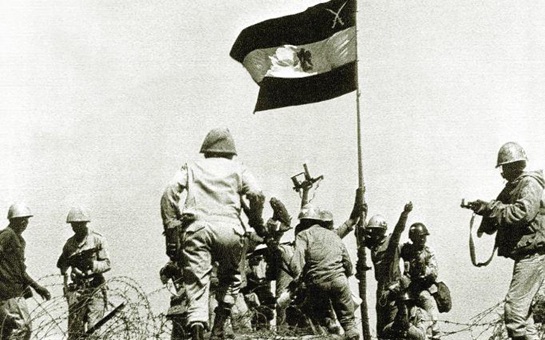


On April 25 each year, Egypt marks Sinai Liberation Day, a date that does more than commemorate the return of land. It tells the story of a long and complex struggle, one that moved across battlefields, negotiating tables, and courtrooms, before ending with the raising of the Egyptian flag over the peninsula in 1982.
Sinai was not recovered in a single moment. It was reclaimed through a process that reshaped Egypt’s military, diplomacy, and national identity.
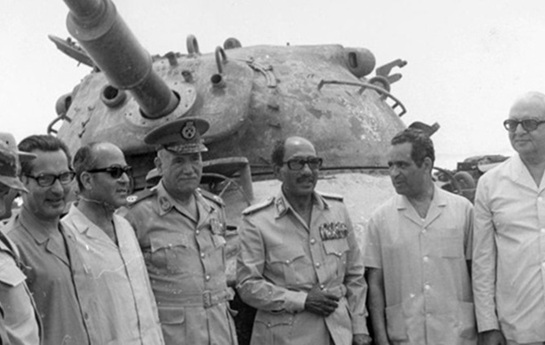
The loss of Sinai in 1967 was a defining shock for Egypt. It was not just a territorial defeat, but a moment that forced the country to rethink its military doctrine, rebuild its armed forces, and restore public confidence.
In the years that followed, Egypt entered a phase of preparation that would lay the groundwork for the 1973 war. The focus was not only on weapons and training, but also on discipline, planning, and understanding the terrain.
“What was taken by force can only be restored by force.”
Anwar El-Sadat, former president of Egypt
By the time Egyptian forces crossed the Suez Canal in October 1973, the objective was clear. This was not a war of total conquest, but a calculated move to break the status quo and force a political solution.
The crossing itself became one of the most defining moments in modern Egyptian history. It restored confidence at home and changed perceptions abroad, proving that the balance of power in the region was not fixed.
The battlefield success of 1973 did not end the conflict, but it changed its direction. It created space for negotiations that would eventually lead to the return of Sinai.
What followed was a long diplomatic process that included disengagement agreements, international mediation, and eventually the signing of the Egypt-Israel peace treaty in 1979.
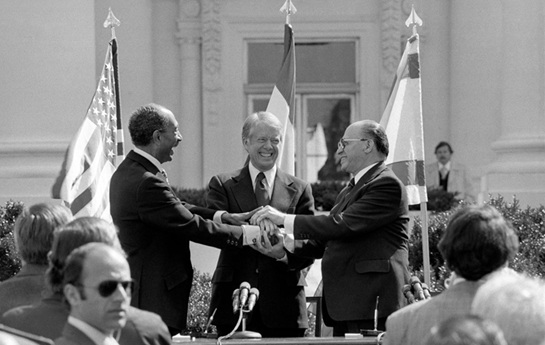
The agreement set out a phased Israeli withdrawal from Sinai, completed in April 1982. But even then, the story was not over.
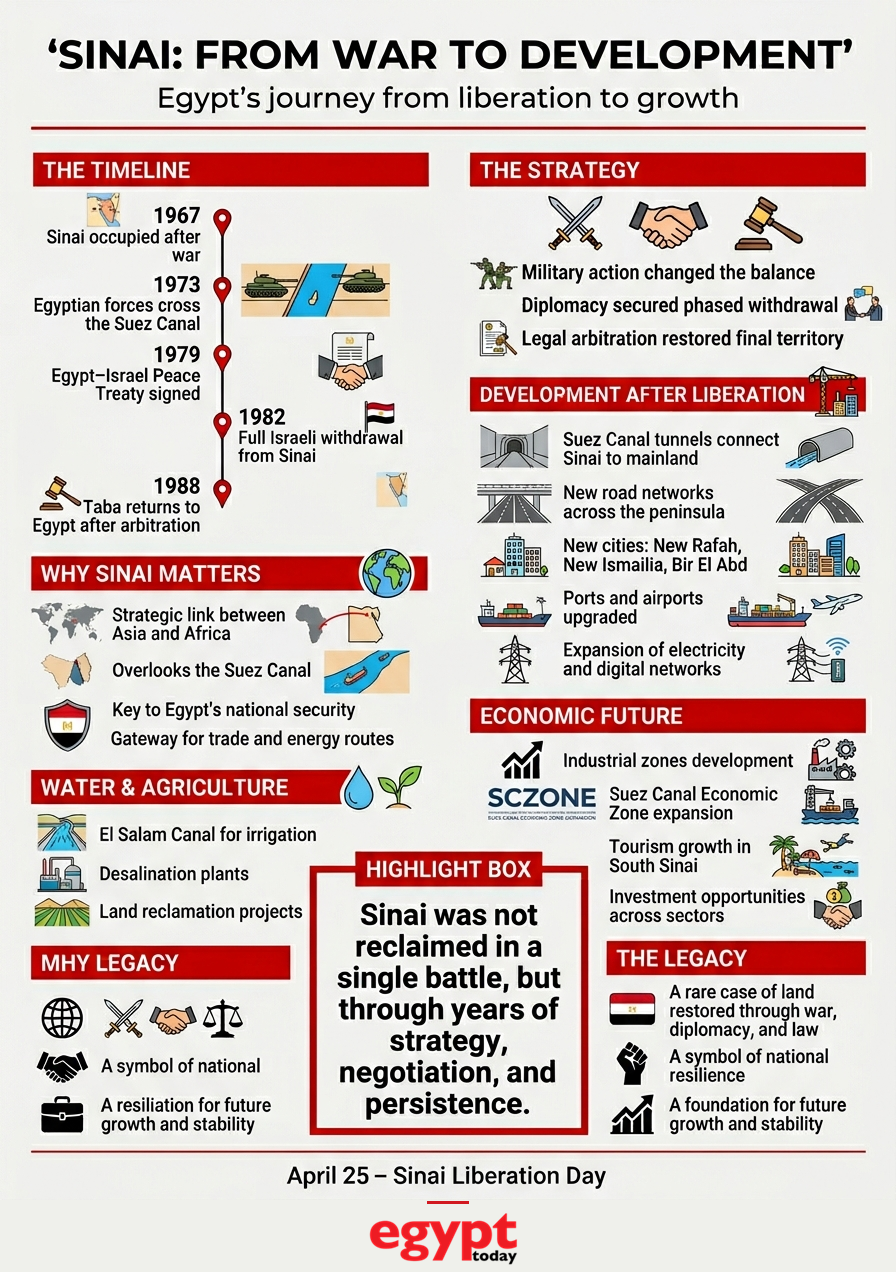
Sinai is occupied, marking a major turning point in Egypt’s modern history.
Egyptian forces cross the Suez Canal, reshaping the balance of power.
The Egypt-Israel peace treaty is signed.
Full Israeli withdrawal from Sinai is completed.
Taba is returned to Egypt after international arbitration.
The dispute over Taba, a small but symbolically significant strip of land, remained unresolved. Egypt took the case to international arbitration, presenting historical maps and legal arguments.
In 1988, the ruling came in Egypt’s favor. Taba was returned, closing the final chapter of Sinai’s recovery.
It was a reminder that sovereignty can be defended not only by force, but also by law.
The recovery of Sinai was not only a military victory, but a triumph of diplomacy and patience.
Hosni Mubarak, former president of Egypt
For decades, Sinai had been seen primarily through a military lens. But after its return, a new question emerged: what comes after liberation?
The answer has been development.
In recent years, Egypt has invested heavily in infrastructure projects aimed at integrating Sinai more closely with the rest of the country. Roads, tunnels under the Suez Canal, new cities, and agricultural projects have all been part of a broader effort to turn the peninsula into a hub of economic activity.
Key projects shaping connectivity, infrastructure, agriculture, energy, and urban expansion across Sinai.
These projects are not just about growth. They are also about stability. Development, officials argue, is a key pillar of long-term security.
Sinai holds a unique place in Egypt’s national consciousness. It represents resilience, patience, and the ability to recover from setbacks.
The story of its return is often told as a sequence of victories, but its deeper meaning lies in how those victories were achieved. Military action created momentum. Diplomacy sustained it. Law secured it.
Few modern conflicts have followed such a path.
Today, Sinai is no longer a frontline. It is a reminder of what sustained national effort can achieve over time.
Sinai Liberation Day is not only about the past. It is also about how that past shapes the present.
For many Egyptians, it stands as proof that challenges, no matter how complex, can be overcome through persistence and coordination across institutions.
It is also a moment to reflect on the cost of that achievement, and the responsibility of preserving it.
Because in the end, Sinai’s story is not just about land. It is about a country that chose to fight, negotiate, and build, until the job was done.

Be Social




Comments
Leave a Comment