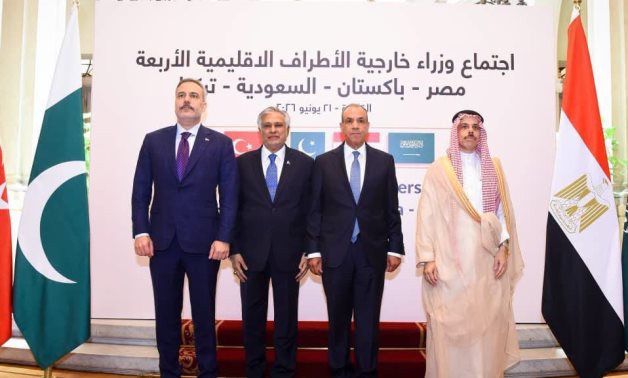
Foreign Minister of Egypt Badr Abdelatty, Saudi Foreign Minister Faisal bin Farhan, Turkish Foreign Minister Hakan Fidan, and Pakistani Foreign Minister Muhammad Ishaq Dar pose for a photo -press photo




CAIRO – 21 June 2026: The Foreign Ministers of Egypt, Pakistan, Saudi Arabia, and Turkey reaffirmed the importance of continued consultation and coordination among their countries in support of peace, security, stability, and prosperity in the Middle East and the wider region.
Egypt hosted the fourth round of the quadrilateral meeting in Cairo on Sunday, bringing together the foreign ministers of the four countries to discuss the latest regional developments following the signing of a Memorandum of Understanding (MoU) between the United States and Iran.
The meeting coincided with a round of diplomatic talks and quadrilateral negotiations involving the United States, Iran, Qatar, and Pakistan in Bürgenstock, Switzerland, aimed at discussing mechanisms for implementing the MoU.
According to a joint statement issued after the meeting, the ministers exchanged views on regional and international developments.
Regarding recent developments, the ministers welcomed the signing of the Islamabad Memorandum of Understanding between the United States and Iran on June 18, 2026. They described the agreement as a constructive step toward de-escalation and ending a conflict that had posed significant risks to regional security and stability, as well as to energy markets, international maritime routes, global supply chains, and international trade.
In this context, the ministers commended the efforts of regional and international actors that helped facilitate the agreement and stressed the importance of faithfully implementing the commitments undertaken by the parties concerned.
The ministers praised the instrumental role played by Pakistan in achieving what they described as a historic outcome, as well as the support provided by Qatar in bringing the negotiations to a successful conclusion. They also welcomed Pakistan's continued close coordination with the four countries on this issue.
Building on this positive momentum, the ministers underscored the importance of achieving a swift and successful conclusion to the next phase of negotiations aimed at reaching a lasting, verifiable, and mutually acceptable resolution to the remaining issues.
They stressed that these efforts should take into account the concerns of countries in the region, particularly regarding the security and stability of the Gulf Arab states and Arab Mashriq, with a view to strengthening collective security and promoting long-term regional stability.
Reaffirming the centrality of the Palestinian cause to peace, security, and stability in the Middle East, the ministers emphasized that the Palestinian issue remains at the heart of efforts to achieve a just, comprehensive, and lasting peace in the region and is a key pillar of a stable and secure regional order.
In this regard, special attention was devoted to the humanitarian and political situation in the Gaza Strip, the West Bank, and occupied East Jerusalem.
The ministers reiterated their support for the legitimate rights of the Palestinian people, including their right to self-determination and the establishment of an independent Palestinian state based on the June 4, 1967 lines, with East Jerusalem as its capital. They described this as an indispensable foundation for achieving a just, comprehensive, and lasting peace in accordance with relevant United Nations Security Council resolutions.
Meanwhile, Iran's Foreign Ministry announced on Sunday that the Bürgenstock talks would address several provisions of the MoU, including oil sales exemptions and the unfreezing of Iranian assets. It added that securing a ceasefire in Lebanon would be a key issue during the Swiss negotiations.
The meeting came days after U.S. President Donald Trump and Iranian President Masoud Pezeshkian formally signed the agreement on Wednesday during the G7 Summit in France.
The MoU marks an initial step toward ending the conflict between the two countries and took immediate effect, while a 60-day negotiating period continues in pursuit of a comprehensive final settlement.
The agreement provides for the immediate and permanent cessation of military operations on all fronts, including in Lebanon. It also establishes a framework for addressing Iran's nuclear program, reopening shipping through the strategic Strait of Hormuz, and lifting sanctions on Tehran.
Egypt and other regional partners have advocated for a diplomatic solution to end the escalation in the Middle East, which has disrupted global energy markets and heightened regional tensions.

Be Social




Comments
Leave a Comment