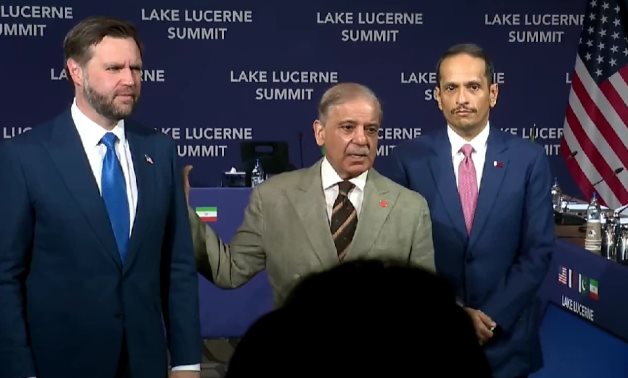
Pakistani PM Shehbaz Sharif speaking next to US Vice President JD Vance and Qatar’s PM Sheikh Mohammed bin Abdulrahman Al-Thani at the Bürgenstock resort, Switzerland, 21 June. White House/Still image




CAIRO – 21 June 2026: Egypt called for building on the recently signed US-Iran memorandum of understanding and advancing negotiations toward a final agreement, as American and Iranian negotiators began direct talks in Switzerland on Sunday.
Egyptian Foreign Minister Badr Abdelatty discussed the US-Iran negotiation track in separate meetings with his Turkish and Pakistani counterparts on the sidelines of quadrilateral talks in Cairo, which also included Saudi Arabia, according to Egypt's foreign ministry.
During talks with Turkish Foreign Minister Hakan Fidan, Abdelatty stressed the importance of building on progress achieved since the signing of the MoU to help reduce regional tensions and support efforts to strengthen security and stability in the Middle East.
Meanwhile, Abdelatty praised Pakistan's efforts, alongside regional partners, in helping secure the US-Iran MoU in his meeting with Pakistani Deputy Prime Minister and Foreign Minister Mohammad Ishaq Dar.
He said the agreement represents an important step toward de-escalation and creating the conditions for a final and sustainable settlement that would enhance regional security and stability.
Dar, for his part, commended Egypt's role in supporting the negotiation process and helping bridge differences between the parties over recent months, which paved the way for the deal.
US and Iranian negotiators met in Switzerland on Sunday for direct talks mediated by Qatar and Pakistan aimed at working out key details of their interim MoU signed last week after nearly four months of war.
The initial accord commits both sides to negotiating a final agreement within 60 days and includes a ceasefire across “all fronts,” including Lebanon, as well as the reopening of the crucial Strait of Hormuz.
The talks come amid questions over implementation of the agreement after Iran announced on Saturday that it had closed the strategic energy waterway in response to ongoing Israeli strikes in Lebanon.
However, the US has challenged Iran's claim, saying the waterway remains open and that US forces are monitoring the situation to ensure its continued operation.
US Vice President JD Vance said Washington hopes to make progress on Iran's nuclear program and the situation in Lebanon, while Tehran said it would press for full implementation of commitments already made under the agreement.
The US delegation is led by Vance, and includes President Donald Trump's Senior Advisor Jared Kushner and US Special Envoy to the Middle East Steve Witkoff.
Iran is represented by Parliament Speaker Mohammad Bagher Ghalibaf and Foreign Minister Abbas Araghchi.
Pakistan, which has acted as a mediator throughout the conflict and previously hosted talks between Washington and Tehran, is also participating.
Prime Minister Shehbaz Sharif and Army Chief Field Marshal Asim Munir joined the discussions.
The preliminary agreement also envisages a $300 reconstruction and economic development “plan” for Iran and the lifting of “all types of sanctions” on Tehran.
Under the deal, the two sides commit to negotiating and achieving a final deal within maximum 60 days, subject to extension by mutual consent.
What is the US-Iran initial peace deal and what are its 14 key points?

Be Social



Comments
Leave a Comment