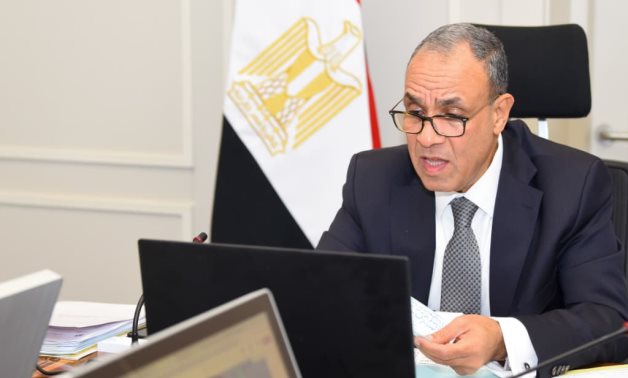
File- Egypt’s Minister of Foreign Affairs Badr Abdelatty gives a speech during the ministerial-level extraordinary session of the League of Arab States on March 8, 2026- press photo




CAIRO – 25 April 2026: Egypt’s Minister of Foreign Affairs, Badr Abdelatty, held a series of telephone calls with regional and international counterparts as part of ongoing coordination efforts to contain rising tensions in the region and support diplomatic solutions.
In a call with Pakistan’s Deputy Prime Minister and Foreign Minister, Muhammad Ishaq Dar, the two sides discussed regional developments and efforts to de-escalate the situation. They reviewed ways to advance the diplomatic track between the United States and Iran, expressing hope for a second round of negotiations that would help consolidate the ceasefire, reduce tensions, and create conditions for ending the current conflict.
Both ministers emphasized that dialogue and negotiation remain the most effective means to resolve the crisis. Abdelatty also stressed the importance of safeguarding freedom of international navigation and taking into account the security concerns of regional countries, particularly the Gulf Arab states.
The two sides agreed to continue close coordination to support diplomatic efforts, reduce tensions, resume negotiations, and promote political solutions while avoiding military escalation.
In a separate call on Friday, April 24, Abdelatty spoke with Canada’s Minister of Foreign Affairs, Anita Anand, where they discussed ways to strengthen bilateral relations and exchanged views on key regional issues.
Abdelatty underscored the importance of enhancing economic and trade cooperation, highlighting opportunities to expand Canadian investments in Egypt, particularly in the energy, agriculture, and water resources sectors.
On regional developments, he reviewed Egypt’s efforts to contain tensions and reiterated the importance of prioritizing diplomatic solutions. He affirmed Egypt’s support for the ongoing negotiating track between the United States and Iran as a pathway to de-escalation and renewed political dialogue.
Regarding the Palestinian issue, Abdelatty stressed the importance of completing the second phase of the plan proposed by U.S. President Donald Trump. He highlighted the need for the National Committee for the Administration of the Gaza Strip to begin operating from within Gaza, alongside the swift deployment of an international stabilization force to help support the transitional phase and enhance security conditions.
He also reiterated Egypt’s firm rejection and condemnation of ongoing Israeli violations in the West Bank.
For her part, Anand praised Egypt’s active role in promoting regional stability and commended Cairo’s efforts to contain crises and support peaceful resolutions.
As part of his continued diplomatic outreach, Abdelatty also held a call with Oman’s Foreign Minister, Badr Al-Busaidi, to discuss the rapidly evolving regional situation and coordinate efforts to reduce tensions.
The two ministers exchanged views on developments in U.S.-Iran negotiations, stressing the importance of supporting diplomatic efforts to reach understandings that would reinforce the ceasefire, end the conflict, and promote stability in the region.
They emphasized the need to prevent renewed military confrontations, maintain freedom of international navigation, and prioritize dialogue as the only viable path to lasting stability.
During the call, Abdelatty reaffirmed Egypt’s full solidarity with Oman and all Arab Gulf states, stressing that the security of the Gulf is an integral part of Egypt’s national security and underscoring the importance of addressing the region’s security concerns.

Be Social




Comments
Leave a Comment