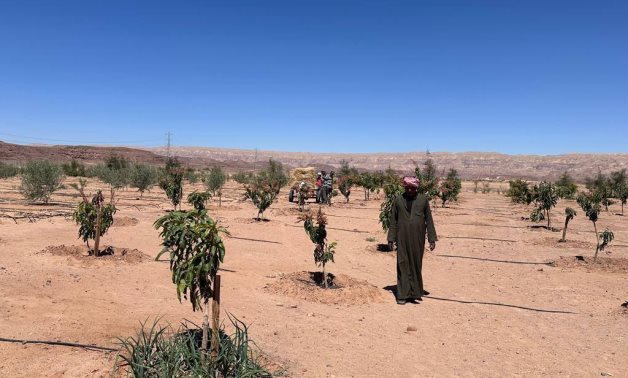
Olive saplings in Sinai- Press photo




CAIRO – 23 April 2026: On the occasion of Sinai Liberation Day, Minister of Agriculture Alaa Farouk reviewed a year of progress in agricultural development across the Sinai Peninsula, highlighting Egypt’s broader strategy to position the region as a hub for investment, agriculture, and sustainable communities.
The review covered projects implemented by the Desert Research Center between April 2025 and April 2026. Farouk emphasized that the ministry is adopting a science-based, field-oriented approach to strengthen food security and integrate Sinai residents into sustainable development plans, in line with Egypt Vision 2030.
As part of these efforts, a cooperation protocol was signed between the Desert Research Center and QNB Egypt to finance 40 agricultural projects in South Sinai under the first phase of the “Namaa” initiative, aimed at supporting small enterprises and empowering women. The center also partnered with the General Petroleum Company to establish a smart development community in Ras Sudr’s Al-Bagha area, focusing on water desalination, livestock support, and waste recycling.
In cooperation with the FAO, a livelihoods enhancement project was implemented, including 100 field schools benefiting 1,200 farmers and women, along with the distribution of 50 tons of animal feed to support livestock breeders.
Farouk noted that agricultural communities in Sinai have evolved into integrated development models, with 18 communities hosting 2,122 families across 11,000 feddans. These communities received 350,000 olive saplings and 2,000 Siwa date palm offshoots, in addition to bio-fertilizers.
Three integrated agricultural service centers were also established at a total cost of EGP 390 million, equipped with machinery worth EGP 200 million and covering 42,000 square meters.
The minister highlighted additional milestones, including the inauguration of the Center of Excellence for Water Desalination and a Regional Gene Bank in Ras Sudr. A contract was also signed with the Arab Contractors Company to rehabilitate the Sheikh Zuweid Research Station at a cost of EGP 230 million, doubling its olive seedling production capacity.
Efforts also included land surveying in Sheikh Zuweid and Arish, irrigation system upgrades at Qantara East, and monitoring successful wheat harvests in South Sinai. The Desert Research Center conducted around 280 field visits, alongside the “Ask and Consult Before You Spend a Lot” initiative, which provided technical support through 220 visits and handled 8,000 inquiries via WhatsApp.
In addition, 10 educational films and 50 scientific publications were produced, and a smart digital library and chatbot were launched to provide continuous agricultural guidance. Training programs for farmers were expanded, focusing on best practices in cultivation, pruning, and farm management.
Farouk stressed the importance of agricultural extension services, noting significant progress in digital extension tools and continuous on-the-ground support by researchers and experts.
Veterinary convoys were also deployed, examining and treating hundreds of animals and birds across North and South Sinai, including in Nuweiba and Saint Catherine. Farmers received training in modern wool shearing techniques, and 25 shearing machines were distributed. Alternative feed solutions using halophytic plants were introduced to reduce costs.
The minister announced EGP 5 million in funding for women-led small projects in Sinai, alongside training programs in Sheikh Zuweid. For the first time, 10 demonstration plots for oilseed sunflower cultivation were introduced, and 250 farmers received high-yield barley seeds.
The second phase of the integrated development project in Wadi Feiran and Saint Catherine has also been launched, focusing on greenhouses, beekeeping, and water harvesting systems.
Farouk added that emergency responses to recent floods included rapid damage assessments in Wadi Saal, provision of irrigation equipment and seedlings, and land rehabilitation at the ministry’s expense. Poultry projects were also introduced to support affected families.
He concluded that mechanization service fees have been reduced by 50 percent for Sinai farmers, alongside the provision of subsidized seeds and fertilizers. Outstanding students were honored through the “Learn and Benefit” initiative to promote applied agricultural education.
The minister stressed that supporting Sinai farmers remains a top priority, describing them as a cornerstone of sustainable development in the region.

Be Social




Comments
Leave a Comment