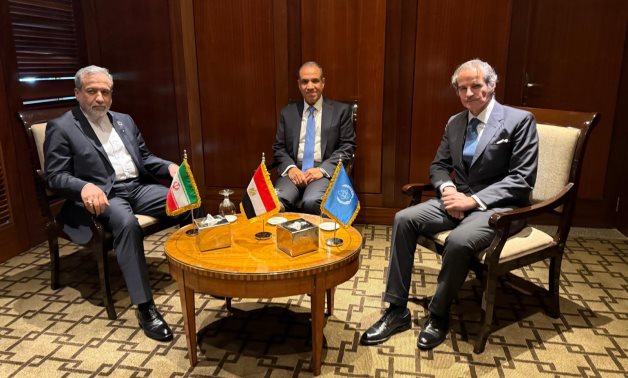
FILE – Foreign Minister Badr Abdelatty meets Iran’s Foreign Minister Abbas Araghchi (L) and IAEA Director General Rafael Grossi (R) in Cairo in June 2025. IAEA




CAIRO – 16 November 2025: Egypt’s Foreign Minister Badr Abdelatty underscored the need to maintain efforts aimed at de-escalation, confidence-building and creating conditions conducive to continued cooperation between Iran and the International Atomic Energy Agency (IAEA).
These steps, he said, would provide a genuine opportunity for diplomatic solutions and the resumption of talks to reach a comprehensive agreement on Iran’s nuclear program that takes all parties’ interests into account and supports regional stability.
Abdelatty made the remarks in phone calls with Iran’s Foreign Minister Abbas Araghchi and IAEA Director General Rafael Grossi to review the cooperation underway between Iran and IAEA regarding the country’s nuclear file.
The calls also covered developments ahead of the upcoming IAEA Board of Governors Meeting.
Abdelatty stressed the importance of sustaining dialogue within multilateral frameworks to reinforce the nuclear nonproliferation regime at both regional and international levels and bolster global security and stability.
Grossi, for his part, praised the Egyptian president’s efforts to expand the peaceful uses of nuclear energy in support of national development goals, particularly the El-Dabaa nuclear power plant project.
He described the project as a model of cooperation between member states and the agency.
Cairo has been working to revive cooperation between Iran and the IAEA, which Tehran suspended following US airstrikes on key Iranian nuclear sites in June.
Iran and the nuclear watchdog reached an agreement in Cairo in September with Egyptian mediation to resume inspections. However, Tehran later halted the deal implementation after the United Nations reimposed sweeping sanctions.
The UK, France and Germany have triggered the process of restoring the sanctions, which had been lifted under the 2015 nuclear deal, after repeated talks failed to produce progress on Tehran’s nuclear program.

Be Social




Comments
Leave a Comment