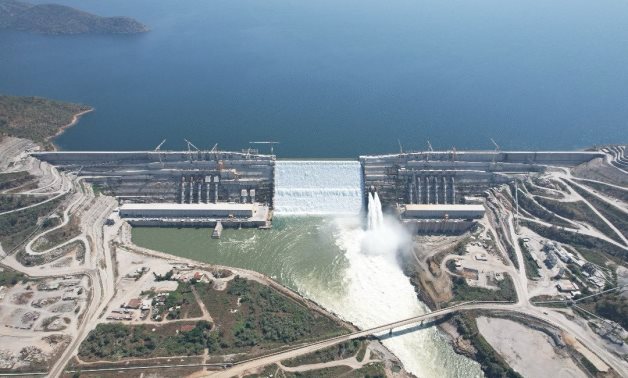
FILE - Grand Ethiopian Renaissance Dam (GERD) - Ethiopian gov't




CAIRO – 3 October 2025: Egypt has accused Ethiopia of “reckless” management of the Grand Ethiopian Renaissance Dam (GERD), which triggered an unusually severe and delayed flood on the Nile beyond the normal seasonal peak.
In a statement on Friday, the Egyptian Ministry of Water Resources and Irrigation denounced Ethiopia’s "unilateral" management of its "illegal dam that violates the international law." The $5 billion mega dam is capable of holding back up to 74 billion cubic meters of water.
The ministry stressed that sudden, uncoordinated water releases last month created a “man-made flood” that inundated farmland and villages in Sudan and “placed the lives and resources of the populations of the two downstream countries (Egypt and Sudan) at risk.”
Egypt emphasized that such unilateral practices by Ethiopia “lack the most basic standards of responsibility and transparency, and pose a direct threat to the lives and security of the peoples of the downstream countries.”
Moreover, the “unregulated and chaotic” dam management, Egypt stressed, “exposes as false Ethiopia’s repeated claims that its actions cause no harm to others.”
Cairo accused Addis Ababa of “political exploitation of water at the expense of human lives and regional security.”
The Day of the Inauguration
The Egyptian ministry detailed the scientific reasons behind the “man-made flood,” blaming it on “Ethiopian rush to complete the filling in an unregulated manner … in pursuit of a mere media snapshot” during the dam’s inauguration on 9 September.

Egypt accused Ethiopian dam operators of “flouting accepted technical and scientific practices” by stockpiling far more water than expected at the end of August while sharply reducing releases from about 280 million cubic meters a day to just 110 million cubic meters on 8 September.
The ministry affirmed that Ethiopia, instead, should have followed a gradual and scientifically regulated process of storing water in GERD between July and October, before releasing it steadily throughout the year to generate electricity.
The Blue Nile’s flood season runs from July to October and typically peaks in August, the statement noted.
The ministry stated that the recent unilateral filling of the dam by Ethiopian operators was designed to quickly raise water levels to 640 meters above sea level.
Ethiopia then opened the dam’s middle and emergency spillways for only a few hours, solely for a “media snapshot and political show” during the inauguration “without any regard for water safety or the interests of downstream states.”
What Caused the Flood?
The Egyptian ministry said Ethiopia abruptly and ‘without justification’ released massive volumes of stored water, estimated at about 2 billion cubic meters, during September.
On 10 September, after the dam inauguration, operators discharged an estimated 485 million cubic meters of water in a single day, followed by “sudden and unexplained” surges that peaked at 780 million cubic meters on 27 September, before dropping to 380 million on 30 September.
Estimates showed a drop of nearly one meter, equivalent to the release of about 2 billion cubic meters of stored water, besides the normal flood-related discharges.
This, Egypt said, increased the volume of water released downstream and underscored “the unregulated and chaotic nature of the dam’s management.”
“The Ministry of Water Resources and Irrigation believes that what happened on the Blue Nile – the hastened, unlawful filling of the Ethiopian dam followed by the massive release of water immediately after the so‑called inauguration ceremony — was not a necessary action, but rather reflects an unregulated and irresponsible management of a dam of this scale.”
Impact on Sudan
Egypt emphasized that the delayed and more acute flood has inflicted severe losses on Sudan, citing reports from the United Nations Office for the Coordination of Humanitarian Affairs (OCHA).
Sudanese authorities reported this week that floodwaters from the swollen Nile River have encircled at least seven districts in Sudan’s capital, Khartoum, Sudan Tribune reported.
The ministry underscored that the convergence of the unusually large volumes of water from the dam at this time of year, combined with delayed and irregular rainfall in Sudan and higher-than-normal flows from the White Nile, led to a sudden surge in water levels, flooding large areas of farmland and inundating numerous Sudanese villages.
Faced with these emergency conditions, operators of Sudan’s Roseires Dam had no option but to store only a small portion of this water and pass the majority through its gates to protect the safety of the dam, given its limited storage capacity, the ministry explained.
This year’s flood levels at the Nile’s main three tributes – the White Nile, the Blue Nile, and the Atbara River – were about 25% above average, though still lower than last year’s unusually high flood, the ministry noted.
Egypt Dismisses Ethiopia Claims
Egypt refuted Ethiopia’s repeated claims that the dam would regulate floods and protect Sudan from inundation, while providing power for the Ethiopian people.
Egypt and Sudan have long condemned Addis Ababa’s filling and operation of the mega dam without a legally-binding agreement that ensures the water rights of both downstream nations and protect their populations during the periods of extended drought.
“Egypt has repeatedly warned that the existence of a dam storing 74 billion cubic meters in violation of international law and without a binding legal agreement, combined with such chaotic and reckless management, represents a constant and ongoing threat to the downstream countries during both droughts and floods,” the ministry underscored.
How Floods Are Affecting Egypt
Several Egyptian governorates across the Nile Delta have been impacted by the annual flooding as water inundated a range of floodplain areas.
Governors of Gharbia, Menoufia, and Beheira have called on residents illegally living on the Nile’s floodplain to evacuate promptly to ensure their safety.
The ministry dismissed claims circulating on some media platforms and social networks about governorates being submerged as “false and misleading,” stressing that flooding is limited to some floodplain areas.
The ministry emphasized that these specific lands are naturally part of the Nile’s reserve and are usually expected to be inundated during high water levels.
“The lands recently inundated are naturally part of the Nile’s floodplain, which the river has historically contained during periods of increased flow over past decades,” the statement confirmed.
Dealing with Encroachments Amid Floods
The ministry stated that encroachments on these lands in the form of cultivation or construction have usually caused losses when water levels rise, stressing these areas not being designated for permanent agriculture.
“Encroachments on the riverbed have serious technical consequences, foremost among them reducing the river’s discharge capacity, which is a vital source of life for the Egyptian people,” the statement warned.
The ministry said it annually warns citizens and undertakes substantial and costly operations to safeguard the crops and property of violators as “part of the national fabric.”
“Nonetheless, continued violations by a small number of individuals hinder water delivery to tens of millions of citizens and farmers, adversely affecting agricultural activity and the national economy as a whole.”
In anticipation of potential flooding, the ministry took precautionary measures, including issuing a directive to all governors early in September to alert citizens to remain vigilant.
Governors were instructed to urge residents to take necessary steps to protect their property and crops located on the Nile’s floodplain, even though such use is unauthorized and in violation of the law, the statement emphasized.
The ministry underlined the Egyptian state’s commitment to protecting citizens and mitigating the potential impacts of flooding.
Message of Reassurance
Concluding its 14-point statement, the ministry reassured citizens that the state, through all its agencies, monitors the situation around the clock, supported by the Aswan High Dam as “the primary safeguard.”
“The High Dam, with its storage and discharge capabilities, remains the primary safeguard protecting Egypt from Nile fluctuations and sudden floods.”
The ministry also reassured citizens that Egypt’s water resource management is conducted with high efficiency and careful planning, accounting for all contingencies to ensure water needs are met and lives and property are protected.

Be Social




Comments
Leave a Comment