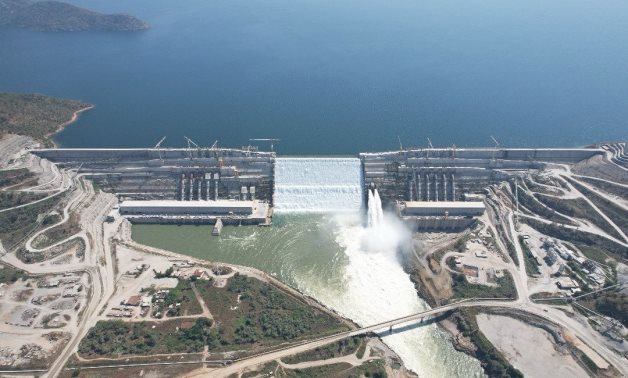
A file photo of the Grand Ethiopian Renaissance Dam (GERD) - GERD's X




CAIRO – 27 September 2025: Foreign Minister Badr Abdelatty accused Ethiopia of “endangering the lives of millions in the two downstream states” of Egypt and Sudan through unilateral actions on its Blue Nile mega dam.
As he addressed the high-level debate of the 80th session of the United Nations General Assembly (UNGA) on Saturday, Abdelatty condemned Ethiopia’s “destabilizing unilateral policies” in the Horn of Africa and the Eastern Nile Basin.
He highlighted Ethiopia’s finalization of construction of its Grand Ethiopian Renaissance Dam (GERD) unilaterally, imposing a fait accompli on the downstream states.
“Egypt has long sought to strengthen cooperation among the Nile Basin states and to support development in those brotherly nations with which we share the Nile, a source of prosperity and growth for us all,” the foreign minister remarked.
“In contrast, Ethiopia has chosen to violate international law and impose a fait accompli through its unilateral policies that destabilize the Horn of Africa and the Eastern Nile Basin.”
His remarks come after Ethiopia this month inaugurated its $5 billion dam, with a reservoir capacity of 74 billion cubic meters, while ignoring Egyptian-Sudanese longstanding calls for a legally-binding agreement that governs the filling and operation of the dam.
Egypt and Sudan argue that such a deal would ensure their water rights, especially at the times of drought.
Ethiopia rejects a legally-binding deal on the dam, describing the project as a sovereign right and a cornerstone of its development and energy ambitions.
On the day of inauguration on 9 September, Egypt submitted a formal letter to the UN Security Council condemning GERD as an “illegal unilateral measure.”
The letter said Cairo had shown “utmost restraint” for years by resorting to diplomacy and international organizations, including the UN.
Adopting such measures, Egypt said, “is not out of weakness, but out of Egypt’s firm conviction in the importance of cooperation to achieve the common good of all Nile Basin states.”
Cairo has repeatedly asserted the unilateral filling and operation of the dam, without a binding legal agreement, pose an existential threat, as the country depends on the Nile for more than 98 percent of its water needs.
During his UNGA address today, Abdelatty stressed that Egypt is capable of protecting its water rights and will not compromise them.
“Ethiopia has chosen to violate international law, pursued destabilizing unilateral policies in the Horn of Africa and the Eastern Nile Basin, and announced the completion of its dam while dreaming, or rather deluding itself, that Egypt would forget its existential rights and interests in the Nile,” Abdelatty stated.
‘Taking GERD to International Judiciary’
The foreign minister said Egypt remains open to judicial and arbitration mechanisms under international law, but questioned any genuine intent from the Ethiopian side to abide by them.
“If anyone boasts of commitment to international law, we are fully prepared to address the matter before judicial and arbitration mechanisms, should there be sincere intent to submit to these frameworks, which, in reality, has never and will never exist,” Abdelatty said.
He stressed that the UN Charter and the principles of international law grant Egypt the right to defend its existential interests in the Nile.
“As they (Ethiopia) resort to stalling while threatening the lives of millions in the downstream states, we will not relent in protecting our rights, and we are capable of doing so,” he declared.
‘Ethiopia’s Intransigence’
Over more than a decade of talks, Egypt and Sudan have blamed Ethiopia’s intransigence and lack of political will for repeated deadlocks in GERD talks, which had been conducted under the umbrella of the African Union.
Egypt escalated the GERD dispute to the UN Security Council in 2020, then jointly with Sudan in 2021, and once again on its own in 2025.
In July 2021, at Cairo and Khartoum’s request, the Security Council convened a session on the GERD crisis. Both warned that Ethiopia’s unilateral actions threatened regional stability.
The session concluded with a UN Security Council presidential statement urging the three countries to “finalize expeditiously the text of mutually acceptable and binding agreement on the filling and operation of the GERD, within a reasonable time frame.”
However, negotiations later collapsed without progress.
By March 2024, Egypt’s Irrigation Minister Hani Sewilam announced that Cairo does not intend to engage in further negotiations regarding the dam in the same form, deeming them as a “waste of time.”
Speaking during the World Water Day celebrations, Sewilam emphasized that Ethiopia will bear the costs of any potential harm caused to Egypt by the dam, as per the 2015 Declaration of Principles signed by the three countries.

Be Social



Comments
Leave a Comment