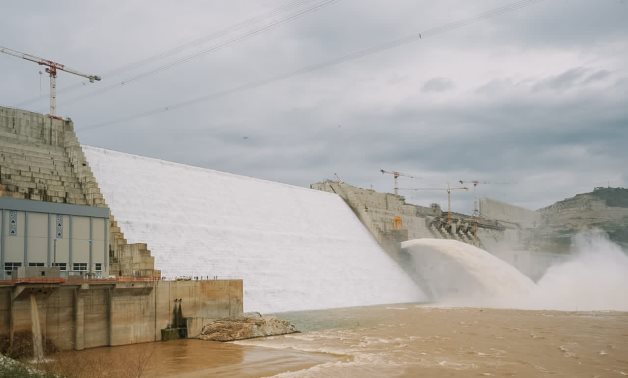
FILE - Grand Ethiopian Renaissance Dam (GERD) - Ethiopian gov't




CAIRO – 10 July 2025: Prime Minister Mostafa Madbouly stated that Egypt’s stance regarding the Grand Ethiopian Renaissance Dam (GERD) has “not changed at all,” stressing that a written regulatory framework is required to govern the dam during the times of prolonged drought.
Madbouly highlighted Ethiopian Prime Minister Abiy Ahmed’s remarks last week that Addis Ababa has completed the construction of the mega dam, which he insists “is not a threat” for the downstream countries: Egypt and Sudan.
“To our neighbours downstream - Egypt and Sudan - our message is clear: the Renaissance Dam is not a threat, but a shared opportunity,” Ahmed said to announce the completion of dam construction.
Ahmed extended an invitation to Egypt and Sudan to participate in the dam’s official inauguration in September.
Egypt and Sudan have engaged in talks with Ethiopia for more than a decade in a bid to secure a binding agreement concerning the GERD to protect the two downstream countries’ water rights, especially during prolonged drought.
However, Addis Ababa proceeded with the dam filling and operation without the two downstream countries’ consent.
Given Egypt's heavy reliance on the Nile for its water requirements, the country perceives the filling and operation of the dam with the absence of a clear legally-binding agreement as an “existential threat.”
Egypt is also concerned with the dam’s potential impact on the nation’s already strained water supply.
Egypt grapples with severe water shortages with a per capita water supply of around 550 cubic meters per year—well below the globally recognized threshold for water scarcity set at 1,000 cubic meters per person.
Meanwhile, Ethiopia views the project as essential to cover its growing electricity demand with around half of the population living without power.
The 74 billion cubic meter dam can generate up to over 5,000 MW of electricity, constituting more than double Ethiopia’s current output.
Last year, Minister of Water Resources and Irrigation Hani Sewilam said Egypt does not intend to engage in further negotiations regarding GERD in its current proposed form, deeming them as a “waste of time.”
Sewilam emphasized that Ethiopia will bear the costs of any potential harm caused to Egypt by the dam, as per the 2015 Declaration of Principles signed by Egypt, Ethiopia, and Sudan.
‘Writing Down Good Deeds’
After concluding a Cabinet meeting on Wednesday, Madbouly underlined the need for a written regulatory framework “to ensure rights of current and future generations regarding Nile water.”
The Egyptian PM highlighted a recent bilateral meeting with his Ethiopian counterpart during the BRICS summit in Brazil, noting that Ahmed has underscored his pledge to not cause any harm to Egypt.
“What is important to us, given these good intentions, is that these statements and intentions are translated into something written that both nations respect—a document that will govern future relations between the two countries or even all Nile Basin countries,” Madbouly stated.
“I emphasized this during our bilateral meeting.”
He underlined that “Egypt is not against the development of any African country, but it has legitimate rights in the Nile River.”
Madbouly emphasizing that “Egypt will not allow any harm regarding its rights to Nile water,” noting that “all measures taken by the state during the dam filling process have successfully neutralized the filling operation.”
Madbouly stated that Egypt maintains relationships with all countries around the world and does not oppose any state.
“Our relations with all African nations are always based on mutual respect. We consistently affirm that we are not against development in any country, but it must not infringe upon Egypt's rights to the Nile River's water, which is a firm stance.”

Be Social




Comments
Leave a Comment