CAIRO - 18 May 2026: The International Finance Corporation (IFC) has marked 50 years of partnership with Egypt’s private sector, underscoring its role in mobilizing more than $10 billion in investments and financing across nearly 300 projects since 1976.
The milestone reflects a long-standing development relationship that has evolved alongside Egypt’s economic transformation, with IFC support spanning energy, agribusiness, manufacturing, healthcare, tourism, and financial services.
According to the institution, its work in Egypt is part of a broader World Bank Group engagement exceeding $40 billion since 1959, combining policy financing and development projects through the World Bank, investment and advisory support from IFC, and risk guarantees from MIGA aimed at encouraging private capital flows.
Over the years, IFC-backed investments have helped shape several landmark developments, including participation in the Benban Solar Park, which became one of the world’s largest solar installations at the time of completion, as well as Egypt’s first utility-scale battery storage project completed in 2025.
In infrastructure, the Damietta Alliance Container Terminal is expected to become a major logistics hub, with projected job creation of around 80,000 positions by 2040, highlighting the sector’s growing role in trade facilitation and economic connectivity.
The institution also pointed to structural gains in financial inclusion, which rose from 27 percent in 2016 to 76.3 percent by 2025, supported by IFC-backed financial institutions and targeted programs such as the ZAAT initiative with Banque Misr, which expanded access to formal banking for more than 80,000 women entrepreneurs.
In agribusiness, IFC cited its long-standing partnership with Wadi Group, which developed from desert farming operations into one of Africa’s leading egg producers, reflecting the sector’s contribution to food security and export capacity.
The IFC also plays an increasing advisory role in Egypt’s economic reform agenda, including its appointment by Prime Minister Mostafa Madbouly to support the Asset Monetization Program, in addition to its involvement in expanding private sector participation in 11 airports across the country.
As part of the next phase of cooperation, IFC signed a $40 million financing agreement with Nile Sugar Company to support sugar beet cultivation in Minya. The project aims to reduce import dependence in a country that currently meets around 80 percent of its domestic sugar demand, while strengthening agricultural supply chains and supporting small farmers.
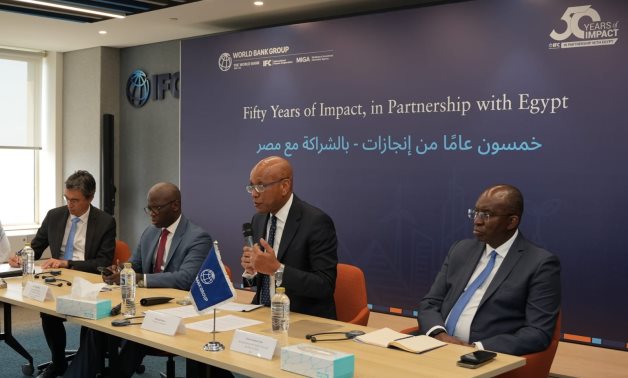
Speaking at the conference marking the anniversary, World Bank Group Vice President for the Middle East, North Africa, Afghanistan and Pakistan Ousmane Dione described the partnership as one that has delivered “50 years of progress and success,” adding that the focus ahead is on strengthening human capital and enabling private sector-led growth.
IFC Vice President for Africa Ethiopis Tafara said Egypt’s experience demonstrates how sustained investment, reforms, and entrepreneurship can expand opportunity, stressing that the World Bank Group now operates as a unified platform to support job creation and development impact.
IFC said its journey in Egypt began with a $5.6 million investment in the Arab Ceramic Company in 1976, marking the start of a long-term partnership that has since expanded into one of its most extensive country portfolios globally.
The institution added that future cooperation will continue to prioritize private capital mobilization and employment generation, particularly as around 1.3 million young Egyptians enter the labor market each year.








Comments
Leave a Comment