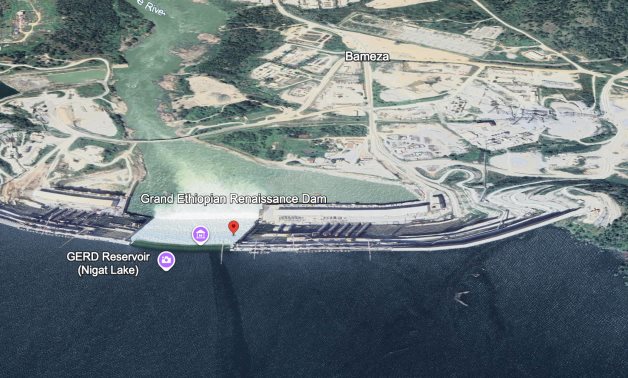
A satellite image of the Grand Ethiopian Renaissance Dam (GERD) taken on July 19, 2026 via Google Earth




CAIRO – 19 July 2026: The Permanent Committee for Regulating the Nile River's Flow held its periodic meeting on Sunday under the chairmanship of Minister of Water Resources and Irrigation Hani Sweilem, to review the Nile's flow conditions and Egypt's overall water situation during the peak water demand season.
The committee reviewed developments related to the operation of the Grand Ethiopian Renaissance Dam (GERD), describing it as an illegal dam that violates international law. It discussed recent fluctuations in downstream discharge resulting from the dam's continued unilateral operation in the absence of a legally binding agreement governing its filling and operation, including clear operating rules and a regular mechanism for data exchange between Ethiopia and the downstream countries.
The committee stressed that the current situation requires operators of downstream dams and water facilities to continuously review and update their operating scenarios to ensure efficient water resources management and respond to changing hydrological conditions.
Rainfall and Water Inflows
The committee also reviewed rainfall conditions across the Nile Basin and water inflows from the Blue Nile, White Nile, and Atbara River. According to the committee, water flow during June was above average, while flows recorded so far in July have been below average.
It noted that these indicators are still insufficient to accurately assess this year's flood season, adding that a clearer picture is expected after the first ten days of August, when a significant portion of the Blue Nile's seasonal flow, arriving during the second half of July and early August, will have reached downstream areas. The committee pointed out that the Blue Nile's discharge during the final ten days of July typically accounts for around half of the month's total flow.
It also emphasized that the accuracy of flood forecasts improves as the rainy season progresses and additional hydrological and climatological data become available.
The committee reviewed the latest forecasts issued by regional and international climate centers regarding the evolution of the El Niño and La Niña climate patterns and their potential impact on rainfall across several regions, including East Africa.
It noted that while these climate indicators play an important role in preparing seasonal forecasts, their influence on rainfall in the Nile Basin depends on a range of regional and climatic factors. Consequently, forecasts are continuously updated throughout the rainy season using real-time observations collected from across the basin.
The committee further stressed that the Nile is naturally characterized by significant daily and seasonal fluctuations in its flow. As a result, assessments of the water situation are based on comprehensive analyses of multiple hydrological and climatic indicators rather than short-term changes alone, ensuring that operational decisions are grounded in scientific evidence.
Sweilem directed ministry officials to continue daily monitoring of rainfall and water inflow indicators while regularly updating hydrological and climate forecasts. He said this would enable the ministry to revise operational scenarios and take timely measures to ensure optimal water resources management.
The minister also affirmed that Egypt's water management system relies on continuous monitoring of hydrological and climate indicators and the dynamic operation of the country's water infrastructure, allowing authorities to respond efficiently to different hydrological scenarios.
He stressed that the Aswan High Dam will remain the cornerstone of Egypt's water security, citing its storage capacity and operational flexibility as the key factors enabling it to cope with varying hydrological conditions while ensuring that the country's water needs are met.
Sweilem concluded by emphasizing the importance of maintaining continuous coordination among all ministry departments and relevant authorities nationwide to ensure stable and efficient water resources management and respond promptly to any developments.

Be Social




Comments
Leave a Comment