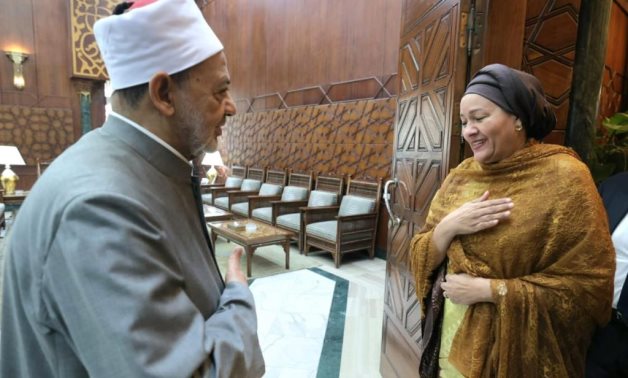
Prof. Dr. Ahmad El-Tayyeb, Grand Imam of Al-Azhar meets with Ms. Amina J. Mohammed, Deputy Secretary-General of the United Nations in Cairo on June 28, 2026- press photo




CAIRO- 28 June 2016: Prof. Dr. Ahmad El-Tayyeb, Grand Imam of Al-Azhar, Egypt’s top Islamic Sunni institute, warned that artificial intelligence without ethical safeguards cam cause the erosion of values and the consolidation of control over humanity’s future in the hands of a few.
Prof. Dr. Ahmad El-Tayyeb’s warning came on Sunday at Al-Azhar Headquarters during his meeting with Ms. Amina J. Mohammed, Deputy Secretary-General of the United Nations, and her accompanying delegation.
The Grand Imam expressed his appreciation for choosing Al-Azhar as the venue for launching the United Nations Initiative on Artificial Intelligence and Sustainable Development, affirming that, throughout more than 1,080 years of fulfilling its mission, Al-Azhar has remained a guardian of religious values and human ethical principles. He stressed that Al-Azhar is the most suitable institution to lead a global dialogue that bridges technology and ethical values.
Sheikh Ahmed El-Tayyeb stated, “When we speak of timeless human values, we are, in fact, speaking of the religious values brought by the divine messages. No scientific advancement can truly be a blessing for humanity if it is detached from these values.”
He emphasized that the rapid advancement of artificial intelligence technologies raises genuine concerns regarding their impact on ethical and human values, noting that excessive reliance on these tools has already begun to negatively affect thinking and creativity.
He added that such technologies have become, in some cases, a means of reinforcing negative behaviors, circumventing values, and appropriating the efforts of others. The Grand Imam warned that the absence of an overarching ethical framework governing artificial intelligence could lead the world toward a future in which human dignity declines and the principles upheld by the divine messages are gradually eroded.
The Grand Imam added, “I fear that the rapid expansion of artificial intelligence, if pursued without ethical safeguards, may lead to the emptying of human minds of their role in thinking and creativity, turning it into a tool that weakens human beings rather than elevating them, thereby threatening the future of humanity as a whole.”
He wondered about the future of humanity if such technology were placed in the hands of a limited few to control the destiny of peoples, the directions of development, and the future of humankind in general. He noted that scientific progress is of great importance and offers immense benefits to humanity, but it must not come at the expense of ethics.
He stated, “The question that should concern the world today is not to what extent will technology and artificial intelligence tools advance? We should rather ask who will regulate this advancement? What system of values and ethics will guide it? And who will define responsibility? When ethics are absent, scientific progress itself becomes a source of danger to humanity.”
At the same time, he affirmed his confidence that Allah will not leave His creation vulnerable to the manipulation of religious and ethical values. He expressed his appreciation for the role played by the United Nations, under the leadership of its Secretary-General, Mr. António Guterres, in defending international law and justice and confronting injustice. He also affirmed Al-Azhar’s readiness to join any joint international efforts that ensure artificial intelligence is utilized to serve humanity rather than control it.
For her part, Ms. Amina J. Mohammed expressed her pleasure at meeting His Eminence the Grand Imam and her appreciation for his role in promoting the values of human fraternity, coexistence, and global peace. She conveyed to His Eminence the greetings of the United Nations Secretary-General and expressed her delight at launching the UN initiative on artificial intelligence from Al-Azhar Ash-Sharif, a global institution with a longstanding legacy of values and principles.
She explained that, in recent years, the United Nations has initiated extensive discussions on AI governance based on placing human beings, their dignity, and ethical values at the heart of this technology. She added that these discussions are being officially launched today from Al-Azhar before extending to major religious and cultural institutions around the world.
The UN Deputy Secretary-General praised the Grand Imam’s vision, which emphasizes the necessity of preserving human dignity in the digital technology era. She stressed that technology must remain a tool serving people, not a means of controlling them, and that its responsible use should contribute to enhancing people’s well-being, achieving justice, and narrowing the gap between nations.
Mohammed also highly commended the Document on Human Fraternity signed by the Grand Imam and late Pope Francis, affirming the continuation of cooperation between the United Nations and Al-Azhar. She further praised His Eminence’s courageous decision to establish the Faculties of Artificial Intelligence at Al-Azhar University, describing them as a model that combines scientific advancement with ethical grounding to prepare generations capable of directing technology toward serving humanity.

Be Social




Comments
Leave a Comment