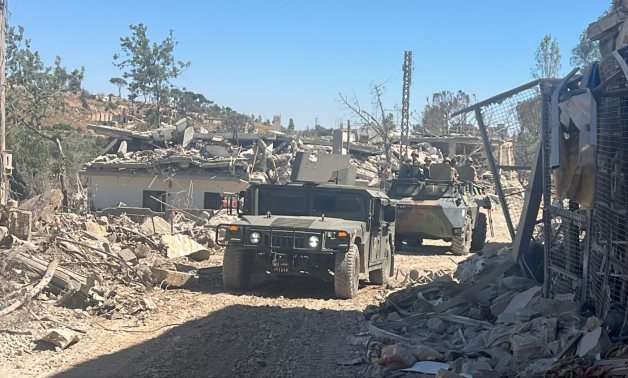
A file photo of Lebanese army patrols operating in Nabatieh, southern Lebanon amid devastation caused by Israeli strikes. Lebanese Armed Forces




CAIRO – 28 June 2026: Egypt and Qatar have pushed for the full implementation of a framework agreement between Israel and Lebanon, which includes provisions on ending Israeli hostilities and the disarmament of non-state armed groups.
In a phone call on Saturday, Egypt’s Foreign Minister Badr Abdelatty and Qatar’s Prime Minister Sheikh Mohammed bin Abdulrahman Al Thani welcomed the US-brokered agreement and urged full execution of its provisions.
They stated that full implementation of the framework deal could help enhance Lebanon’s security, stability and sovereignty, while supporting state institutions, according to a statement by the foreign ministry.
They also called for a full Israeli withdrawal from Lebanon and an end to Israeli attacks.
They also stressed the need to preserve Lebanon's sovereignty and bolster its state institutions as part of broader efforts to maintain stability in the country.
Israel and Lebanon signed a US-brokered framework agreement on Friday after days of negotiations in Washington, marking a significant diplomatic breakthrough.
The framework deal is aimed at eventually ending the Israeli occupation of southern Lebanon and restoring the state sovereignty over all Lebanese territory.
Under the framework, Israel and Lebanon affirm the right of each state to “exist in peace, and their mutual desire to live in security as neighboring sovereign states.”
Israel and Lebanon hereby declare their “intent to conclusively end the conflict, address its underlying causes, and to therewith formally conclude any state of war between them.”
The two sides also commit to “a reciprocal, sequenced process, with clear conditions, whereby the LAF (Lebanese Armed Forces) will restore effective sovereign authority over all Lebanese territory, pending the verified disarmament of non-state armed groups and dismantlement of associated infrastructure.”
This process should enable the Israeli army to “progressively redeploy out of the Lebanese territory.”
Lebanon was drawn into the latest Middle East escalation after the US and Israel launched strikes on Iran on February 28, prompting Hezbollah to fire rockets into Israel in retaliation for the killing of Iranian Supreme Leader Ali Khamenei.
Despite the recent ceasefire deal, Israel has conducted several attacks on the Arab country over claims of threats from Hezbollah.
Israeli attacks on Lebanon since March 2 have killed at least 4,246 people and wounded 12,190 others, according to the Lebanese health ministry.

Be Social




Comments
Leave a Comment