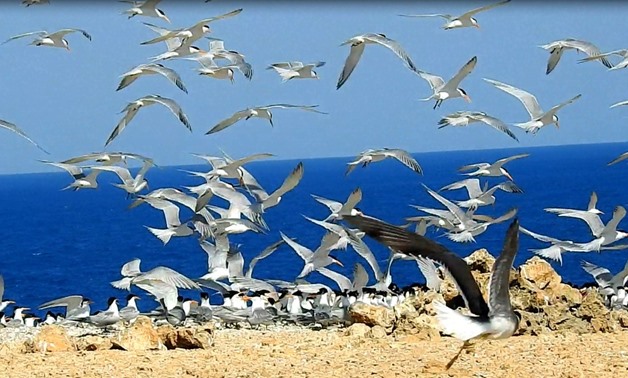
File - Photo of flocks of birds migrating to the Red Sea Island, Red Sea Governorate, Egypt




CAIRO – 20 June 2026: Egypt has about 34 important sites for migratory birds, which host millions of birds each year as they travel between Europe and Africa in spring and autumn, Youm7 reported on Saturday.
Egypt is one of the world's most important bird migration routes. Millions of migratory birds pass through the country annually, thanks to its strategic location linking Africa, Asia, and Europe, its diverse environments, and the rest and feeding stops it offers along the long migratory journey.
Speaking to Youm7, Dr. Ahmed Ghallab, Director of the Red Sea Reserves, said that during their annual migration, birds land and rest in specific types of terrain, including wetlands, marine islands, mountains, desert valleys, and coastal flats.
He noted that the most prominent of these sites include Lake Bardawil, Al-Zaraniq, and Wadi Al-Rayan in Fayoum; Lake Nasser in Aswan; Jabal Al-Zeit, north of the Red Sea; and Nabq and Ras Mohammed in Sinai, along with the Red Sea islands more broadly- all considered easily accessible and environmentally significant.
"Bird migration isn't just an amazing natural phenomenon," he added. "It plays an essential role in maintaining environmental balance and biodiversity, by controlling pest populations and supporting the health of ecosystems."
He said Egypt, through the Ministry of Environment and other relevant authorities, is working continuously to protect migratory birds and their natural habitats. This includes reducing the impact of wind farms and power lines on bird migration paths as renewable energy projects expand, as well as monitoring migration patterns, regulating hunting activity, and preserving natural environments and native species.
The Red Sea Reserves also run ongoing monitoring programs for migratory and resident birds, using field observation and environmental studies to better understand bird behavior during migration- including their routes, crossing times, and feeding and resting areas.

Be Social




Comments
Leave a Comment