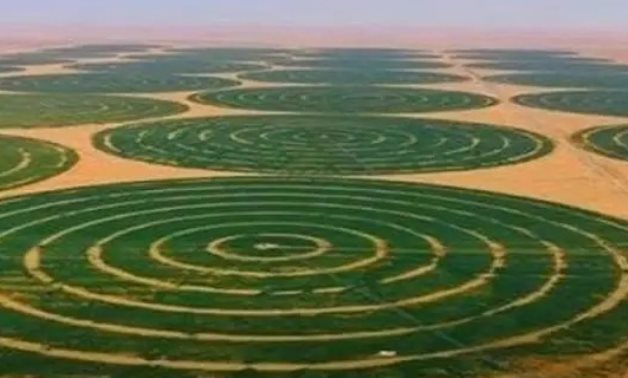
A screenshot of a view of the New Delta Project during the inauguration of the project vy President Sisi on May 17, 2026




CAIRO - 17 May 2026: President Abdel Fattah El-Sisi inuagurated on Sunday the New Delta Project, one of the largest national initiatives undertaken by the Egyptian state as part of its strategy to enhance food security, expand agricultural land, and establish integrated productive communities based on modern technology and advanced agricultural processing industries.
The project is supervised by the Future of Egypt for Sustainable Development Authority, which oversees a group of development projects founded on the integration of agriculture, industry, logistics, and infrastructure within a comprehensive vision aimed at supporting the national economy and reducing dependence on imports. The cost of the project is nearly LE 800 billion.
Located west of the old Delta along the Sheikh Zayed Axis, the New Delta Project connects the governorates of Matrouh, Beheira, Giza, and Fayoum. The project spans approximately 2.2 million feddans, making it one of the world’s largest agricultural expansion projects.
The project aims to achieve self-sufficiency in strategic crops, reduce the import gap, support agricultural processing industries, maximize the added value of agricultural production, establish new urban and productive communities, and create both direct and indirect employment opportunities.
The New Delta Project relies on an advanced smart agriculture system that incorporates modern drip and center-pivot irrigation technologies, in addition to digital control and remote sensing systems to manage the irrigation and fertilization processes. These technologies contribute to improving water and energy efficiency while reducing waste.
Integrated Water Resource System
The project depends on an integrated water resource system that combines surface water, treated agricultural drainage water, and groundwater. Approximately 10 million cubic meters of surface water and 7.5 million cubic meters of treated agricultural drainage water are supplied daily to support agricultural operations.
The New Delta Project has also witnessed the implementation of extensive infrastructure works, including the construction of 697 kilometers of open canals, 9,100 kilometers of pipelines, 28 main pumping stations, and the operation of 8,100 center-pivot irrigation systems. In addition, a road network extending over 12,000 kilometers has been established.
Infrastructure development further included the construction of 18 electrical substations with a combined capacity of 2,051 megavolt-amperes, alongside electricity networks consisting of approximately 121,000 utility poles and transmission lines extending over 19,000 kilometers.
The Future of Egypt for Sustainable Development Authority prioritizes the cultivation of strategic crops such as wheat, sugar beet, and flax to strengthen food security and reduce imports. The project also supports the expansion of industries linked to agricultural production. More than 250 agricultural and investment companies participate in implementing the project’s agricultural system, making it a notable model of public-private partnership in agricultural development and productivity.
A key component of the project’s water conveyance system is Main Pumping Station No. 3, known as “Nabai.” The station has a pumping capacity of approximately 9.75 million cubic meters of water per day and serves nearly 470,000 feddans of agricultural land.
The station is equipped with a fully integrated digital operation and control system connected to a SCADA network, enabling real-time monitoring and management of operational processes. It also incorporates advanced protection and security systems to ensure operational continuity and safeguard against power outages.
Egypt’s Future Industrial City
To maximize the added value of agricultural production, Egypt’s Future Industrial City was established as part of the project. The city includes factories specializing in juices, frozen fruits and vegetables, concentrates, sugar, starch, glucose, animal feed, and other food products. It also contains refrigeration and freezing facilities, as well as packaging plants.
The project additionally includes the Sphinx Crops Trading Center, which is described as the largest integrated agricultural produce market in the Middle East. The center features specialized markets, sorting and packaging stations, refrigerated warehouses, an agricultural commodities exchange, and a financial and business hub.
The New Delta Project is founded on the principles of sustainable development and the green economy through water reuse, energy conservation, the adoption of smart operating systems, and the expansion of sustainable agricultural practices.
The project is expected to generate approximately 10,000 direct jobs and more than 360,000 indirect employment opportunities as part of the state’s broader strategy to establish new development communities and strengthen the productive economy.
Overall, the New Delta Project represents one of Egypt’s most significant strategic initiatives, reflecting the state’s commitment to achieving a transformative leap in the agricultural and food processing sectors while enhancing the national economy’s capacity for sustainable development in the years ahead.
Additionall reporting by Amr Mohamed Kandil and Zaki Al Kady

Be Social




Comments
Leave a Comment