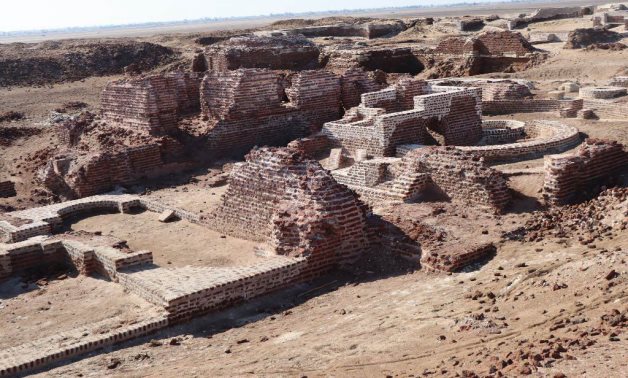
One of the archeological sites in Sinai- press photo




CAIRO – 24 April 2026: On the occasion of Sinai Liberation Day, it is worth highlighting some of the most important recent archaeological discoveries, as well as newly restored sites across the Sinai Peninsula.
I) Discoveries
One of the most notable recent discoveries is the remains of a unique religious building dedicated to the local deity Pelousios at Tell el-Farma in North Sinai. This finding sheds light on the status of the ancient city of Pelusium and its pivotal role in the transmission and influence of religious ideas.
Umm Arak Plateau in South Sinai
The Ministry of Antiquities has also uncovered a site of exceptional historical and artistic value, previously unknown, now identified as the Umm Arak Plateau. It is located in a sandy area approximately 5 kilometers northeast of the Serabit el-Khadim Temple and the copper and turquoise mining zones. Its strategic location overlooks a vast open expanse extending north toward the Tih Plateau, suggesting that it was used throughout history as an observation point, gathering place, and rest area.
The site is considered one of the most significant rock art locations discovered in recent years. The chronological and technical diversity of its carvings transforms it into an open-air museum, documenting the evolution of human artistic and symbolic expression from prehistoric times through the Islamic periods. This diversity grants the site exceptional scientific importance.
Tell al-Kharouba site in the Sheikh Zuweid area of North Sinai
It is a large military fortress dating back to the New Kingdom — one of the biggest and most significant fortifications ever found along the ancient Horus Military Road, near the Mediterranean coast.
This discovery sheds new light on the strategic genius of the pharaohs of the New Kingdom, who built a chain of fortresses and defensive outposts to safeguard Egypt’s eastern borders and secure one of the most vital trade and military routes connecting ancient Egypt with Palestine.
The discovery of this massive fortress is an important step in reconstructing the complete picture of the Egyptian fortification network on the eastern borders during the New Kingdom. It confirms that Egyptian civilization was not limited to temples and tombs, but was a state with strong institutions capable of protecting its land and borders.
Tell Habwa site in North Sinai
The Tell Habwa site in North Sinai contains the remains of a mud-brick structure believed to have been one of the royal rest houses or palaces located along Egypt’s eastern gateway. These remains were uncovered during archaeological excavations carried out as part of the Sinai Development Project.
Preliminary scientific studies of the artifacts found within the structure suggest that it dates back to the reign of King Thutmose III of the Eighteenth Dynasty in the New Kingdom period. Based on the building’s architectural layout and the limited number of pottery fragments discovered, it is likely that the structure functioned as a royal rest house.
Tell Abu Seifi Site in North Sinai
Excavations at the site revealed an extension of a Roman fort, along with the remains of walls and a circular mud-brick tower. Parts of residential buildings and annexes were uncovered, as well as sections of the wall surrounding the temple. In addition, large kilns were discovered, which were likely used to produce lime from limestone for various purposes, including as mortar for construction.
Qasrawet (Qaṣr al-Ġayṭ) Site in North Sinai
Excavation revealed a residential house with seven rooms and several entrances, including a kiln and a variety of pottery vessels for daily use and storage. Excavation also unearthed a mud-brick house and a number of pottery vessels of varying sizes and shapes dating from the Nabataean-Roman period.
II) Restoration
Restoration and maintenance work has been completed on a number of archaeological sites in the historic city of Farma in North Sinai Governorate, as part of the Sinai Development Project.
The Ancient City of Farma in North Sinai
The restoration work included reinforcing several important archaeological elements within the city of Farma, most notably the walls, towers, and gates of the Farma Citadel, which extend over an area of approximately 80,000 square meters. It also included the remains of the Roman-era Sheikhs' Building, the southern Roman bath, and the ruins of the western church, built in the rotunda style, a rare architectural style in 5th-century AD Christian architecture. The southern church, one of the most prominent archaeological churches in the city, was also restored.
The work also included the meticulous restoration of the inscribed lintels discovered in the Temple of Zeus Cassius, as part of a comprehensive plan to preserve the artistic and architectural features of the site. The restoration work was carried out according to the latest scientific methods. Precise examinations and analyses were conducted on the original building materials to ensure the use of compatible materials that preserve the archaeological character and architectural authenticity of each archaeological element.
Khan al-Khuwaynat site in the Zaranik Nature Reserve, North Sinai
Restoration works were made to the scattered limestone blocks that fell from the ruins of the archaeological buildings at the site, besides the commencement of cleaning and debris removal to reveal the archaeological elements within them. These blocks will be used in the partial reconstruction of some of the arcades and the pillars of the Khan's architectural units.
Al-Arish Museum, North Sinai
Work is underway to develop and upgrade the museum in preparation for its opening.
Wadi al-Nasb Site Remains in North Sinai
Ninety-five percent of the restoration work has been completed so far. Restoration work at the remains of the Wadi al-Nasb site is also nearing completion.
The rate of restoration at the Temple of Hathor in Serabit al-Khadim, as well as at Wadi Maktab and the Cave, has reached 55 percent.
In addition, routine maintenance and conservation work have been carried out on the rock inscriptions, with salts, dust, and dirt mechanically removed.
Maintenance and restoration at the Wells and Springs of Moses Archaeological Site have reached 95 percent. Weeds and plants have been cleared, including harmful vegetation such as reeds and esparto grass, as well as any human waste found in the wells.
Sand dunes have been removed from the oasis pathways, and some palm trees and other vegetation obstructing the view have been trimmed or secured.
As for the museums of South Sinai, restoration work has reached 95 percent completion.

Be Social




Comments
Leave a Comment