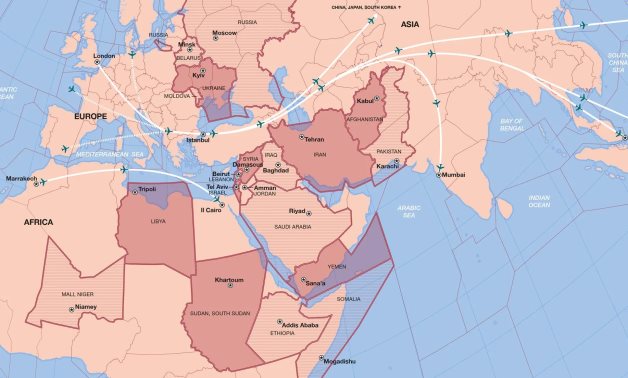
Cargo ships move through a strategic sea lane as tensions raise insurance costs and force route changes across global trade.




CAIRO – 11 March 2026: In times of war or international conflicts, observers can usually tell when a regional crisis is turning global by watching the shipping maps.
The first signs do not always come from official statements or battlefield updates; as they show up in quieter places, a sudden change in vessel routes, an alert about a certain sea route lane, a spike in freight costs, or a delay that ripples from one port schedule to the next. And once those signals start biling up, the impact is rarely contained to the region where the fighting is happening.
That is because global trade depends on a handful of narrow maritime corridors. They look small on the map, but they carry a huge share of the world’s energy and goods. When the threat level rises around them, shipping companies do what they are built to do, reduce risk, protect cargo, and avoid surprises. The problem is that when shipping becomes cautious, it also becomes expensive, and those costs land, sooner or later, on consumers.
Strait of Hormuz: A checkpoint, or a chokepoint:
The Strait of Hormuz is the chokepoint markets watch first. Even the possibility of disruption there can shake prices because it is closely tied to oil and gas flows. And energy is not just a commodity on a chart. It sits inside almost everything.
When fuel costs rise it becomes more expensive to transport goods to keep supply chains moving. It raises the price of fertilizer, which then affects agriculture. It pushes up the cost of refrigeration and storage. In a tense period, the energy story quickly becomes an inflation story.
Red Sea: Another nerve centre:
The Red Sea is another nerve centre. For global shipping, it is not only about whether ships can pass, but how predictably they can pass. When the risk environment changes, some vessels reroute to longer paths.
That is not a minor adjustment as it means extra days at sea, higher fuel consumption, higher crew and operational costs, and higher insurance. For companies that depend on tight delivery schedules, that delay has its own cost, inventory gets stuck on the water, production plans shift, and prices become harder to hold.
This is why disruptions in trade are often not shutdowns, but rather slowdowns. The world does not suddenly stop trading, it simply trades less efficiently. And inefficiency is expensive.
Food prices tend to react faster than many people expect. Staples move across oceans at scale, grain, cooking oil, sugar, animal feed, and when freight and insurance rise, even slightly, the math changes. Add energy shocks, and the cost of production and distribution rises too. In many importing countries, higher global prices can also feed into currency stress, which makes imports more costly in local terms. The result is that families feel the pressure even when shelves are still stocked, because markets price risk early.
Egypt watches this closely because it sits at the intersection of these routes, and because the country’s economic stability is tied to the smooth movement of trade, energy supplies, and shipping patterns. When the wider region is unstable, Egypt is forced to plan for the spillover, not only in security terms, but in everyday economic terms: ensuring fuel supply schedules, avoiding gaps in availability, protecting the local market from sudden imported volatility, and keeping essential goods moving without panic pricing.
That is why, in periods like this, maritime security is not a specialist topic. It is the story behind price tags and delivery times. The Strait of Hormuz, the Red Sea, and the wider network of commercial corridors are the arteries of the global economy. When they come under pressure, the world pays for it, usually first in energy, then in shipping costs, and finally at the supermarket.

Be Social




Comments
Leave a Comment