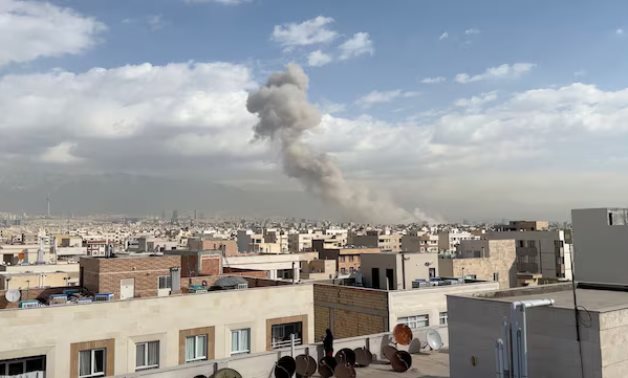
Smoke rises following an explosion, after Israel's Defence Minister Israel Katz said Israel had launched a pre-emptive attack against Iran - WANA/Handout via REUTERS




CAIRO - 28 FEBRUARY 2026: Israeli media outlets reported on Saturday that Israeli strikes hit Iran’s “presidential headquarters” in Tehran, as Israel’s Defence Minister Israel Katz announced what he called a “pre-emptive” attack and ordered an immediate state of emergency across Israel amid expectations of retaliation.
Al Qahera News, citing Israeli media, said the presidential compound in Tehran was struck.
Katz said Israel had carried out a pre-emptive strike against Iran “to remove threats” facing the country, and warned that a missile and drone response targeting Israeli civilians could follow.
Reports from inside Tehran described multiple explosions across the capital. Financial Times reporting referenced smoke rising near Pasteur Street, an area associated with senior state offices, while Iranian outlets cited blasts in central and northern districts.
At this stage, there has been no independent confirmation of the exact targets, the scale of damage, or casualty figures. The “presidential headquarters” claim remains based on media reporting, not an official Iranian statement.
Sirens, civil defence warnings, and airspace restrictions
In Israel, sirens sounded in multiple areas as the military advised civilians to identify the nearest shelters and avoid non-essential travel due to the security situation, according to reports carried by Egyptian outlets.
International reporting also said Israel moved to close its airspace to civilian flights after the strikes began, reflecting heightened fears of rapid escalation.
Saturday’s developments push the region deeper into uncertainty at a moment when diplomatic channels had been active. Reuters reported that U.S. Iran negotiations resumed in February, but Israel has repeatedly argued that any deal must go beyond enrichment limits to include dismantling Iran’s nuclear infrastructure and restrictions on missile capabilities.
Iran, for its part, has signaled it could discuss nuclear curbs in exchange for sanctions relief, while rejecting any linkage to missiles and insisting it would defend itself against attack.
The immediate focus now is the next move. Whether Iran responds directly, and how, will shape everything from regional security calculations to aviation routes and market nerves in the hours ahead.

Be Social




Comments
Leave a Comment