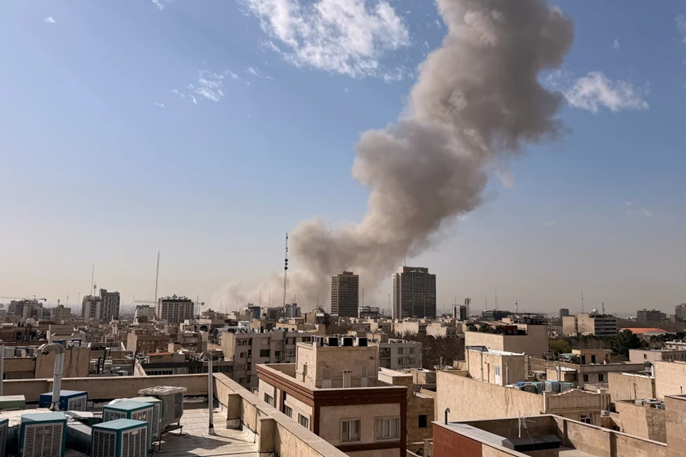
![Smoke rises over central Tehran after explosions reported by Iranian media, following Israel’s announcement of pre-emptive strikes - [Photo Credit: AP/Vahid Salemi]](http://www.egypttoday.com/siteimages/Larg/202602280857485748.jpg "Smoke rises over central Tehran after explosions reported by Iranian media, following Israel’s announcement of pre-emptive strikes - [Photo Credit: AP/Vahid Salemi]")
Smoke rises over central Tehran after explosions reported by Iranian media, following Israel’s announcement of pre-emptive strikes - [Photo Credit: AP/Vahid Salemi]




CAIRO - 28 FEBRUARY 2026: A fresh wave of military confrontation swept across the Middle East early Saturday after Israel said it had begun “pre-emptive” strikes against Iran, with Iranian media reporting multiple explosions in Tehran and Israel moving quickly to tighten civil aviation measures amid expectations of retaliation.
Israel’s Defence Minister Israel Katz said Israel had carried out a pre-emptive strike “to remove threats to the State of Israel,” without detailing the targets or the scope of the operation.
Iranian outlets reported blasts in the capital, with Fars News Agency saying three explosions were heard in central Tehran and that thick smoke was rising from the area around Pasteur Street. Later updates from Iranian media suggested the blasts were linked to missile strikes, while Tasnim reported additional explosions in the northern Seyyed Khandan area, also possibly caused by missile strikes.
Independent confirmation of the exact targets and damage was not immediately available, and Iranian state media did not publish a definitive account of the cause or casualty figures in initial reporting.
In Israel, air raid sirens sounded in parts of the country as authorities warned the public to prepare for possible Iranian missile or drone retaliation, according to international reporting.
Israel also moved to restrict civilian aviation. Reports said Israel closed its airspace to civilian flights after the strikes began, reflecting the expectation of rapid escalation and the risk of cross-border launches.
The attack comes as diplomacy has been struggling to keep pace with the region’s security spiral. The United States and Iran had resumed negotiations in February in an effort to resolve the long-running nuclear dispute and avert a wider confrontation, but Israel has repeatedly argued that any agreement must go beyond limits on enrichment and include dismantling Iran’s nuclear infrastructure, alongside restrictions on Iran’s missile programme.
Iran, for its part, has said it is prepared to discuss curbs on its nuclear programme in exchange for sanctions relief, while rejecting any linkage to missiles and warning it would defend itself against attack.
Saturday’s strikes also revive memories of a 12-day air war last June, after which tensions remained high and the risk of renewed action never fully receded.
For now, the most immediate question is whether Iran responds directly, and how quickly. Any retaliation could widen beyond the two countries, given the density of military assets and regional bases, and the likelihood that airspace restrictions and travel disruptions spread across neighbouring corridors.
Markets and airlines will also be watching closely. When conflicts flare in this region, commercial aviation routes can shift within minutes, and energy and shipping risk premiums tend to rise quickly, even before the full picture of damage becomes clear.
Egypt, like other regional states, will be monitoring the situation for its potential spillover effects, from wider security dynamics to economic reverberations tied to energy, trade routes, and investor sentiment.

Be Social




Comments
Leave a Comment