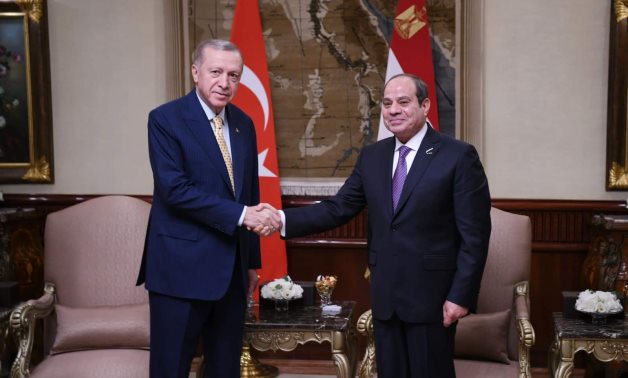
Sisi and Erdogan in 2024




CAIRO - 4 February 2026: Turkish President Recep Tayyip Erdogan’s visit to Cairo reflects a mutual drive to reshape the Middle East’s strategic balance and underscores Egypt's central role in resolving regional crises, according to high-level diplomatic analysis.
In a Wednesday statement to the Middle East News Agency (MENA), former Ambassador to Ankara Abdel Rahman Salah El-Din and former Assistant Foreign Minister Mohamed Hegazy both characterized the visit as a turning point. They noted that the meeting—Erdogan’s third in two years—comes at a critical time as both nations seek to de-escalate tensions between Tehran and Washington while addressing the aftermath of the war in Gaza.
Strategic coordination on regional flashpoints
The diplomats emphasized that Cairo and Ankara are increasingly aligned in their rejection of scenarios that would divide Middle Eastern states along ethnic or sectarian lines.
Highlighting the weight of the meeting, Salah El-Din stated, “The visit reflects a mutual realization by Egypt and Turkey of the importance of cooperation in reshaping the strategic balance in the Middle East, in the face of Israeli attempts to reformulate the region according to the results of the Gaza war."
This consensus is particularly evident in the Palestinian cause, where both nations advocate for a two-state solution that ensures political and geographical connectivity between the West Bank and Gaza. Egypt has notably supported Turkish mediation in ceasefire talks despite Israeli reservations.
Hegazy noted that the diplomatic timing reflects an increasing Turkish recognition of Egypt’s geopolitical weight. He remarked, “The visit reflects a growing Turkish realization that Egypt remains a central actor that cannot be bypassed in any serious approach to addressing regional crises or reformulating stability equations."
Egypt and Turkey’s consensus is also evident in several key areas:
* Libya and Syria: There is a shared commitment to preserving state sovereignty and national institutions. The return of Egyptian and Turkish firms to Libya serves as a practical indicator of this growing rapprochement.
* The Horn of Africa: The leaders are coordinating closely on the territorial integrity of Sudan and Somalia to prevent further institutional collapse in the region.
Economic and military expansion
The diplomatic thaw is being matched by significant economic growth. Salah El-Din highlighted that bilateral trade has surged from $5 billion in 2013 to approximately $9 billion currently. Under the framework of the Strategic Cooperation Council, the two countries aim to reach a $15 billion trade target within the coming years.
Egypt currently serves as a vital manufacturing hub for Turkish investors, with $3 billion in investments and approximately 200 Turkish companies operating in the Egyptian market. This cooperation now extends into advanced industries, vocational training, and joint military efforts.
The visit marks a transition from rebuilding trust to establishing practical mechanisms for long-term security and economic integration, aimed at protecting mutual interests in an increasingly volatile region.

Be Social




Comments
Leave a Comment