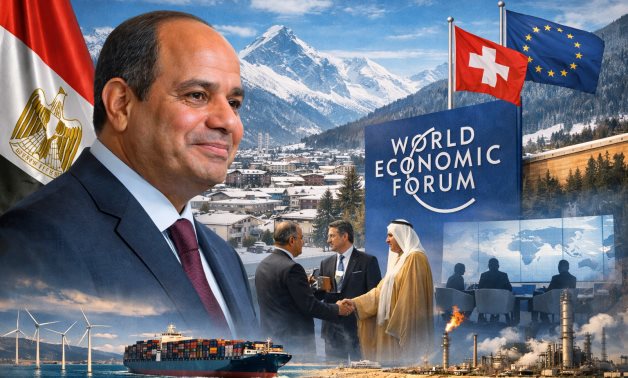
Egyptian President Abdel Fattah El-Sisi attends the World Economic Forum in Davos, as Egypt promotes investment, trade and regional diplomacy - Egypt Today




CAIRO - 20 JANUARY 2026: When Egypt shows up in Davos, it rarely does so to simply “attend”. It comes to negotiate, to reassure, to sell a story about stability, and to position itself as a problem solver in a world where risk is again being priced into everything, from supply chains to sovereign debt.
This year, Egypt’s participation at the World Economic Forum’s Annual Meeting, held in Davos from January 19 to 23 under the theme “A Spirit of Dialogue”, arrives at a moment when geopolitics is crowding into boardrooms and investment decisions are increasingly tied to security, logistics, and access to markets.
Egyptian President Abdel Fattah El Sisi is scheduled to deliver a special address at the forum on January 21, a prominent slot that signals Cairo’s intent to speak directly to global decision makers. A day earlier, Reuters reported that El Sisi is set to meet U.S. President Donald Trump on the sidelines of Davos, a meeting Egypt’s presidency described as the first between the two leaders since Washington said it was launching a “second phase” of its plan to end the war in Gaza.
That combination, a headline geopolitical meeting and a high profile forum address, illustrates how Egypt views Davos, not as a conference, but as a concentrated marketplace where diplomacy, capital and narrative compete in real time.
The World Economic Forum likes to describe itself as a platform for dialogue. Countries, however, judge it by access, to leaders, to capital, and to the informal conversations that often determine whether a deal advances or stalls.
This year’s meeting is drawing close to 3,000 participants from more than 130 countries, with record political attendance, the forum says, including close to 65 heads of state and government and hundreds of CEOs. For Egypt, that density matters because it compresses months of outreach into a few days, and because emerging markets often find it harder to secure the kind of attention that major powers take for granted.
The meeting with Trump is a case in point. Egypt’s relationship with Washington spans security cooperation, regional mediation and economic support, and Cairo has repeatedly tried to keep that relationship anchored even as U.S. politics and Middle East crises pull it in different directions. The Reuters report also said Egypt is reviewing a U.S. invitation related to Trump’s “Board of Peace”, while noting Egyptian participation in a Gaza related executive board, signaling that Cairo is being pulled deeper into the architecture of post war arrangements.
For Egyptian officials, Davos offers a chance to translate that geopolitical relevance into economic outcomes, by arguing that Egypt is not only a frontline state, but also an investable hub.
Egypt’s Davos message in recent years has increasingly followed a two step logic.
First, convince investors that macroeconomic stability is improving. Second, persuade them that Egypt can convert that stabilization into growth, exports, and predictable returns.
On the stability side, Cairo can now point to concrete indicators that many investors track more closely than speeches.
Egypt’s net international reserves reached $51.4516 billion at the end of December 2025, according to the Central Bank of Egypt, a figure officials present as evidence of stronger external buffers. Inflation, while still a politically sensitive issue for households, has eased sharply from its peak levels in 2023. CAPMAS data reported by Ahram Online put annual headline inflation at 10.3% in December 2025, compared with 23.4% a year earlier.
The IMF, a reference point for many portfolio investors and lenders, reached a staff level agreement in late December on Egypt’s fifth and sixth reviews under its Extended Fund Facility, which Reuters said could unlock a $2.5 billion disbursement, pending board approval. In the IMF’s framing, the story is one of stabilisation progress paired with continued pressure to accelerate structural reforms, especially reducing the state’s footprint and pushing forward with divestments.
Egypt also highlights external partnerships that provide financing and signal political confidence. The State Information Service reported that Egypt received a €1 billion second tranche of the EU’s €7.4 billion financing package, describing it as support aligned with reform and stabilisation efforts.
From Cairo’s perspective, the Davos opportunity is to convert these signals into a broader re rating, convincing investors that Egypt is moving from crisis management to opportunity creation.
Egypt’s geography is its most repeated argument. It sits at the junction of Africa, the Middle East, and the Mediterranean, with the Suez Canal as a global chokepoint that can either amplify growth or magnify vulnerability depending on regional security.
Davos allows Egypt to make a hub strategy feel tangible to global firms that are redesigning supply chains and hedging geopolitical risk. It is not simply a slogan about location, it is a pitch about logistics, industrial zones, renewable power, and access to large consumer markets.
That pitch is also shaped by the hard lesson of the past two years. Attacks on shipping in the Red Sea pushed many vessels away from the Suez route, hurting Egypt’s foreign currency inflows. Reuters previously quoted El Sisi saying disruptions cost Egypt about $800 million per month in Suez revenues.
Now, some shipping lines are cautiously returning. Reuters reported that Maersk plans to resume Suez Canal and Red Sea sailings for a key service from late January, though uncertainty remains, and other firms, including CMA CGM, have also announced diversions due to a complex risk environment.
Egypt’s canal authority has tried to frame the recovery as a demonstration of resilience. The Suez Canal Authority said the canal earned total revenues of $40 billion from 2019 to 2024, and it has argued that projections could improve in 2025 to 2026 as traffic conditions stabilise.
In Davos, this becomes part of a larger narrative, that Egypt is not only exposed to regional shocks, but is also central to the solutions that reduce those shocks.
A second pillar of Egypt’s Davos messaging is energy, specifically, renewable energy, grid expansion, and green hydrogen.
In the last few years Egypt has positioned itself as a potential production and export platform for clean fuels, leveraging sun, wind, and proximity to European demand. The World Economic Forum previously reported that Egypt signed memoranda of understanding related to green hydrogen and renewables, with Planning Minister Hala El Said citing a pipeline figure of around $40 billion in potential investment tied to projects in the Suez Canal Economic Zone.
Cairo’s argument is that it can offer scale, industrial land, and export routes, and that it is building institutions to organise that push. The WEF “Egypt Country Platform” points to a national low carbon hydrogen strategy and governance structures such as a national council for green hydrogen, illustrating an effort to move from announcements to execution.
In early 2026, local reporting said a 100 MW green hydrogen project in the Suez Canal Economic Zone began partial production and started exporting to European and U.S. markets, citing a government statement. Whether investors accept that as a turning point will depend on contracts, pricing, and long term policy consistency. Still, the existence of an operational project helps Egypt argue in Davos that its energy transition is no longer only a set of conference panels.
This matters because global investors increasingly ask emerging markets a blunt question, where does hard currency come from in five years. Egypt’s answer is a mix, tourism, logistics, manufacturing, and now, potentially, clean energy exports.
Davos 2026 also arrives as water rises on the global agenda. The WEF has branded 2026 as a “Year of Water”, linking forum discussions to what it calls “Blue Davos”, a strand of events focused on water ecosystems, resilience and investment in water security.
For Egypt, this is not an abstract global theme. Water is politics, food security, public confidence, and national identity.
Egypt’s leadership has long described the Nile as existential, and Davos gives Cairo a place to elevate that concern to a global audience that increasingly understands water as a systemic economic risk. The water agenda also connects to Egypt’s broader diplomacy on the Nile Basin, a dispute that periodically returns to the top of its foreign policy priorities.
This is where the meeting with Trump gains additional significance. Reuters reported Trump said he was ready to restart U.S. mediation between Egypt and Ethiopia over the dam dispute, an issue Egypt and Sudan consider a threat to their water supplies. In Davos terms, that is not only a diplomatic headline, it is part of Egypt’s effort to show that its strategic issues are being heard at the highest levels, and that Cairo can mobilise partners.
Egypt’s Davos case is also about role, not only reforms.
Cairo has spent years presenting itself as a stabilising actor that can speak to multiple sides across the Middle East. The Gaza war and ceasefire arrangements have intensified that narrative, placing Egypt in the centre of mediation efforts, humanitarian access discussions, and post war governance debates.
The Reuters report on the El Sisi Trump meeting referenced evolving U.S. frameworks around Gaza governance and Egypt’s reported participation in related boards. For Cairo, Davos is a place to reinforce that Egypt is indispensable in any sustainable regional settlement, and that this indispensability should carry economic weight.
This logic is familiar to investors and governments, stability lowers risk premiums, and a state that can help de escalate crises becomes more attractive as a base for regional operations. Egypt wants to be seen as that base.
The domestic angle: showing the private sector, not only the state
A notable shift in Egypt’s Davos strategy is the effort to put private sector faces on the national story.
Business oriented Egyptian outlets have tracked the presence of ministers and executives in Davos sessions, reflecting an attempt to show that Egypt’s economic diplomacy is not only government led, but also supported by domestic firms trying to scale regionally. EnterpriseAM, for example, noted multiple Egyptian speakers participating in panels on industrial policy and emerging markets.
For an international audience, this matters because it signals a pipeline of bankable opportunities beyond sovereign debt.
Davos, in this framing, becomes a marketing and matchmaking venue. Ministers can pitch policy priorities, while companies can seek partners, technology, and financing, and investors can decide whether Egypt’s risk return profile has shifted enough to justify new allocations.
Egypt’s case, however, is being made against a difficult backdrop.
Reuters reported that a WEF global risks survey ranked “economic confrontation” as the top near term risk, reflecting growing fears that tariffs, investment restrictions, and resource competition will increasingly shape the world economy. That matters for Egypt because it relies on trade flows, external financing, and foreign currency earnings.
In this environment, the most persuasive message to investors is predictability. Egypt’s Davos message is built to convey that, policy direction is clear, partnerships are deepening, and macro buffers are stronger than during the peaks of the 2023 to 2024 stress period.
Egypt does not attend Davos simply for headlines, although headlines help. It attends because the forum sits at the intersection of what Egypt needs and what the world is debating.
It needs capital to finance development and industrial expansion. It needs energy partnerships to accelerate renewables and manage import bills. It needs trade stability in the Red Sea corridor, because the Suez Canal is not only a national asset but also a symbol of Egypt’s place in the global economy. It needs support, or at least understanding, on water security and regional diplomacy.
Davos offers an unusually concentrated setting where those needs can be pursued simultaneously, through meetings with presidents, conversations with CEOs, and participation in panels that shape investor perceptions.
Egypt’s leadership will argue that the country’s rising stature is grounded in a simple fact, few states sit at the crossroads of so many global agendas at once, Gaza, trade corridors, energy transition, African and Arab diplomacy, and water security. That is the story Cairo wants to project, that Egypt is not a peripheral emerging market, but a central node in a fractured world.
Whether investors buy the full narrative will depend on what happens after Davos, the pace of reforms, the depth of private sector opportunity, and the resilience of external buffers as global conditions change.
But in Davos itself, Egypt’s objective is clear, to turn presence into partnerships, geopolitical relevance into economic returns, and a week of meetings into a longer term repositioning.

Be Social



Comments
Leave a Comment