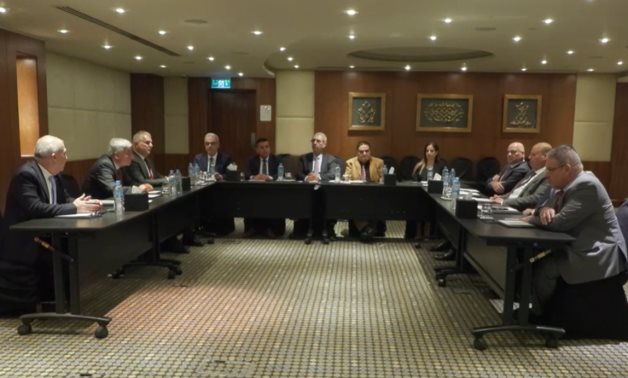
The first meeting of the Gaza Administrative Committee in Cairo




CAIRO – 16 January 2026: In continuation of Egypt’s efforts to start the second phase of the ceasefire agreement in Gaza, Cairo hosted, on Friday, the first meeting of the 15-member Palestinian National Committee for the Administration of the Gaza Strip.
The meeting coincided with an announcement by Steve Witkoff, U.S. envoy to the Middle East, regarding the start of the second phase of the agreement.
The second phase of the plan focuses on activating the Palestinian national administration in Gaza to strengthen Palestinian identity and establish a state presence. Overseen by Egypt, it aims to rebuild the Strip after two years of devastation, integrating economic and social support, infrastructure development, and protections to prevent displacement or separation from the West Bank.
The Sharm el-Sheikh agreement, sponsored by Egypt with U.S. and other mediators, goes beyond a ceasefire, aiming to establish a national Palestinian administration in Gaza, uphold international principles, and advance a path toward a two-state solution.
U.S. Middle East envoy Steve Witkoff emphasized that opening the Rafah crossing from both sides is crucial for completing the final stages of ending the Gaza war and building trust between Palestinians and Israelis.
He stated that Hamas disarmament is key to a lasting peace and highlighted the role of recent prisoner swaps in shifting Hamas’s stance. Witkoff praised the creation of a technocratic “Peace Board” as a historic step to replace Hamas and enable Gaza’s reconstruction. He stressed that rebuilding the Strip is contingent on Hamas relinquishing its arsenal, framing disarmament as a prerequisite for civilian administration, international oversight, and long-term stability.
Tasks of the Gaza Administration Committee
Ali Shaath, head of the Palestinian National Committee for the Administration of the Gaza Strip, announced the official start of the committee’s work following its first meeting in Cairo. The 15-member technocratic committee has secured initial donor funding and a two-year operational budget, alongside the establishment of a World Bank–managed fund for Gaza’s reconstruction and relief.
In an interview with Al Qaher News, Shaath said the committee’s action plan is based on the Egyptian Plan, endorsed by the Arab League and welcomed internationally, and focuses on urgent humanitarian relief, infrastructure repair, and housing reconstruction amid widespread destruction in Gaza. The first phase includes providing 200,000 prefabricated housing units, to be developed into integrated residential complexes with essential services.
He emphasized that the committee operates under national consensus and international backing, with a mandate grounded in UN resolutions and political agreements, and aims to serve as a bridge between Gaza and the West Bank. Prioritizing humanitarian needs, especially for women, children, and the sick, the committee seeks to restore dignity, rebuild livelihoods, and revive Gaza’s pre-war development achievements, while working closely with Egypt and Arab partners to implement reconstruction efficiently.
Egyptian initiative to revive education in Gaza
The Egyptian Committee in Gaza, under presidential directives, has launched a major campaign to revive education in Gaza, where schooling has been disrupted for over two years.
The initiative aims to quickly restore learning by building new schools and educational points across the Strip, equipped with essential classroom furniture and temporary structures like tents.
The campaign emphasizes flexibility to reach students wherever they are, maintain continuity, and provide stability amid difficult conditions. By creating functional learning spaces, the effort seeks to reconnect children with teachers, restore routine, and uphold education as a vital pillar for community resilience during the ongoing crisis.

Be Social




Comments
Leave a Comment