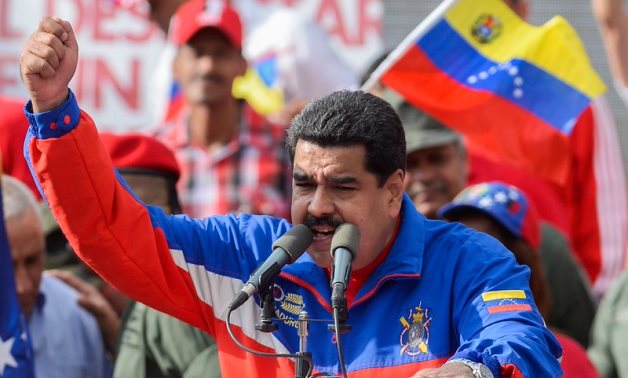
Venezuelan President Nicolas Maduro - FILE/CC




CARACAS – 3 January 2026: In the early hours of Saturday, the United States carried out an abrupt military operation across Venezuela, which included capturing the Latin American country’s president and his wife.
The strikes began around 2 a.m. local time in the capital, Caracas, and lasted for roughly an hour and a half, during which residents reported loud explosions, military aircraft overhead, and plumes of smoke rising above parts of the city.
The Venezuelan government confirmed that multiple regions were hit, including the states of Miranda, Aragua, and La Guaira.
“The United States of America has successfully carried out a large scale strike against Venezuela and its leader, President Nicolas Maduro, who has been, along with his wife, captured and flown out of the country,” US President Donald Trump said in a Truth Social post.
Why Did the US Act?
In the lead-up to the strikes, Washington had sharply escalated its accusations against Maduro’s government.
US officials alleged that Venezuela was operating as a “narco-state” and claimed that the country’s 2024 presidential election had been manipulated.
Maduro has consistently rejected those allegations, arguing that the United States has long sought to undermine his government in order to gain control over Venezuela’s vast oil resources, the largest proven reserves in the world.
Casualties
Venezuela’s ruling political movement, known as “Chavismo,” said that both civilians and members of the armed forces were killed during the strikes, though it did not release specific casualty numbers. There has been no independent confirmation of the toll.
What Happens Next?
US officials signaled that the operation inside Venezuela was complete.
Republican Senator Mike Lee said Secretary of State Marco Rubio told him that Maduro will be brought to the United States to face criminal charges, and that no additional military action inside Venezuela is expected.
Attorney General Pam Bondi stated that Maduro and his wife will be prosecuted in US courts and that they “will soon face the full wrath of American justice.”
The situation marks one of the most significant foreign interventions in Venezuela’s modern history and raises major questions about the country’s political future, regional stability, and international reaction in the days ahead.
World Reacts
Reacting to the operation, China said it is “deeply shocked” and “strongly condemns” the use of force by the US against a sovereign country and a president.
France said the operation “violates the principle of not resorting to force, that underpins international law,” stressing that “no lasting political solution can be imposed from the outside.”
Russia said the United States had committed an “act of armed aggression against Venezuela,” calling it “deeply concerning and condemnable.”
Argentina hailed the move with President Javier Milei writing: “Freedom moves forward. Long live freedom.”
Mexico said “dialogue and negotiation are the only legitimate and effective means” to resolve disputes.
British Prime Minister Keir Starmer said “we should all uphold international law.”
Brazil’s President Luiz Inacio Lula da Silva said the bombings and Maduro’s capture “cross an unacceptable line.”
Ukraine’s Foreign Minister Andrii Sybiha said Maduro’s government had violated every principle of freedom and human rights “in every respect.”
President Alexander Lukashenko said Belarus “categorically condemns the act of American aggression against Venezuela.”
European Union Foreign Policy Chief Kaja Kallas said the EU is “closely monitoring the situation” and that the bloc has repeatedly stated that Maduro “lacks legitimacy.”
European Commission President Ursula von der Leyen said the EU “stands by the people of Venezuela and supports a peaceful and democratic transition.”
Chile’s President Gabriel Boric called for a “peaceful solution” to the crisis.
President Gustavo Petro said Colombia rejects “any unilateral military action that could … put civilian population at risk.”

Be Social




Comments
Leave a Comment