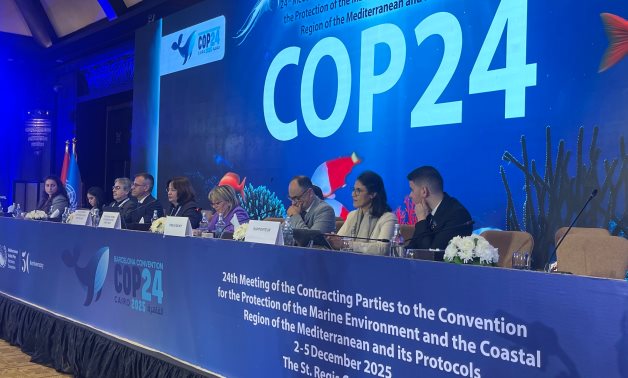
The 24th Conference of the Parties to the Barcelona Convention (COP24) presided over by Head of the Egyptian Environmental Affairs Agency adopted the Cairo Declaration- December 4, 2025- Samar Samir/Egypt Today




CAIRO – 5 December 2025: The 24th Conference of the Parties to the Barcelona Convention (COP24) — presided over by Ali Abu Senna, Head of the Egyptian Environmental Affairs Agency — has adopted the Cairo Declaration, affirming a collective commitment to conserving and sustainably using the Mediterranean Sea and its marine and coastal resources. The 46-point declaration positions environmental protection as a cornerstone of regional stability, prosperity, and sustainable development.
The declaration reaffirms the member states’ commitment to combating illegal, unreported, and unregulated fishing; achieving and sustaining a healthy, well-monitored, and resilient Mediterranean Sea in Good Environmental Status; and adopting the Mediterranean Strategy for Sustainable Development (MSSD) 2026–2035.
Member states also called upon national, sub-national, and local authorities, as well as regional actors and initiatives, to integrate the objectives of the MSSD 2026–2035 into their development plans.
The Contracting Parties to the Barcelona Convention represented at the Cairo-hosted meeting included Albania, Bosnia and Herzegovina, Cyprus, Croatia, Egypt, the European Union, France, Greece, Israel, Italy, Libya, Lebanon, Malta, Monaco, Montenegro, Morocco, Slovenia, Spain, Tunisia, and Turkey.
Here is the full text of the Declaration:
We, the Ministers and Heads of Delegation of the Contracting Parties to the Convention for the. Protection of the Marine Environment and the Coastal Region of the Mediterranean (Barcelona Convention) and its Protocols, gathered in Cairo, Egypt, on 4 December 2025, to reaffirm our shared commitment to the conservation and sustainable use of the Mediterranean Sea and its marine and coastal resources, as a cornerstone of regional stability, prosperity, and sustainable development,
1. Celebrating with pride the 50th anniversary of UNEP/MAP and the 30th anniversary of the adoption of the post-Rio Barcelona Convention (50/30 anniversary), a milestone that provides a unique opportunity to put emphasis on the progress achieved in protecting and preserving the Mediterranean marine and coastal environment, to recognize the successes of regional cooperation under the Convention and its Protocols, and to renew our determination to address
2. the persistent and emerging challenges that threaten the sea we share; Determined to ensure that the Mediterranean region continues to be a beacon of multilateral cooperation, peace, prosperity, environmental stewardship and just, inclusive and sustainable development for current and future generations, as articulated in the outcome document from the Rio+20 Conference “The Future We Want”, the UN Agenda 2030 for Sustainable Development and its Sustainable Development Goals (SDGs), and the 2024 UN Pact for Future;
3. Acknowledging that the prosperity and resilience of our societies and economies are inseparably linked to the health, sustainable management and resilience of the marine and coastal ecosystems of the Mediterranean, requiring inclusive environmental governance and collective determination to accelerate sustainable solutions towards a Sustainable Blue Economy in line with SDG 14 and other ocean-related SDGs, recognizing the Contracting Parties’ respective national circumstances and capabilities, and the need for enhanced support from all sources, including accessible finance, capacity building, technical assistance, and technology transfer, to ease their full and effective implementation for enhanced protection and preservation of marine and coastal environment;
4. Embracing the adoption and upcoming entry into force of the Agreement under the United Nations Convention on the Law of the Sea on the Conservation and Sustainable Use of Marine Biological Diversity of Areas beyond National Jurisdiction (BBNJ Agreement) which marks a historic step in ensuring that the vast biodiversity in areas beyond national jurisdiction is protected and sustainably managed, complemented by regional efforts within the framework of the Barcelona Convention, in safeguarding marine and coastal ecosystems;
5. Recalling the Political Declaration adopted at the Third United Nations Ocean Conference (UNOC-3), Our Ocean, Our Future: United for Urgent Action that was held in Nice (France) from 8-13 June 2025, and building on the Declaration of the Ministers of the Mediterranean, announced on the same occasion, reaffirming our shared commitment to the protection and preservation of the Mediterranean Sea, as a regional contribution to the global efforts aiming at achieving SDG14;
6. Recalling the United Nations Environment Assembly (UNEA-6) Resolution UNEP/EA.6/Res.15 on Strengthening ocean efforts to tackle climate change, marine biodiversity loss and pollution, which invites member states to scale-up means of implementation to enhance capacity to deliver on the ocean-related SDGs, and its references to the Regional Seas Programme, including the Regional Seas Conventions and Action Plans and taking note of the work delivered by UNEP/MAP with the “G7 Workshop on the role of the Regional Seas Conventions and Action Plans,” in the framework of the 2024 Italian G7 Presidency, as a concrete follow-up;UNEP/MED IG.27/CRP.2
7. Noting the UNEA-7 Report UNEP/EA.7/20 document on reporting Progress in the implementation of resolution 6/15 on strengthening ocean efforts to tackle climate change, marine biodiversity loss and pollution;
8. Welcoming the progress achieved in the delivery of the UNEP/MAP Medium-Term Strategy for 2022-2027 and looking forward to the process for the development of the new Medium-Term Strategy for 2028-2032, to be inspired by the forthcoming UNEP Medium-Term Strategy 2026-2029;
A United Call for Environmental and Climate Action
9. Reaffirm our commitment to the implementation of the United Nations Framework Convention on Climate Change (UNFCCC) and the Paris Agreement and to accelerate and scale up climate action worldwide to hold the increase in the global average temperature to well below 2°C above pre-industrial levels and to pursue efforts to limit the temperature increase to 1.5°C above pre-industrial levels and welcome the convening of the Ocean and Climate Change Dialogue through the UN Climate Change Conferences;
10. Welcome the Regional Climate Change Adaptation Framework (RCCAF) 2026-2035 as well as the Ecosystem Approach (EcAp) Policy and Roadmap 2026-2035 as overarching regional frameworks to advance sustainable and climate resilient development in the region and progress towards the achievement of Good Environmental Status, and committing to their effective implementation;
11. Look forward to an effective operationalization of the new Regional Activity Center onClimate Change, through the adoption of its mandate and the Terms of reference of its FocalPoints, in delivering its mandate, in a complementary manner with existing actions and activities, to support Contracting Parties efforts to strengthen their climate- resilience and adaptation capabilities to withstand the adverse effects of climate change, as well as efforts towards climate neutrality;
12. Integrate climate change adaptation into Nationally Determined Contributions and National Adaptation Plans to strengthen resilience and adaptive capacities of coastal communities and ecosystems in line with Paris Agreement;
13. Reiterate our concern by the unprecedented rapid deterioration of biodiversity worldwide, including in the Mediterranean, one of the world’s biodiversity hotspots, and recall the adoption of the Post-2020 Strategic Action Programme for the Conservation of Biodiversity and Sustainable Management of Natural Resources in the Mediterranean Region (Post-2020 SAPBIO) as the Mediterranean's regional plan to implement the Kunming-Montreal Global Biodiversity Framework (GBF);
14. Resolving to further advance integrated responses to the interlinked crises of climate change, biodiversity loss, and pollution through the Paris Agreement, the Kunming-Montreal Global Biodiversity Framework, the BBNJ Agreement, the ICZM Protocol and the UNOC-3 Declaration of the Ministers of the Mediterranean, in line with the 2030 Agenda, and committing to implement the Mediterranean Strategy for Sustainable Development (MSSD) 2026-2035, the Regional Climate Change Adaptation Framework (RCCAF) 2026-2035 the Ecosystem Approach (EcAp) Policy and Roadmap 2026-2035, as guiding frameworks for regional and national action, as well as the Strategy for Water-Energy-Food-Ecosystem (WEFE) Nexus in the Source-to-Sea Mediterranean Continuum;
15. Emphasizing the importance of ensuring the effective conservation and sustainable management of the MCPAs and OECMs, thereby contributing to the global efforts towards the achievement of Target 3 of the GBF of the United Nations Convention of Biodiversity (CBD), through the implementation of the Post-2020 SAPBIO;UNEP/MED IG.27/CRP.2
16. Reaffirm our commitment to the protection of Mediterranean marine and coastal ecosystems and biodiversity by intensifying efforts towards strengthening and expanding the network of Marine and Coastal Protected Areas (MCPAs) and identifying and establishing Other Effective Area Based Conservation Measures (OECMs) with the aim to protect 30% of marine and coastal areas of the Mediterranean Sea by 2030;
17. Welcoming the adoption of the roadmap for transitioning to Low Carbon Shipping in the Mediterranean as the regional contribution to the global efforts in addressing greenhouse gas (GHG) emissions from ships;
18. Recognizing the urgent need to align the maritime sector with the UNFCCC and the Paris Agreement goals and accelerate the transition to a sustainable, low-carbon future in a just manner;
19. Taking note of the one-year adjournment of the second extraordinary session of the International Maritime Organisation’s (IMO) Marine Environment Protection Committee which convened to consider the adoption of Net-Zero Framework. We continue to engage with all partners to fulfil the levels of ambition of the IMO 2023 Strategy on the reduction of GHG emissions from ships;
20. Welcome the entry into force of the Mediterranean Sea Emission Control Area for Sulfur Oxides and particulate matter (Med SOx ECA), as a step forward in enhancing interregional cooperation for sustainable and climate-resilient development, and committed to finalize our work in exploring the feasibility for the possible designation of the Mediterranean Sea, as a whole, as an Emission Control Area for Nitrogen Oxides (Med NOx ECA) pursuant to MARPOL Annex VI;
21. Reaffirming the commitment to strengthen inter-regional Danube–Black Sea–Mediterranean Source-to-Sea cooperation in order to enhance the resilience of river basins and coastal areas and to improve the health and sustainability of large marine ecosystems, in line with the principles set out in Articles 4 and 5 of the UNOC-3 Declaration of the Ministers of the Mediterranean;
22. Recognizing the role of Regional Seas Conventions and Action Plans in supporting countries and regions in addressing marine pollution and enhancing the conservation and sustainable use of the ocean and its resources, as well as their contribution to the achievement of SDG14 and the ocean related targets of the 2030 Agenda, and commit to raising the profile of the UNEP/MAP-Barcelona Convention system and promoting its involvement, as appropriate, at relevant ocean-related global events with the participation and support of the Secretariat;
23. Reaffirm our determination and ambition to work together, in line with UNOC-3 Declaration of the Ministers of the Mediterranean and United Nations Environment Assembly (UNEA) resolution 5/14, towards fulfilling the Intergovernmental Negotiating Committee’s (INC) mandate to develop an international legally binding instrument on plastic pollution, including in the marine environment, We particularly commit to collaborate building on the Mediterranean experience and well-established tools and measures to address marine litter, in particular marine plastic litter;
24. Reiterate our commitment to upscale actions to tackle pollution, including marine litter, in the Mediterranean, by:
a. Enhancing the effective implementation of the legally binding Regional Plan for Marine Litter Management in the Mediterranean and the Regional Plans on Agriculture Management, Aquaculture Management and Urban Stormwater Management in the Mediterranean under Article 15 of the Land Based Sources and Activities Protocol;
b. Identifying and implementing measures to prevent, control and reduce plastic pollution at the source, in particular marine plastic litter, microplastics and Abandoned, Lost and otherwise Discarded Fishing Gear and to move towards safer and more sustainableUNEP/MED IG.27/CRP.2 alternatives by employing circular economy models that incorporate inter alia recycling processes, by adopting sustainable production and consumption patterns, and by applying the principle of extended producer responsibility;
c. Working on regulating and gradually reducing, with the aim of eliminating by 2030, theproduction and consumption of the most environmentally damaging single-use plastics and the use of certain chemicals of concern in plastics, based on criteria to be defined, especially those that come in direct contact with consumers and those most likely to cause harm or hinder circularity;
d. Encouraging investments in effective urban and industrial wastewater treatment, in environmental sound management of waste including relevant infrastructure, recycling, and circular economy approaches to prevent land- and sea-based pollution;
e. Enhancing the effective implementation of the Mediterranean Offshore Action Plan 2026-2035 in the framework of the Protocol for the Protection of the Mediterranean Sea against Pollution resulting from Exploration and Exploitation of the Continental Shelf and the Seabed and its Subsoil (Offshore Protocol);
f. Enhancing cooperation on, monitoring, data collection and early warning systems for pollution detection between Contracting Parties between regional partners as appropriate;
25. Urge Contracting Parties to implement the National Action Plans and Programmes of Measures, as key policy instruments at the national level for advancing sustainable development and safeguarding the environment across the Mediterranean region, while enhancing coherence with other national policies and strategies;
26. Acknowledge with appreciation the contribution of the Global Environment Facility (GEF) funded MedProgramme in enhancing the environmental security of the Mediterranean by addressing key challenges faced by countries; and call upon the GEF to build on the achievements of the MedProgramme and continue supporting the Mediterranean countries, including through a new programme to be funded at the next GEF programmatic period;
Sustainable Blue Economy: an important lever to contribute to SDGs achievement in the Region
27. Envisaging to further support the implementation of policies and actions to boost a sustainable blue economy for the well-being, prosperity and employment in the Mediterranean region, as a catalyst for an accelerated green and just transition;
28. Considering with appreciation the 2015 and 2021 Union for the Mediterranean Ministerial Declarations that commit to advance sustainable blue economy in the Mediterranean and the related implementation roadmap, as well as the several regional initiatives providing a substantial contribution to this end;
29. Calling for the effective integration and implementation of Marine Spatial Planning (MSP) and Integrated Coastal Zone Management (ICZM) within national and regional strategies to ensure the incorporation of climate mitigation, adaptation, and nature-based solutions into maritime and coastal policies and as well as for a coherent and sustainable land and sea use planning to ensure the development as an enabler of sustainable blue economy;
30. Resolving to promote eco-innovation, sustainable infrastructure and efficiency in industry, as integral components of a circular economy that offer a transformative pathway to economic growth that safeguards the environment, mitigates greenhouse gas emissions and promotes climate neutrality, while generating quality jobs and new opportunities for inclusive prosperity;UNEP/MED IG.27/CRP.2
31. Renew our commitment for achieving and sustaining a healthy, well monitored, resilient Mediterranean and in Good Environmental Status, where ecosystems are preserved and restored, resource intensity is reduced and efficiency is enhanced, consumption and production patterns are aligned with sustainability principles, and innovation and technology are deployed responsibly to prevent and mitigate environmental risks, thus providing a solid foundation for a sustainable blue economy;
32. Reaffirm our commitment to decisive and collective action to ensure sustainable fisheries and to strengthen the fight against illegal, unreported, and unregulated (IUU) fishing in line with UNOC-3 Declaration of the Ministers of the Mediterranean;
33. Welcome the adoption of the Mediterranean Strategy for Sustainable Development (MSSD) 2026-2035 and call upon, national sub-national and local authorities and regional actors and initiatives to integrate into their development plans the objectives of the MSSD 2026-2035, its strategic directions and its flagship initiatives, as relevant, and to contribute to its effective delivery, as leading regional Strategic Reference Framework on Sustainable Development that raises the level of ambition to accelerate progress toward achieving the SDGs in the Mediterranean;
34. Promote regional cooperation, knowledge-sharing, and innovative financing mechanisms that enable Mediterranean countries to transition towards resource-efficient, climate-resilient, and ocean-positive economies;
35. Explore, identify and effectively deploy the potential of sustainable blue economy to provide a range of solutions for both climate change mitigation and adaptation, in particular nature based solutions, by promoting the protection and restoration of coastal ecosystems such as seagrass meadows and their capacity to absorb and store carbon, and accordingly urge the prioritization and investment in nature-based solutions for building coastal resilience, protecting biodiversity, and achieving climate goals in the region;
36. Call for a reinforced support to technology transfer on mutually agreed terms and capacity building policies and actions as critical enablers for the sustainable blue economy transition in order to enhance access to innovative technologies, best practices, and knowledge-sharing;
37. Enhance the capacities of sub-national and local authorities as well as coastal municipalities to integrate sustainable blue economy as part of their medium and long term policies and operational plans, including sustainable coastal and maritime tourism, and as an opportunity to further support a resilient, sustainable and inclusive growth at the local level;
Stronger Partnerships of Mediterranean Stakeholders, with an enhanced role for women and youth
38. Urge all stakeholders and major actors at global, regional, national and local level, including intergovernmental organisations, public and private entities and civil society, to intensify their engagement in achieving a healthy, climate resilient and prosperous Mediterranean, where no one is left behind and where women and youth are empowered with the relevant knowledge, skills and opportunities to actively participate and contribute;
39. Support further mainstreaming the pivotal role of women and youth participation into UNEP/MAP-Barcelona Convention processes and projects and empowering them as leaders in sustainable blue economy sectors, climate action, and marine and coastal conservation by promoting education for sustainable development, inter-generational collaboration, youth-led initiatives such as Youth4Climate, and through relevant Flagship Initiatives of the MSSD 2026-2035;
40. Underscore that the adaptation needs in our Mediterranean basin are rising at an alarming pace faster than available resources, driven by escalating climate impacts, water scarcity, sea-levelUNEP/MED IG.27/CRP.2 rise, and increasing pressure on coastal communities and ecosystems and call for a substantial scale up of accessible adaptation finance, particularly grant based and concessional resources, aligned with national adaptation plans and long-term strategies, tailored to address water security, coastal adaptation, food systems resilience, and climate induced biodiversity loss;
41. Call upon financial institutions to match their priorities and support to the needs of the Contracting Parties in meeting high environmental standards and sustainable development in line with the objectives of and commitments under the MAP-Barcelona Convention and its Protocols, and in accelerating their implementation, including the implementation of the MSSD 2026-2035;
42. Express our determination to enhance cooperation and synergies with other regional and global actors and initiatives on sustainable blue economy including the Union for the Mediterranean (UfM), IMO, the General Fisheries Commission for the Mediterranean (GFCM), the Plan of Action for a Model Mediterranean Sea (PAMEx), the African Ministerial Conference on the Environment (AMCEN), the Blue Mediterranean Partnership, the Sustainable Blue Economy in the Western Mediterranean (WestMED), as well as the EU Strategy for the Adriatic-Ionian Region (EUSAIR), the MedFund and the Monaco Blue Initiative;
Capitalizing on 50 years of achievements to invest in the future
43. Emphasize the role of the UNEP/MAP-Barcelona Convention system as a catalyst for transformative change, capable of guiding collective action to ensure that the Mediterranean Sea continues to provide livelihoods, food security, and prosperity for present and future generations, while contributing directly to the achievement of the 2030 Agenda and its SDGs;
44. Express sincere appreciation to the four Champion Countries as decided by COP23, Slovenia, France, Egypt and Spain, for the successful organization of the milestone high-level event for the 50/30 anniversary held on 10 June 2025, during the UNOC-3, in Nice, France;
45. Celebrate with pride the 50/30 anniversary and, aware of entering in the new cycle of its delivery, commit to prepare and deliver the UNEP/MAP Medium-Term Strategy 2026-2035 with a renewed vision to scale-up contribution to the achievement of the SDGs in the Mediterranean and to the full alignment with the global efforts on the ocean agenda, where the UNEP/MAP-Barcelona Convention system continues contributing as front runner;
46. Express gratitude to the Government of Egypt for its warm hospitality during the 24th Meeting of the Contracting Parties to the Barcelona Convention and its Protocols.

Be Social



Comments
Leave a Comment