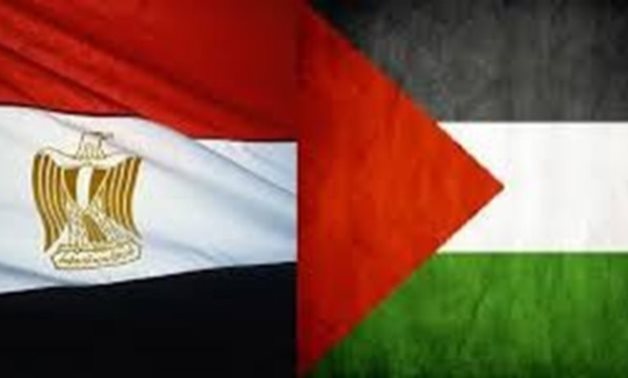
Egyptian and Palestinian flags - file




CAIRO - 7 October 2025: The successive recognitions of the Palestinian state that we have recently witnessed represent an unprecedented victory for the cause since its inception.
The recognitions reflect the strenuous efforts of many regional powers, led by the Egyptian state, which realized the true objective behind the war launched by the occupation on the Gaza Strip two years ago: undermining international legitimacy, which is fundamentally based on the two-state solution.
This came after suspicious calls issued by Benjamin Netanyahu and his government, most notably the displacement of Palestinians from their lands. Egypt rejected this call from the moment of the aggression and publicly announced it during the Cairo Peace Summit, held less than two weeks after the war.
From the very beginning of the war on Gaza, Egypt took a firm and unwavering stance: rejecting any attempts to displace Palestinians from the Strip or to annex the territory.
Cairo warned early on that forced displacement would not only violate international law but also destabilize the entire region.
This has resulted in Egypt being subjected to smear campaigns because of its rejection of the displacement plan and the liquidation of the Palestinian cause.
This came in addition to rumors and lies circulating in media outlets like that Egypt is prepared to temporarily relocate half a million Gaza residents to a designated city in North Sinai as part of Gaza’s reconstruction efforts, which is something that Egypt has categorically and unequivocally denied.
Steadfast and firm stance
In March, a statement issued by the Egyptian State Information Service (SIS) labelled these allegations as baseless and entirely false.
The SIS reiterated Egypt’s steadfast and principled stance, declared since the early days of the genocide against Gaza in October 2023, rejecting any attempt—whether forced or voluntary—to displace Palestinians from their homeland, particularly to Egypt. The statement emphasized that such a move would liquidate the Palestinian cause and pose a grave threat to Egypt’s national security.
At the emergency Arabic summit in Cairo held in March, Egypt reaffirmed its unwavering position through a reconstruction plan presented and was unanimously approved by the summit.
The plan ensures the rebuilding of Gaza without the displacement of a single Palestinian from the enclave.
Over the past two years, President Abdel Fattah El-Sisi has met with international leaders, and during press conferences, he repeatedly stressed that Egypt rejects the displacement of the Palestinian people from their land.
Months later, this position has increasingly shaped international discourse. What began as Egypt’s clear rejection of displacement and annexation has now been echoed globally.
Unprecedented blow
Meanwhile, efforts were not limited to mere condemnation and denunciation, but extended to adopting a consensual diplomacy, through which it succeeded in exposing the violations committed by the occupation, which in reality go beyond the pretext of "self-defense," starting with the bombing of civilians and their facilities, and continuing with Through starvation and even forced displacement of thousands of people, in clear violation of international law.
The West's recognition of the Palestinian state represented, and continues to be, an unprecedented and powerful blow to the occupation government at a pivotal moment, especially since it restored momentum to the issue and transformed it from being the center of the region to one of the most important issues on a broader international scale.
This is especially true given the international awareness that violating international legitimacy at this time will set a precedent that could lead to further steps in the future, repercussions not only limited to the Middle East but also extending to their own borders.
The successive blows Israel has received following international recognition of the Palestinian state will inevitably be followed by further measures, which the Israeli occupation government is expected to take, imposing a new reality and implementing policies that will restrict the Palestinian Authority and deprive the state of its third constituent element.
Consequently, there is an urgent need for new tools that will achieve the greatest degree of justice and equality among states, far removed from blatant discrimination in favor of certain powers at the expense of others.
Historic consensus
The international community has shifted its tone, with many nations aligning with Egypt’s vision and emphasizing the need to preserve Palestinian territorial integrity.
In a historic development, a large number of countries have officially recognized the State of Palestine—something unprecedented since the 1947 UN Partition Plan.
As of September 2025, the State of Palestine is recognized as a sovereign state by 157 of the 193 member states of the United Nations (UN).
Palestine has been a non-member observer state of the UN General Assembly since November 2012. This limited status is largely due to the fact that the United States, a permanent member of the UN Security Council with Veto power, has consistently blocked Palestine’s full UN membership.
Palestine is recognized by the other four permanent members, which are: China, France, Russia and the United Kingdom.
However, this recent wave of recognition signals a turning point, reflecting growing global consensus on the urgency of a just and lasting solution based on international legitimacy and Palestinian statehood.
Latest development
US President Donald Trump said on Friday that Hamas’ response to his plan means that ‘they are ready for a lasting peace’.
He urged Israel to stop bombing Gaza to allow hostages out of the strip safely. He also affirmed that discussions have already begun regarding the details of ending the Gaza war.
Hamas announced Friday that it would release all Israeli captives, both the living and the remains of the dead under the framework of US President Donald Trump’s Gaza proposal.
Egypt is hosting delegations from Israel and Hamas to discuss the ground conditions and details of the exchange of all Israeli detainees and Palestinian prisoners, in accordance with US President Donald Trump's proposal. This comes in the hope of ending the war and alleviating the suffering of the Palestinian people after nearly two years of suffering.
Collective responsibility
Egypt’s diplomatic efforts, regional leadership, and early clarity on the Gaza issue have played a pivotal role in steering international attention toward rejecting displacement and reaffirming Palestinian rights.
Another path linked to the collective responsibility of the international community, within the framework of the necessity of upholding international legitimacy, is manifested in the need for the Palestinian state to be represented in numerous other institutions and organizations, which represents another important recognition of it.
While the top priority at the current moment is to impose a ceasefire and prepare the atmosphere for serious negotiations on the final status, the responsibility is not limited to the international side, but rather falls largely on the shoulders of the Palestinians themselves.
Palestinians need to end the state of division on the one hand, while the Palestinian Authority implements the necessary reforms to represent all Palestinians.
This represents a top priority, so that the occupation and its allies do not use the division as an excuse and the lack of a party qualified to represent the Palestinians during the negotiations.

Be Social




Comments
Leave a Comment