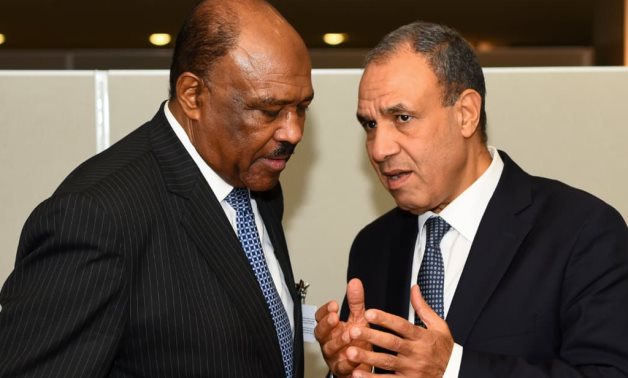
Dr. Badr Abdelatty, Minister of Foreign Affairs, met on with Mr. Mohi El-Din Salem, the Minister of Foreign Affairs of Sudan, on the sidelines of the UNGA 80- press photo on September 26, 2025




CAIRO – 26 September 2025: Dr. Badr Abdelatty, Minister of Foreign Affairs, Emigration, and Egyptian Expatriates, met on Thursday, September 25, with Mr. Mohi El-Din Salem, the Minister of Foreign Affairs of Sudan, on the sidelines of the high-level segment of the 80th session of the United Nations General Assembly in New York.
The Foreign Minister reaffirmed Egypt’s consistent position in support of Sudan’s security, stability, unity, sovereignty, and territorial integrity. He stressed the importance of maintaining and supporting Sudan’s national institutions and emphasized Egypt’s keenness to engage positively with various efforts aimed at achieving a ceasefire in Sudan and alleviating the humanitarian suffering of the brotherly Sudanese people.
Minister Abdelatty also highlighted the significance of enhancing economic and trade cooperation between the two countries, as well as working towards further deepening and developing bilateral relations in various fields.
The meeting also addressed water security, where both ministers reaffirmed the united stance of the two countries as downstream countries of the Nile River. They emphasized the necessity of full adherence to international law in the Eastern Nile Basin and firmly rejected any unilateral actions in the Nile River.
On September 9, 2025, Egypt, represented by Minister of Foreign Affairs and Migration Badr Abdelatty, sent an official letter to the president of the United Nations Security Council on Tuesday in response to Ethiopia’s recent event celebrating the completion and operation of the Grand Ethiopian Renaissance Dam (GERD). Cairo emphasized that the move constitutes a clear breach of international law and established norms.
The foreign minister stressed that Ethiopia’s attempts to give the dam a false veneer of legitimacy cannot alter the fact that it remains a unilateral action in violation of international law. He affirmed that such actions produce no legal consequences regarding the governing framework of the Eastern Nile Basin under international law.
The crisis between the three Nile basin countries dates back to May 2011 when Ethiopia started building the dam. Egypt voiced concern over its water share [55.5 billion cubic meters]. Three years later, a series of tripartite talks between the two countries along with Sudan began to reach an agreement while Ethiopia continued the dam construction.
In 2015, the three countries signed the Declaration of Principles, per which the downstream countries [Egypt and Sudan] should not be negatively affected by the construction of the dam.
In October 2019, Egypt blamed Addis Ababa for hindering a final agreement concerning a technical problem, calling for activating Article No. 10 of the Declaration of Principles, which stipulates that if the three countries could not find a solution to these differences, they have to ask for mediation. Despite Egypt’s repeated rejections, Ethiopia continued its unilateral acts and filled the reservoir of its dam annually without going back to Egypt or Sudan.

Be Social




Comments
Leave a Comment