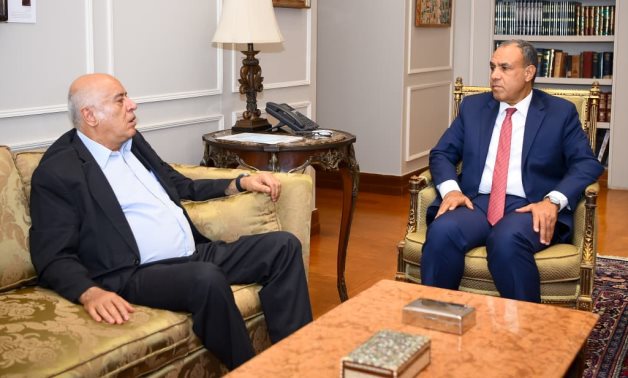
Foreign Minister Badr Abdelatty meets with Secretary-General of the Central Committee of Fatah Movement Jibril Rajoub in Cairo, 7 September 2025 - Egypt's MFA




CAIRO – 7 September 2025: Egypt’s Foreign Minister Badr Abdelatty has stressed the importance of Israel accepting the Egypt-Qatar proposed ceasefire deal, which is based on a framework put forward by US Middle East envoy Steve Witkoff.
Abdelatty made the remarks in a meeting with Secretary-General of the Central Committee of Fatah Movement Jibril Rajoub in Cairo on Sunday.
The foreign minister emphasized that a ceasefire is critical to launch Gaza’s reconstruction, starting with the international conference for early recovery and reconstruction. Egypt is set to host this conference once a ceasefire is reached, in coordination with the Palestinian Authority and the United Nations.
Abdelatty reaffirmed Egypt’s firm rejection of Israel’s military operations in Gaza as well as any plans for forcible displacement of Palestinians.
He also condemned Israel’s crimes of genocide or the use of starvation as a weapon against the Palestinian people.
Abdelatty outlined Egypt’s ongoing efforts to end the Israeli war on Gaza, emphasizing Cairo's active role in advancing a ceasefire and facilitating humanitarian aid access to the besieged territory.
The Israeli war has been ongoing over the past 700 days, flattening most of the enclave and plunging population into famine.
Israel has killed over 64,300 people, injured nearly 163,000 more, displaced most of the population, and has caused dozens of civilians including children to die from starvation and acute malnutrition.
In mid-August, Hamas agreed on a proposal put forward by Arab mediators Egypt and Qatar, calling for a 60-day temporary ceasefire and the release of half of living and dead captives still held in Gaza.
Moreover, Hamas has reiterated their openness to a comprehensive deal that would see the release of all captives in one go in exchange for a permanent ceasefire and the withdrawal of Israeli troops from the enclave.
Meanwhile, Israel has not issued an official response to the mediator’s proposal.
Despite de-escalation efforts, Israel is proceeding with a globally-condemned operation to take over Gaza City, home to nearly half of the enclave’s 2.2 million population, and displace its residents.
Israeli airstrikes have flattened high-rise residential buildings and ordered residents to evacuate southward, threatening a deeper humanitarian crisis in an enclave that is already suffering a famine confirmed by a UN-backed report last month.
Condemning E1 Settlement Plan
On the situation in the West Bank, Abdelatty condemned Israel’s settlement expansion plan in the E1 area.
He also denounced other Israeli practices in the West Bank, including land confiscation and settler intimidation campaigns targeting Palestinian communities.
Abdelatty and Rajoub discussed international diplomatic efforts, particularly strategies to mobilize global support for recognizing the State of Palestine.
They reviewed the anticipated outcomes of the upcoming international conference on implementing the two-state solution, set to take place in New York on the sidelines of the United Nations General Assembly later this month.
The foreign minister reaffirmed Egypt’s full support for the legitimate rights of the Palestinian people, foremost among them the right to self-determination and the establishment of an independent state along the June 4, 1967 borders, with East Jerusalem as its capital.
Last month, Israeli hardline Finance Minister Bezalel Smotrich has announced plans to “bury” the possibility of a Palestinian state by reviving the controversial E1 settlement project in the West Bank.
The plan envisions thousands of new settler housing units that would severe the West Bank, cutting it off from East Jerusalem, and dividing any future Palestinian state in two.
The E1 project has been condemned internationally—including by Arab states, the EU, and the UK—as a flagrant breach of international law.

Be Social




Comments
Leave a Comment