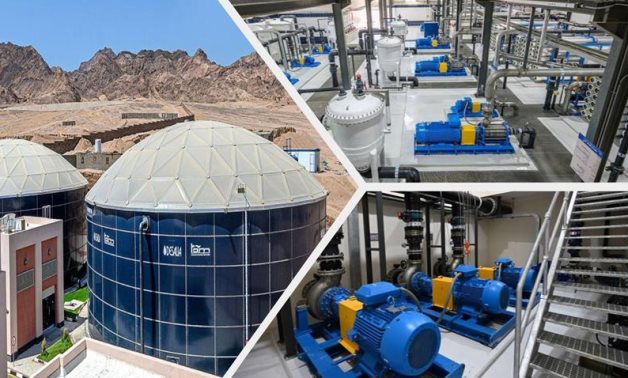
A seawater desalination in South Sinai's Dahab - FILE




CAIRO – 31 August 2025: Egypt is targeting the production of 10 million cubic meters of desalinated water per day within the next five to six years, Prime Minister Mostafa Madbouly said, noting Egypt’s plans to localize this industry.
Madbouly stressed the government’s interest in expanding the seawater desalination efforts through cooperation with specialized Chinese companies as he met on Sunday with Qingyun Kong, the head of a Chinese company experienced in this field.
The meeting took place on the sidelines of the Shanghai Cooperation Organization (SCO) Plus Meeting hosted in the Chinese city of Tianjin.
The prime minister underlined Egypt’s pressing needs in the field of seawater desalination, seeking to localize the industries related to the components of desalination plants.
For her part, Kong expressed her company’s interest in collaborating with Egypt and presented a Chinese-developed desalination model with a daily capacity of 10,000 cubic meters, powered by renewable energy and scalable to meet Egypt’s larger demands.
Madbouly concluded the meeting by proposing direct communication between the company's representatives and relevant Egyptian authorities to explore avenues for joint cooperation in this critical sector.
Egypt relies almost entirely on the Nile River for its freshwater needs but is actively expanding its seawater desalination efforts to secure sustainable water resources and address water scarcity.
While the nation’s water needs amount to about 114 billion cubic meters annually, available water resources do not exceed 60 billion cubic meters per year.
The current per capita share of water is around 500 cubic meters annually, less than half the internationally recognized water poverty threshold.
Although desalinated water is not widely used for drinking, it, along with treated water, plays a critical role in supporting development projects, including agriculture and industry, as well as in serving coastal cities.
The country has adopted a national desalination strategy, beginning in 2017 with a first phase targeting a capacity of 1.3 million cubic meters per day. The second phase extends through six five-year plans until 2050.
According to Minister of Housing Sherif El-Sherbini, the strategy is focused on meeting growing water demand amid population growth and providing alternative water sources to halt the transfer of surface drinking water to several coastal governorates.
The strategy also aims at meeting water demands required for urban development.
Egypt is already operating around 100 desalination plants with a combined capacity of 1.2 million cubic meters per day, according to a study by the Egyptian Center for Strategic Studies, citing official figures from the Ministry of Housing.
Plants are located in key coastal governorates including Matrouh, Beheira, South Sinai, the Red Sea, Port Said, and Alexandria.
The water desalination strategy targets 11 coastal governorates where transporting Nile water over hundreds of kilometers is inefficient and costly, according to the minister.
Centralized desalination plants are now being prioritized to optimize land use, reduce production costs, and limit water transport to no more than 50 kilometers to minimize loss and maximize efficiency.

Be Social




Comments
Leave a Comment