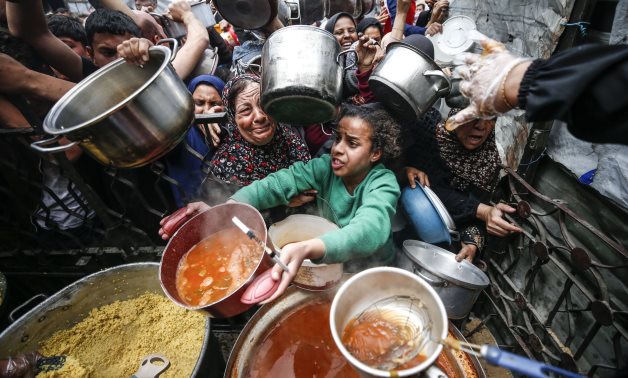
Residents gather to receive free food from a charitable kitchen in Gaza City - Photo: WAFA




CAIRO – 15 August 2025: Egypt has called for increased international pressure on Israel to allow the full delivery of humanitarian aid to Gaza through all crossings, during talks with the European Union and France on Friday.
Foreign Minister Badr Abdelatty conveyed Egypt’s position in separate phone calls with EU foreign policy chief Kaja Kallas and French Foreign Minister Jean-Noël Barrot.
Abdelatty condemned Israel’s starvation policy against innocent civilians in Gaza, the Ministry of Foreign Affairs stated.
He stressed that, as the occupying power, Israel bears full responsibility for opening its five border crossings with Gaza to ensure the flow of humanitarian, medical, and relief assistance to the enclave.
He briefed Kallas on Egypt’s close coordination with Qatar and the United States to broker a comprehensive agreement that would secure a ceasefire, enable the entry of aid, and ensure the release of captives and a number of Palestinian detainees.
The minister also confirmed that Egypt is preparing to host an international conference on early recovery and reconstruction in Gaza, to be held immediately upon reaching a ceasefire agreement.
The conference will be organized in full coordination with regional and international partners, including the EU.
Establishing Palestinian State
Abdelatty reaffirmed to both Kallas and Barrot Egypt’s firm support for the establishment of an independent Palestinian state, as part of the Palestinian people’s legitimate right to self-determination.
In his conversation with the French foreign minister, Abdelatty praised France’s recent announcement of its intention to recognize the Palestinian state, describing it as a bold step.
He stressed that establishing an independent Palestinian state based on the June 4, 1967, borders, with East Jerusalem as its capital, remains the only path to achieving lasting peace and stability in the region.
‘Greater Israel’
Meanwhile, Abdelatty during the phone calls reaffirmed Egypt’s rejection of recent statements promoting the so-called concept of “Greater Israel,” warning that such rhetoric—alongside other Israeli practices—fuels hatred, extremism, and instability across the region.
Abdelatty also condemned Israel’s recent decisions to expand settlements in the occupied West Bank, describing them as a blatant violation of international law.
Earlier this week, Israeli Prime Minister Benjamin Netanyahu asserted that he is on “a historic and spiritual mission,” expressing strong attachment to the “Greater Israel” vision.
The term “Greater Israel” is widely used to describe a religiously driven ideology among Zionist extremists, envisioning an Israeli state that extends into parts of modern-day Egypt, Syria, Jordan, and Lebanon.
Netanyahu’s remarks sparked widespread Arab condemnation, including from Egypt, which called for clarification in light of their serious implications. Egypt’s Foreign Ministry emphasized that such statements reflect a rejection of the peace path and a deliberate move toward escalation.
E1 Settlement Expansion
Meanwhile, Israeli hardline Finance Minister Bezalel Smotrich has announced plans to “bury” the possibility of a Palestinian state by reviving the controversial E1 settlement project in the West Bank.
The plan envisions thousands of new settler housing units that would severe the West Bank, cutting it off from East Jerusalem, and dividing any future Palestinian state in two.
The E1 project has been condemned internationally—including by Arab states, the EU, and the UK—as a flagrant breach of international law.
UK Foreign Secretary David Lammy said the Israeli settlement plan “must be stopped.”
Israel’s expansion of settlements in the occupied Palestinian territories comes at a time when several countries—including in Europe—have announced plans to recognize the State of Palestine next month in an effort to revive the prospects of a two-state solution.
Western Recognition of Palestine
French President Emmanuel Macron took the initiative in July, announcing that France would recognize the Palestinian state during the upcoming United Nations General Assembly (UNGA) in September.
Macron stressed the importance of building a viable Palestinian state that contributes to regional security by accepting demilitarization and fully recognizing Israel.
“There is no alternative,” he declared.
Australia, the United Kingdom, Canada, and Malta have also stated their intention to follow suit next month, with some attaching specific conditions. Portugal has announced it is considering recognition.
These moves come amid Israel’s prolonged war in Gaza, which has killed more than 61,700 Palestinians and starved to death over 200 people—half of them children—due to Israeli restrictions on aid delivery.

Be Social




Comments
Leave a Comment