

Many humanitarians view airdrops as dangerous because dropped aid can land directly on tents or people, causing serious harm or even death, besides being inadequate.
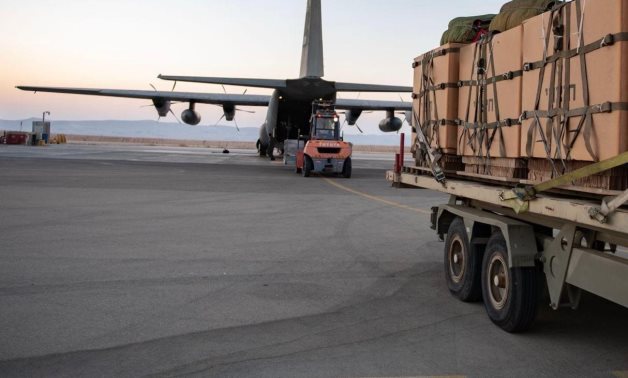
An Israeli plane takes on humanitarian aid for airdrop in Gaza - Israel's embassy in the UAE




CAIRO – 27 July 2025: Hamas has called the Israeli plan to airdrop humanitarian aid on Gaza starting Sunday amid increasing reports of deaths due to starvation and malnutrition “a symbolic and deceptive step.”
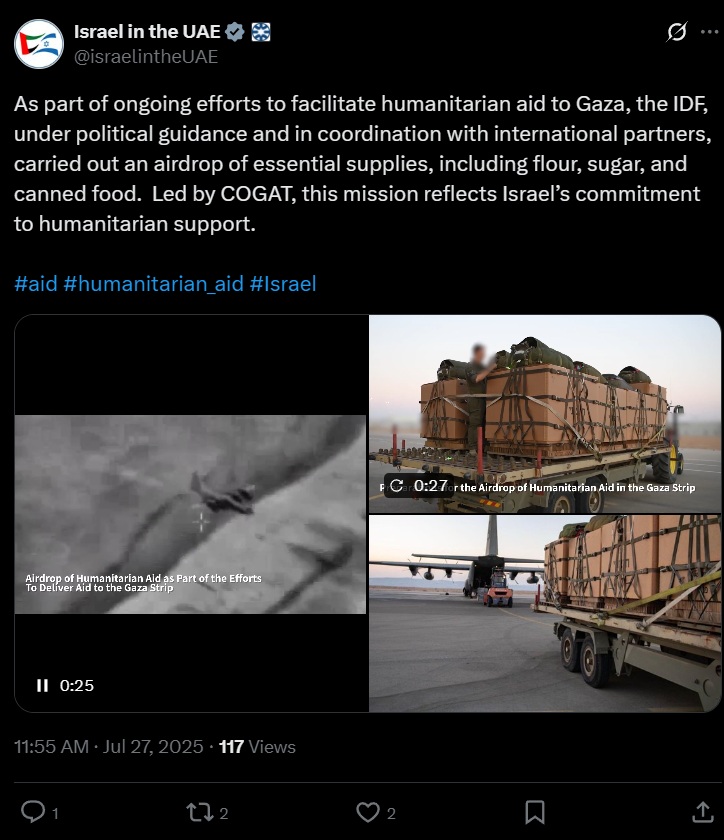
The Israeli army reportedly started airdropping aid in Gaza as part of a plan it announced on Saturday, which also includes a 10-hour pauses in hostilities in three areas cross Gaza and establishing humanitarian corridors to facilitate UN aid deliveries.
In a Telegram post on Sunday, Hamas emphasized that the urgent arrival of humanitarian aid, including food and medicine, to people in Gaza is “a natural right necessary to halt the humanitarian catastrophe” imposed by the Israeli occupation.
Hamas warned that the Israeli airdrop operations and the so-called humanitarian corridors “embody a blatant policy for controlling starvation, not ending it.”
The Palestinian movement accused the Israeli authorities of “aiming to establish coercive realities under the fire of bombardment and hunger, endangering civilians' lives and degrading their dignity instead of providing them with protection and comprehensive relief.”
Hamas said the Israeli occupation seeks, through such step, to “whitewash its image before the world and to circumvent the rights of the Palestinian people to lift the blockade.”
The movement also stated that Israel disregards the demands of the international community to stop the starvation policy enacted by the Israeli government.
Hamas called for halting the Israeli aggression, lifting the blockade, fully and permanently opening the land crossings for humanitarian aid, and ensuring its flow to people according to the mechanisms approved by the United Nations.
It emphasized these steps as the only way to end the starvation crime in the Gaza Strip.
Hamas blamed the Israeli government for the death of over a thousand civilians and injuries to around 6,000 more by “imposing inhumane realities and mechanisms to control aid and oversee starvation.”
‘10-Hour Pause’
Food experts have frequently warned of a looming famine in Gaza as photos of children, skin and bone and dying from hunger, have drawn global outcry.
The worsening humanitarian crisis in the enclave, which has endured nearly 22 months of unrelenting war, has also triggered intensive calls from Israel’s closest allies in Europe for an end to the fighting.
Gaza’s health ministry noted on Saturday that a total of 127 people, including 85 children, have lost their lives to starvation and malnutrition.
The UN World Food Programme (WFP) has warned that a quarter of the population in Gaza is facing famine-like conditions, with Israel placing heavy restriction on aid entry.
Amidst starvation reports and global pressure, the Israeli army, responsible for killing nearly 60,000 Palestinians through the war, announced that it will start ‘tactical pauses’ in Gaza’s Gaza City, Deir Al Balah and Al Mawasi areas from 10 AM to 8 PM every day until further notice starting today.
They also announced designating secure routes from 6 AM to 11 PM to ensure the safe movement of UN and aid organization convoys and allow distribution of food and medical supplies to the population “throughout” the enclave.
Many humanitarians view airdrops as dangerous because dropped aid can land directly on tents or people, causing serious harm or even death, besides being inadequate.
After the pauses took effect, Al Qahera News posted footage for the arrival of many humanitarian trucks loaded with tons of aid to the Karm Abu Salem crossing for inspection by Israeli authorities before entering to Gaza.
The Egyptian Red Crescent (ERC) also announced today launching a convoy of 100 humanitarian aid trucks carrying more than 1,200 tons of food supplies, set to be delivered to southern Gaza through the Karm Abu Salem crossing.
UNRWA has called for allowing unrestricted and uninterrupted humanitarian assistance to Gaza, noting that they have the equivalent of 6,000 trucks loaded with food and medical supplies in both Egypt and Jordan.

Be Social


Comments
Leave a Comment