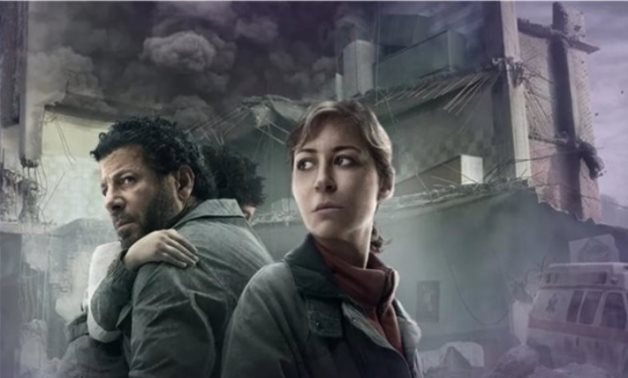
Sohab El Ard.




The series Sohab El Ard stands out as one of the most powerful and emotionally resonant dramas to emerge from recent seasons. Rather than presenting the Gaza war through distant headlines or political summaries, the show dives into the human stories behind the conflict, portraying the lives, struggles, and resilience of ordinary people caught in extraordinary circumstances.
Written by Ammar Sabry, directed by Peter Mimi, and produced by United Media Services, the 15-episode drama blends political reality with deeply personal narratives. Through interconnected storylines, the series captures how hope, compassion, and solidarity can survive even amid the devastation of war.
A Story Rooted in Humanity
At the center of the series is Egyptian doctor Salma, portrayed by Menna Shalaby, who joins a medical convoy heading to Gaza. Her journey begins at the Rafah border crossing, where she attempts to persuade security officials to allow a special oxygen device into the enclave to help sick children. After intense negotiations, she finally receives permission, marking the start of a story that highlights Egypt’s humanitarian role during the crisis.
Salma’s path soon intersects with that of Nasser, played by Eyad Nassar, a Palestinian father desperately trying to save his nephew Younes while searching for safety for his daughters amid relentless bombardment. Their meeting in a hospital becomes the emotional heart of the story, where doctors, civilians, and families form powerful bonds in the midst of tragedy.
The show’s narrative structure avoids simple heroism. Instead, it focuses on human connection: friends helping one another, families clinging together, and doctors fighting to save lives under impossible conditions.
A Cast That Brings the Story to Life
The strength of Sohab El Ard lies largely in its remarkable performances.
Menna Shalaby delivers one of the most nuanced roles of her career as Dr. Salma. She portrays a compassionate physician who struggles with personal grief after losing her own son, while continuing to dedicate herself to saving children in Gaza. Her performance balances vulnerability and strength, making Salma both deeply human and inspiring.
Eyad Nassar brings emotional depth to Nasser, a man torn between protecting his family and staying loyal to his homeland. His scenes reflecting on exile, loss, and responsibility form some of the series’ most powerful moments.
The supporting cast adds further emotional weight. Kamel El Basha portrays Ibrahim, an elderly Palestinian whose life embodies exile and belonging between Palestine and Egypt. Adam Bakri plays Majd, whose fierce devotion to remaining in his homeland represents the resilience of Palestinian identity.
Meanwhile, Essam El Saqqa brings warmth and authenticity to the role of Samir, an Egyptian driver transporting aid convoys through Rafah. In one memorable scene, Samir defiantly honks his truck horn at Israeli forces while delivering humanitarian aid, a moment that captured viewers’ emotions and symbolized the courage of ordinary Egyptians supporting Gaza.
Young Palestinian actress Tara Abboud also delivers a powerful performance as Karma, whose confrontations with Israeli interrogators evolve into one of the series’ most politically charged storylines.
Depicting the Reality of War
What makes Sohab El Ard particularly impactful is its unflinching portrayal of the suffering experienced by Palestinian civilians.
Throughout the series, viewers witness devastating scenes that mirror real-life tragedies. Homes are destroyed by bombardment. Hospitals are targeted, leaving doctors scrambling to save patients with limited resources. In one heartbreaking moment, Israeli forces shoot Majd while he is simply trying to obtain milk for a hungry infant. In another, elderly civilians are used as human shields.
The series also portrays the emotional consequences of war. Children grow up surrounded by fear instead of play. Families are separated. Entire neighborhoods are reduced to rubble.
One especially powerful storyline involves Fadwa, played by Sara Youssef, who dies while giving birth to her son, a tragic symbol of the countless Palestinian mothers whose children enter a world shaped by conflict and loss.
Even aid deliveries become moments of danger. In a striking visual sequence, humanitarian supplies descend from the sky by parachute while desperate civilians race beneath them, illustrating how survival itself becomes a struggle.
Documenting the Atrocities
Sohab El Ard does not shy away from depicting the harsh realities imposed by Israeli occupation forces. The series provides a harrowing look at the violence inflicted upon Palestinian civilians:
• Targeting of hospitals: Al-Wadiyan Hospital is bombed, killing Raghd and her husband Bassem, alongside other civilians and patients, despite her refusal to leave her husband’s operating room.
• Use of human shields: Elderly Palestinians are forced into dangerous situations as shields, exposing the cruelty and inhumanity of occupation tactics.
• Civilian casualties: Nasser’s uncle, Majd, is shot while performing a simple humanitarian act, bringing milk to a hungry infant, demonstrating the indiscriminate nature of violence.
• Destruction of homes and forced displacement: Nasser’s family home is reduced to rubble, leaving him and his daughters vulnerable. The series portrays the logistical and emotional nightmare of survival amid bombed-out neighborhoods.
• Psychological warfare: Soldiers interrogate survivors, aggressively searching for individuals like Fadwa (Sara Youssef), and occupation forces’ presence creates constant fear and insecurity.
• Death of newborns and mothers: Fadwa dies while giving birth, reflecting the reality faced by countless Palestinian mothers whose children are born into trauma and loss.
The series also examines the broader societal consequences: children are robbed of their innocence, families are torn apart, and everyday survival becomes a battle against both physical destruction and psychological trauma. The camera lingers on trembling hands, labored breaths, and silent grief, humanizing these tragedies in a way that news headlines often cannot.
Egypt’s Lifeline and Humanitarian Solidarity
Amid these atrocities, Sohab El Ard highlights Egypt’s role as a lifeline for Palestinians:
• Medical convoys: Egyptian doctors, nurses, and volunteers risk their lives to deliver urgent aid. In one striking sequence, Essam El Sakka’s character, Samir, honks his truck horn defiantly at Israeli forces while transporting aid through Rafah, symbolizing Egyptian courage and solidarity.
• Rafah crossing: The series emphasizes that all other crossings were closed, making Rafah the sole entry point for humanitarian support. Egypt’s efforts are portrayed not only as political aid but as acts of human compassion.
• Medical care for premature infants: The documentary segment The Key of Return depicts Egyptian medical teams, known as the “White Army,” receiving and treating premature babies evacuated from Gaza. Doctors and nurses describe the intense responsibility and emotional stakes, with families tearfully reunited with their infants.
Dr. Salma’s relentless efforts to secure medical equipment, such as an A-arm X-ray device for urgent surgery, underscore the combination of bureaucratic negotiation, medical expertise, and human determination needed to save lives in crisis conditions.
While the series does not shy away from depicting the brutality of war, it also emphasizes the role of Egypt in supporting Palestinians during the crisis.
The Rafah crossing appears throughout the story as a lifeline for Gaza. Medical convoys, humanitarian aid trucks, and emergency teams cross into the enclave despite immense risks. Egyptian doctors, drivers, and volunteers work tirelessly to treat the wounded and provide assistance.
Through characters like Dr. Salma and Samir, the series highlights Egypt not merely as a neighboring country but as a historical refuge and partner in humanitarian solidarity.
This theme is reinforced in the show’s closing documentary segment, The Key of Return, directed by Karim El Shenawy and Amir El Shenawy.
The film reveals the real-life story of Egyptian medical teams receiving premature infants evacuated from Gaza. Doctors, nurses, and paramedics describe the intense effort to save the babies’ lives after they arrived through Rafah.
Inside El Arish General Hospital, medical teams entered a state of emergency to treat the infants. Some were stable enough to remain there, while the most critical cases were airlifted to New Administrative Capital for specialized care.
The emotional testimonies of doctors and families underscore the humanitarian dimension of the crisis. One grandmother described searching through rows of incubators until she finally found her grandson, embracing him in tears and gratitude.
These real-life stories reinforce the central message of the series: compassion and humanity can endure even in the darkest moments.
Direction and Storytelling
Director Peter Mimi approaches the material with remarkable sensitivity. Rather than relying solely on spectacle, he focuses on intimate moments: a father searching for his child, a doctor struggling to hold back tears, or a family praying beside the ruins of their home.
The cinematography often lingers on silence rather than action, capturing trembling hands, exhausted faces, and quiet moments of grief. This visual language gives the series its emotional authenticity.
Meanwhile, Ammar Sabry’s writing ensures that the narrative never loses its human core. By weaving together multiple perspectives, doctors, civilians, journalists, and families, the script presents a multidimensional portrait of the conflict.
A Series That Balances Pain and Hope
Despite its heavy subject matter, Sohab El Ard ultimately remains a story about resilience. The series reminds viewers that even under siege, life continues. Weddings take place. Children laugh when they can. Families reunite.
In one particularly poignant moment, Dr. Salma saves the life of an injured Israeli despite the surrounding conflict, delivering a powerful message that humanity must always come before hatred.
By the time the series reaches its conclusion, the message is clear: war may destroy buildings and divide borders, but it cannot erase dignity, compassion, or the enduring bond between people.
A Landmark Production
With its ambitious storytelling, powerful performances, and socially conscious message, Sohab El Ard stands as one of the most significant television productions in recent years.
The series demonstrates the growing ambition of Egyptian television under the production of United Media Services, which continues to invest in large-scale projects that combine compelling drama with historical and political awareness.
Ultimately, Sohab El Ard is more than a television series. It is a human chronicle of suffering, courage, and solidarity, one that reminds viewers that behind every headline lies a story of real people fighting to survive.

Be Social



Comments
Leave a Comment