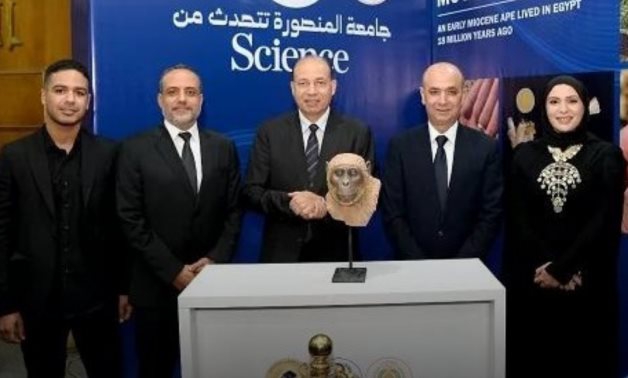
Egypt’s Desert Breakthrough Puts Its Scientists in the Global Spotlight.
Dr. Shorouk El Ashqar, a specialist in mammal studies, spoke about the details of field research expeditions in the Egyptian desert, saying: “We camp in remote areas away from people so we don’t attract attention and can focus on our work. We searched several locations before settling on the site where we set up our camp.”
She added that preparing the research site was not easy, especially with the extreme desert heat. The thermometer recorded very high temperatures, forcing the team to adapt to the harsh conditions and continue working despite the challenges.
During an interview with acclaimed media personality Ahmed Fayek, host of the TV show Egypt Can on DMC TV channel, she explained that the team faced curiosity from passersby but managed to protect the site from interference. She said: “It naturally sparks people’s curiosity, wondering who we are and what we’re doing. But thankfully, everything remained calm and no one disturbed us.”
The researcher emphasized that publishing their work in the journal Science is not just a scientific achievement, but also a form of soft power for Egypt. News of the discovery spreads across international media, highlighting Egypt as a hub for science and discovery. She noted: “Publishing this research alone generates an incredible amount of global attention on Egypt, which is very important for representing our country scientifically.”
In a breakthrough, the Salam Lab team, led by Hesham Sallam, identified a new fossil ape species, Masripithecus moghraensis, from remains discovered at Wadi Moghra in Egypt’s northern desert, dating to approximately 17 to 18 million years, the Early Miocene epoch.
The finding offers crucial fossil evidence from North Africa, suggesting that early ape evolution may have occurred across a wider region, including North Africa and the Middle East, rather than being limited to East Africa.
Using advanced anatomical, statistical, phylogenetic, and biogeographic analyses, the research helps bridge a significant gap in evolutionary history and positions Masripithecus as a key species in understanding early primate dispersal. Its publication in Science, which accepts only around 6 percent of submissions annually, highlights its global scientific importance.
Dr. Sallam described the achievement as a major leap for Egyptian scientific research, noting that it marks an unprecedented milestone for both Egypt and the region. He added that the discovery, based on evidence from the Egyptian desert, reveals a previously unknown chapter of natural history.
He emphasized that the breakthrough is the result of years of dedicated teamwork, reflecting a shared national accomplishment driven entirely by Egyptian efforts.
The study was conducted under the scientific leadership of Hesham Sallam, with Dr. Shorouk El Ashqar serving as lead author.








Comments
Leave a Comment