In a season crowded with familiar formulas and predictable stakes, the Ein Sehreya (Magical Eye) series arrives as a reminder of a fundamental truth in drama: it is never the script alone, nor the direction alone, that creates something exceptional. It is that rare chemistry when a cohesive screenplay meets a conscious visual vision, producing a work that feels as though it sees what we cannot.
The series does not rely on loud twists or rapid shocks. Instead, it builds a layered psychological world where truth fractures, certainty dissolves into doubt, and the audience becomes an active participant in decoding meaning. What elevates the experience further is how each creative pillar stands firmly on its own while serving the whole.
Direction: El Sadeer Massoud and the Architecture of Unease
Director El Sadeer Massoud constructs a visually coherent psychological universe. He avoids gratuitous spectacle, opting instead for sustained tension and emotional suffocation. The camera is not merely recording events; it becomes another “eye” inside the narrative, observing, judging, and exposing fragility.
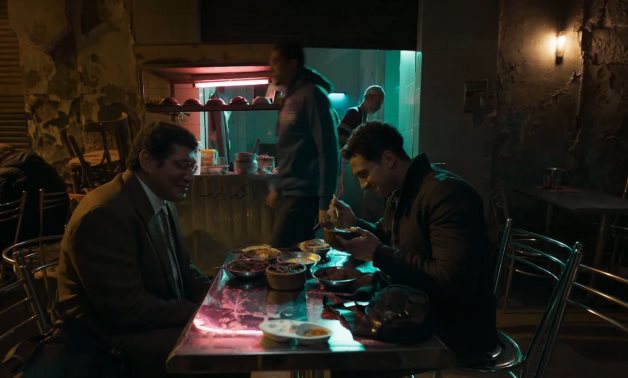
The deliberate pacing allows viewers to penetrate the characters’ inner conflicts. Tight frames, dim lighting, mirrors, and reflections are not decorative choices but dramatic tools that intensify the themes of surveillance and inner collapse.
Writing: Hesham Helal and the Art of Controlled Mystery
Hesham Helal’s script thrives on fragmentation. Truth is never fully handed over; it is carefully distributed across episodes. The narrative respects the audience’s intelligence, planting subtle clues that bloom later with new significance.
The series leans more on internal conflict than external action. While there are moments that could have benefited from tighter editing mid-season, the overall arc remains cohesive and cumulative, rewarding patience with psychological depth.
Performances: A Cast Anchored in Nuance
Essam Omar: A Protagonist on the Edge of Doubt
Essam Omar delivers a restrained and intelligent performance. His strength lies in subtlety, hesitant glances, weighted silences, calculated discomfort. He does not dominate scenes through force but through vulnerability, embodying a man trapped between tangible reality and distorted perception.
Bassem Samra: Gravitas and Complexity
Bassem Samra, portraying “Zaki,” brings layered intensity. His performance balances external toughness with internal fractures. The dynamic between him and Essam Omar forms one of the series’ strongest elements. Their unspoken tension and understated chemistry create a compelling dramatic duet built on psychological friction rather than overt confrontation.
Sama Ibrahim: The Art of Effortless Depth
Sama Ibrahim, as the mother, masters the “effortless” performance style. Quiet yet emotionally charged, she conveys maternal warmth and anxiety through minimal gestures and loaded silences. She becomes the fragile emotional anchor within a morally unstable world.
Omar Sherif: The Human Counterbalance
As Hassan, Omar Sherif offers sincerity and naturalism. His performance introduces emotional softness amid the psychological heaviness, grounding the narrative with relatable humanity.
Jana El Ashqar: Controlled Sensitivity
In the role of Asmaa, the veterinarian, Jana El Ashqar delivers a delicate yet aware performance. She balances empathy with caution, adding further emotional ambiguity to the narrative web.
Faten Saeed: Clinical Stillness
Faten Saeed delivered a touching and natural performance as Basma, Zaki’s daughter, in Ain Sehria. Through her expressive acting and emotional depth, she brought the character to life, capturing Basma’s innocence, sensitivity, and inner strength. Her performance added warmth to the story and made the audience connect with Basma’s journey, proving that Faten Saeed is a young talent to watch.
Mohamed Alaa: Magnetic Threat
Mohamed Alaa, as “Shahab,” delivers one of the most striking performances. His calculated stares, deliberate speech patterns, and controlled body language create a chilling presence. Every question he asks carries suspicion; every pause feels like a trap closing in. It is a performance rooted in mastery of detail and physical control.
Cinematography: The Eye That Watches All
The visual language reinforces the show’s thematic obsession with perception and surveillance. Dark lighting, narrow spaces, and reflective surfaces heighten the suffocating atmosphere. The camera repeatedly reminds us that what we see may not be the full truth. The image functions as a parallel narrative layer, extending psychological tension beyond dialogue.
Beyond Thriller: A Social Conscience
What further distinguishes Ein Sehreya is its engagement with serious social issues. The series does not merely explore psychological collapse; it confronts disturbing realities such as counterfeit medications and unethical drug trials conducted on vulnerable patients in inhumane and illegal ways. These themes ground the philosophical inquiry in urgent social commentary, expanding the series beyond genre into moral territory.
Final Verdict
Ein Sehreya is not designed for fleeting shock value. Its power lies in integration: a thoughtful script, deliberate direction, disciplined performances, and evocative cinematography. It may not be the loudest contender of the Ramadan season, but it is certainly among the most mature and intellectually daring.
It leaves viewers not only questioning what they see, but how they see it and whether the most terrifying truths are the ones we are afraid to confront.








Comments
Leave a Comment