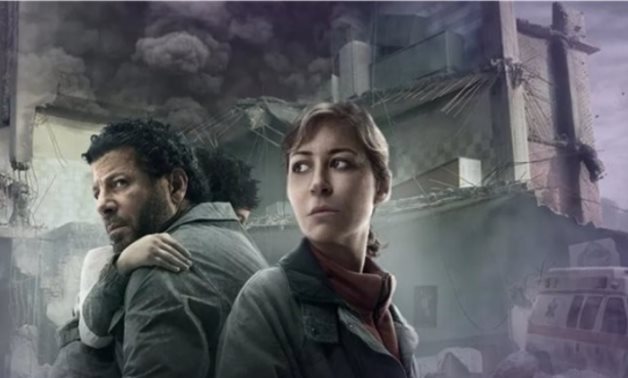
Israeli media did not treat the series Sohab El Ard as just another Ramadan drama in 2026, but rather as a politically charged work disguised as art, with implications that go beyond the screen.
From the first promotional trailer, Israeli channels and newspapers began intensive analyses, focusing on the series’ content, timing, producers, and potential impact on Arab audiences.
The Israeli Broadcasting Authority dedicated extensive coverage to the series, suggesting that its focus on Gaza and its airing during Ramadan gives it a massive audience from North Africa to the Gulf. Reports noted that Egyptian drama, given its reach and influence, has a special ability to shape Arab public awareness, making any depiction of the conflict particularly sensitive.
Channel 12 in Israel highlighted the “implicit messages” in the early episodes, such as scenes of bombing, destruction, and civilians’ daily suffering. Analysts argued that the show reflects “an Egyptian cultural stance supportive of Palestinians” and is part of the broader battle over narratives in the region.
Israeli media is angry that the series of intense humanized scenes may increase Arab empathy for Gaza; and airing during peak Ramadan viewership amplifies its message and influence.
Some Israeli commentators explicitly referred to “Egyptian soft power,” noting that Cairo uses drama as a long-term cultural influence tool, with Ramadan series historically shaping Arab public sentiment. Reports also expressed concern that the show could reach Arabic-speaking audiences inside Israel via digital platforms, adding a new layer to the debate. The coverage often anticipated future episodes, reflecting anxiety over what might unfold.
Observers note that the intensity of Israeli coverage underscores recognition of Egypt’s cultural influence. Unlike political statements, drama reaches audiences through emotion and human stories, leaving a lasting impression.
The Israeli army’s spokesperson for the Arab world, Lt. Col. Ella Waweya, known as “Captain Ella,” launched a sharp attack on the Egyptian series Sahab El-Ard, which is airing during the Ramadan 2026 drama season, in a video posted on her official Facebook page.
Her criticism made one thing clear: the series has struck a nerve. By presenting documented events and visual evidence, Sahab El-Ard sheds light on realities Israel would rather keep hidden, amplifying its impact far beyond the television screen.
Waweya claimed that the series is not a dramatic work but rather a distortion and falsification of facts, and that it contains incitement against the Defense Forces, as she described it. She added that members of the Hamas movement were the ones who assaulted and harmed Palestinian civilians.
The spokesperson’s attack on the Egyptian series drew significant criticism from Arab social media users. They accused her and the army she represents of killing civilians and distorting facts, while praising the Egyptian drama.
Many described it as a slap in the face of the occupation that exposes its crimes to the world. They also declared their commitment to continuing to follow the series after the Israeli attack against it.
The series director, Peter Mimi, responded to the Israeli spokesperson’s attack on his Facebook page.
Mimi wrote: “What facts are being falsified? The videos are there! Anyway, I struggled to find an actress who looks like you! Victory to every oppressed person.”
Israel has gone furious after the series “Sahab El-Ard” exposed the Israeli occupation forces and revealed the massacres carried out by the occupation army against Palestinians, laying them bare before the world.
This has thrown the Israelis into confusion and anger, pushing them to smear the series because it has become one of the most documented dramatic works portraying the occupation’s crimes in the October 7 war.
Thus, Sohab El Ard evolved from a Ramadan series into a cross-border media debate.
While its creators present it as a humanitarian story highlighting Palestinian civilians' sufferings, Sohab El Ard evolved from a Ramadan series into a cross-border media debate.
While its creators present it as a humanitarian story highlighting Palestinian civilians' sufferings, Israel views it as a nightmare. For Israel, the series is a powerful lens that lays bare its humanitarian violations before the world, a reminder that drama can be both art and politics.







Comments
Leave a Comment