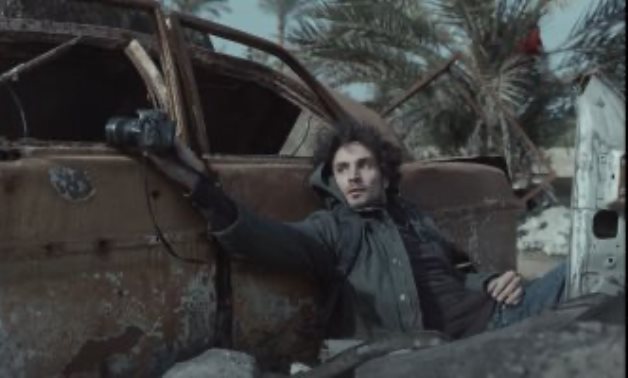




Episode nine of Sohab El Ard delivers one of the series’ most emotionally charged and politically resonant chapters so far. Drawing on powerful parallel storylines, the episode deepens its portrayal of suffering, exile, loyalty, and media distortion, while remaining grounded in intimate human moments.
One of the most harrowing sequences follows Majd, played by Adam Bakri, as he tracks Ibrahim, portrayed by Kamel El Basha, after Israeli occupation forces take him away. In a devastating moment, an Israeli soldier strikes Ibrahim across the face before abandoning him and a group of elderly men in a deserted location, leaving them to die.
The scene captures raw fear and humiliation, but also the quiet courage of persistence. Majd reaches Ibrahim after the soldiers leave, freeing him and the others from their restraints. Yet the reunion is far from triumphant. Ibrahim, already in fragile health, grows angry at Majd for risking himself. The emotional confrontation ends with Ibrahim collapsing unconscious, underscoring both his physical vulnerability and the generational weight of survival.
This sequence exemplifies what the series does best: portraying the harsh and violent treatment of Palestinian civilians while centering their humanity. The camera lingers not only on aggression, but on the aftermath, the trembling hands, the labored breath, the cost carried in silence.
The episode opens with another thread of forced displacement. Nasser, played by Eyad Nassar, sends a friend, played by Tara Abboud, to help Karma and her daughters and grandmother after they are expelled from their home. Their journey is marked by hardship and uncertainty, reinforcing the instability that defines civilian life amid conflict.
Rather than dramatizing heroism in grand gestures, the show focuses on acts of solidarity, friends helping friends, families clinging to one another. It is this emotional realism that gives the series its weight.
Through Ibrahim’s character, the episode reinforces a central theme: Egypt as a second homeland for Palestinians. Ibrahim embodies the exile who found belonging without erasing his roots. His gratitude toward Egypt and his deep attachment to it mirror the experiences of many Palestinians whose lives became intertwined with Egyptian society.
Even in weakness, Ibrahim stands as a symbol of dignity shaped by displacement yet grounded in belonging. The show frames Egypt not merely as a neighboring country, but as a historical refuge and emotional anchor.
Episode nine also tackles media bias in a pointed and provocative scene. When a foreign journalist visits Gaza to report on the destruction caused by Israeli occupation forces, she describes them as “civilized” despite the visible devastation.
Dr. Salma, portrayed by Menna Shalaby, confronts her directly, arguing that after everything that has been done, such a description is indefensible. The confrontation highlights what the series suggests is a broader issue: segments of Western media aligning with Israel’s narrative and shaping coverage in ways critics argue distort facts and overlook realities on the ground.
This moment expands the episode’s scope beyond physical violence to narrative power, who tells the story, and how language can sanitize destruction.
A particularly powerful minute from the episode encapsulates the series’ mission. In just sixty seconds, Sohab El Ard portrays fear, chaos, and the human cost of military aggression with unflinching clarity. The scene reinforces the show’s commitment to telling stories rooted in pain, resilience, and lived reality.
Episode nine stands as a layered and emotionally resonant chapter. From Ibrahim’s near-fatal abandonment and Majd’s desperate rescue, to Karma’s displacement and Dr. Salma’s confrontation with foreign media bias, the episode weaves together personal anguish and political commentary.
Without straying from its grounded tone, Sohab El Ard continues to present itself as more than a drama series. It is a narrative about belonging, survival, and the struggle over truth, where violence unfolds not only on the ground, but also in the stories told about it.

Be Social




Comments
Leave a Comment