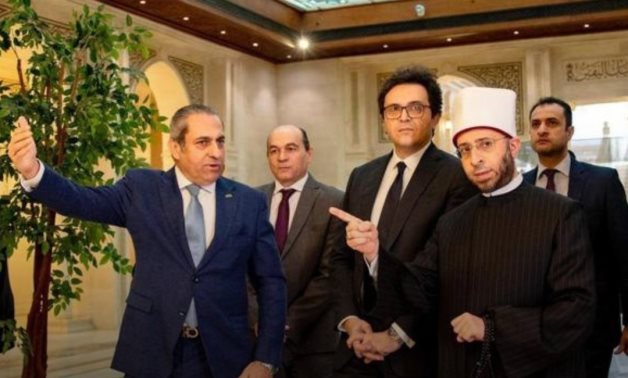
Minister of Culture Dr. Ahmed Fouad Hanno, Minister of Awqaf Dr. Osama Al-Azhari, and Eng. Khaled Abbas, Chairman and Managing Director of the Administrative Capital for Urban Development Company, inaugurated the Holy Quran Reciters Museum, annexed to Dar Al-Quran at the Egyptian Islamic Cultural Center in the New Capital.
The inauguration reflects the Egyptian state’s commitment to preserving its cultural and spiritual heritage and honoring the icons of the Egyptian school of Quranic recitation, which shaped the conscience of the Arab and Islamic worlds for decades.
The officials toured the museum’s galleries, which showcase personal belongings of 11 of Egypt’s most renowned Quran reciters: Sheikh Mohamed Refaat, Sheikh Abdel Fattah El Shaarawi, Sheikh Taha El Fashny, Sheikh Mostafa Ismail, Sheikh Mahmoud Khalil El Hossary, Sheikh Mohamed Siddiq El Minshawi, Sheikh Abu El Enein Shousha, Sheikh Mahmoud Ali El Banna, Sheikh Abdel Basset Abdel Samad, Sheikh Mohamed Mahmoud El Tablawy, and Sheikh Ahmed El Razeqi, in the presence of several members of their families.
Attendees praised the museum’s exhibition narrative, spread across four main halls. The museum also houses a collection of rare manuscripts and artifacts, Al-Azhar certification licenses granted to several reciters, and dedicated listening rooms featuring selected recitations. This offers visitors a comprehensive educational and auditory experience, making it the first cultural institution of its kind devoted to documenting the masters of Quranic recitation and the aesthetics of vocal performance.
Dr. Ahmed Fouad Hanno stated that the opening of the museum embodies the state’s deep appreciation of the Egyptian Quran reciter as a guardian of the Holy Book and a bearer of a spiritual and artistic message that has helped cement Egypt’s status as a leading beacon in the art of recitation. He noted that the voices of Egypt’s great reciters have long been an integral part of the auditory memory and cultural identity of the Arab and Islamic nation, adding that the museum serves as a religious and cultural landmark that documents the history and artistic legacy of Quranic recitation.
Meanwhile, Dr. Osama Al-Azhari affirmed that the inauguration of the Holy Quran Reciters Museum marks an important step in preserving Egypt’s moderate religious identity and honoring the figures of recitation who carried the Holy Quran to hearts before ears. He emphasized that the Egyptian school of recitation played a key role in spreading the correct understanding of the Holy Quran and instilling the values of beauty, reverence, and moderation in the Islamic conscience. He added that Egyptian Quran reciters combined mastery of Quranic sciences with refined performance and sincere delivery, making their recitations a distinctive school passed down through generations.








Comments
Leave a Comment