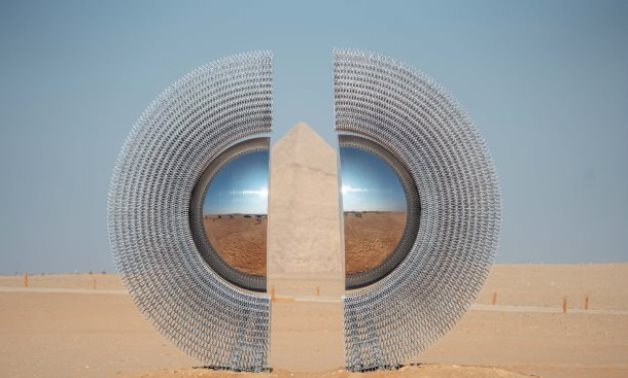




This year’s edition of Forever exhibition once again affirms how art can bridge epochs, merge memory with invention, and spark dialogue between heritage and contemporary imagination. Now in its fifth edition, the event has unfolded across the Giza Pyramids Plateau—running through December 6th—under the patronage of the Ministry of Foreign Affairs, the Ministry of Culture, and the Ministry of Tourism and Antiquities, in partnership with UNESCO.
This edition brought together ten creators from across the world, gathering beneath the shadow of the ancient pyramids to channel a shared celebration of artistic diversity and cultural cross-pollination. Positioned at the crossroads of history, the exhibition reiterates Art D’Égypte’s dedication to championing global artistic voices and exploring how creative expression can revisit humanity’s earliest attempts at eternalizing its existence—attempts once carved in stone by the pharaohs themselves.
Reflecting on his contribution, Italian artist Michelangelo Pistoletto described the pyramids as “the dawn of history,” explaining how his installation The Third Paradise seeks to dissolve temporal borders and weave past, present, and future into a single imaginative continuum. Presenting this work at Giza, he said, rekindles humanity’s connection to its origins while inviting contemplation of a future shaped by ancestral inspiration.
Portuguese artist Alexandre Farto (Vhils) spoke of the humbling experience of creating beside such an enduring human monument. His work Cairo Doors sifts through the everyday imprints of memory—objects, surfaces, and thresholds that carry countless stories—probing what links us across civilizations through the traces we leave behind.
Turkish artist Mert Ege offered a different kind of reflection, describing his polished metal ring The Shen as less an object and more a living state—capturing light, casting moving shadows, and shifting with the breath of the wind. Suspended between heaviness and levity, the piece mirrors time’s elastic nature. For him, standing inside the ring is an invitation to watch the horizon reshape itself, as though the artwork itself walks through time.
The Franco-Russian duo Recycle Group presented Null, a layered symbol that evokes rebirth, rupture, and the rise of a new digital dimension. They described the work as a contemporary meditation on spirituality, where the boundaries between tangible and virtual realities blur. Their suspended forms and mesh structures evoke humanity ensnared in unseen networks, where belief converges with data and consciousness with artificial light.
South Korean artist Jongkyu Park (J.Park) introduced Code of the Eternal, envisioning an encoded dialogue between Egypt and Korea—two ancient civilizations whose legacies reverberate across time. For him, exhibiting at the pyramids carries a moral and spiritual resonance, offering a place where history, language, and cultural identity converge.
From the United States and the Netherlands, Alex Proba and SolidNature collaborated on Infinity Echoes, an homage to the earth’s landscapes and the geological transformations that shape them. They described presenting this piece at the pyramids as standing at the pulse of history—where creativity becomes a timeless language shared across cultures and eras.
Lebanese artist Nadim Karam contributed Desert Flowers, three sculptural forms rising from the sands like revived stories resurfacing through time. Made of repurposed scrap metal, the pieces echo the endurance of memory and the cyclical nature of life, rebirth, and forgetting.
Brazilian artist Ana Ferrari, with her work The Winds, translated the invisible movement of air into a soundscape inspired by the ancient Egyptians’ reverence for nature and music. Her spiral of aluminum flute pipes captures the desert’s voice, crafting a sensory experience that bridges humanity with the universe.
Beninese-French artist King Houndekpinkou unveiled The White Statue Totem, the largest ceramic sculpture of his career. Completing it in Cairo, he views the piece as both a personal evolution and an intimate expression magnified onto a monumental scale. Set against the timeless backdrop of the pyramids, it becomes a vessel for exploring Egypt’s profound spirit.
Egyptian artist Salha Al-Masry closed the circle with Ma’at, a reinterpretation of royal ornamentation transformed into a communal space. Her work reimagines the ancient concept of Ma’at—balance, truth, harmony—by shifting a symbol of authority into an open threshold that meditates on order, chaos, and the essence of human nature.
Together, these works form a sweeping tapestry of voices, visions, and histories—each one in conversation with the desert, the pyramids, and the boundless notion of forever. The exhibition concludes not as an ending, but as a renewed testament to the enduring power of art to transcend time and bind civilizations in one shared narrative of creativity.

Be Social



Comments
Leave a Comment