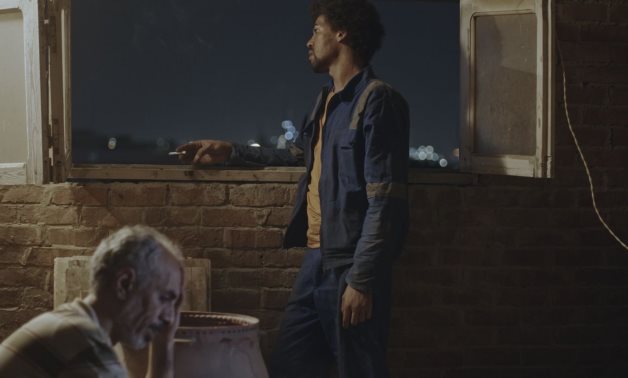
A scene from Egyptian Film Settlment.
In recent years, audiences have become increasingly interested in independent films, eager to watch new and diverse stories that reflect reality with authenticity and depth. This growing interest has led to a rise in independent directors excited to share their perspectives, shedding light on issues often left unaddressed in mainstream media.
One such director is Egyptian filmmaker Mohamed Rashad, whose feature debut, THE SETTLEMENT, will have its world premiere in the newly launched Perspectives Section of the 75th Berlin International Film Festival, running from February 13th to the 24th.
The first thing that comes to mind with the word "settlement" is its historical connotation of isolation, reminiscent of places where patients are separated from society due to fears of spreading infection.
With the theme of isolation in mind, THE SETTLEMENT is set in an apartment separated from the world — on the 21-kilometer mark on the highway to Alexandria, far from the cosmopolitan city and its hustle and bustle. Inspired by real events, the story follows a family of two brothers — 23-year-old troublemaker Hossam and his 12-year-old brother Maro — and a sick mother as they cope with the loss of their father, who tragically died in a factory accident.
The setting serves as a powerful backdrop for the brothers living in this marginalized community, reflecting their isolation and entrapment in their small world as they navigate their new roles following their father's death at the factory where he worked. Instead of pursuing legal action against the factory for unsafe working conditions, they feel compelled to work there, an ironic twist that underscores the film's exploration of systemic exploitation.
To ensure authenticity in his narration, the director rented an apartment in the same neighborhood that he feels perfectly embodies his story and reflects the sense of isolation experienced by the characters. He also filmed in an authentic factory, though it was located in Cairo, as he found that the setting he envisioned could only be realized there.
As the director built this world, he was prompted by questions such as how someone could build their future in the same workplace where their father died and whether the brothers would continue their father's difficult path. This reflection also explores their relationship with their father and the void he left, leading the younger brother to make a father figure out of his elder brother, introducing a narrative characterized by delicacy and depth.
A native of Alexandria whose father worked in textile factories for over four decades, Rashad was inspired by a story shared with him by a law graduate whose father died at a construction site, where the company pressured the family to waive their rights in exchange for a job offer in its legal department.
Rashad not only drew from this story but also sought to enhance authenticity by casting real-life characters and workers alongside actual machinery. This approach allowed the actors to embody the story naturally, thereby increasing its impact on audiences.
For the sake of authenticity, he also cast characters in the lead roles with no prior experience, featuring fresh faces so that the audience could build a relationship with them. “While the norm is relying on professional actors, this experience focused on new talent,” director Mohamed Rashad shared.
“Finding a child actor for the lead role was particularly challenging. The decision was made for the two main leads to be new and fresh, similar to the other roles. The casting process took about six months, involving several auditions, watching plays for new faces, and relying on casting agencies and recommendations. For the child role, they reviewed over a hundred children before finding Islam Ziad,” he added.
Written and directed by Mohamed Rashad, THE SETTTLEMENT stars emerging talents Adham Shoukry, Ziad Islam, Hajar Omar, Mohamed Abdel Hady, and Emad Ghoneim; it is lensed by cinematographer Mahmoud Lotfi and edited by Heba Othman, whose credits include the acclaimed Sudanese film GOODBYE JULIA.








Comments
Leave a Comment