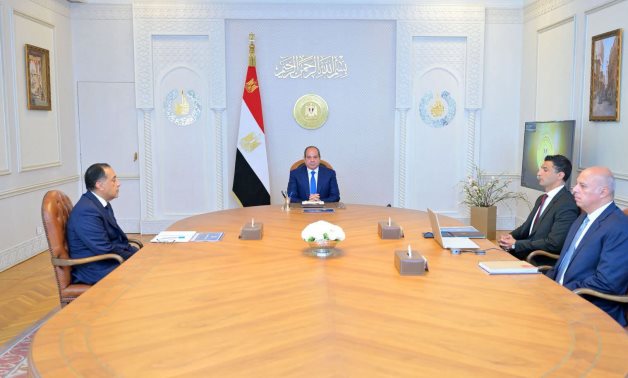




President Abdel Fattah El-Sisi reviewed progress on Egypt’s National Industrial Strategy for 2026–2030 during a meeting with Prime Minister Mostafa Madbouly and Minister of Industry Khaled Hashem.
The strategy aims to raise Egypt’s non-oil exports to $100 billion by 2030 through a comprehensive industrial framework developed in partnership with the private sector, Presidential Spokesman Ambassador Mohamed El-Shennawy said.
Its programmes cover the industrial map, productive villages, distressed factories, legislative and regulatory reforms, institutional development at the Ministry of Industry, supplier development, and support for small and medium-sized enterprises.
Hashem said the plan focuses on priority industries including ready-made garments, textiles, food processing, pharmaceuticals, automotive manufacturing, and electrical, engineering and electronics industries.
El-Sisi directed that every programme under the strategy should have a clear implementation timetable. He also stressed the need to deepen Egypt’s integration into global value chains and strengthen its position as a regional industrial hub serving international markets.
The meeting reviewed measures to expand local manufacturing and facilitate technology transfer in the automotive sector, which has been identified as a strategic priority due to its capacity to attract investment and advanced technology.
The minister highlighted the National Automotive Industry Development Programme as a key mechanism for attracting major international manufacturers. El-Sisi called for faster localisation of vehicle production and components, alongside the expansion of electric vehicle manufacturing in line with Egypt’s green economy objectives.
The president also reviewed Egypt’s roadmap to deepen and localise steel production. He stressed the importance of developing feeder industries for heavy manufacturing to reinforce domestic supply chains, reduce import dependence and increase value added across the economy.
The discussions also covered industrial projects and zones, with Hashem noting that procedures for setting up industrial ventures have been updated. Renewable-energy use is also being expanded across the sector to support the competitiveness of Egyptian industry.
Work is also underway on the “Shams El-Sinaa” initiative, which aims to install solar power systems on the rooftops of around 7,000 factories across

Be Social




Comments
Leave a Comment