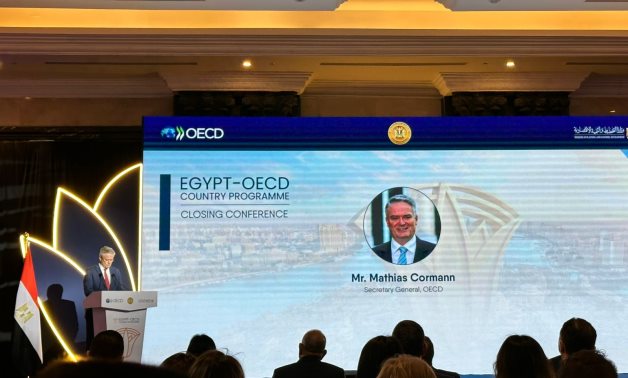




CAIRO - 4 May 2026: OECD Secretary-General Mathias Cormann said the Egypt–OECD Country Programme has evolved into a long-term reform partnership supporting Egypt’s transition toward more inclusive, evidence-based economic policymaking.
Speaking at the closing session of the programme under the patronage of Prime Minister, Mostafa Madbouly, Cormann said the first phase of cooperation delivered concrete institutional and policy gains, laying the groundwork for the next stage of collaboration.
He noted that the programme spans 35 projects across five strategic pillars, implemented with the participation of more than 20 Egyptian government entities, describing it as one of the OECD’s most comprehensive country-level engagements.
Cormann said the partnership has helped advance key reforms, including improvements in governance frameworks, support for state-owned enterprises reform, and the development of a one-stop shop platform aimed at simplifying business procedures and enhancing the investment climate.
He added that the OECD is releasing two new analytical reports, on business dynamics and productivity, designed to strengthen policy design across the full lifecycle of firms and improve productivity outcomes.
Highlighting structural strengths, Cormann pointed to Egypt’s young demographic profile, with nearly 60 percent of the population under the age of 30, calling it a major driver of entrepreneurship and future growth potential.
He also stressed the importance of small and medium-sized enterprises, which account for around 75 percent of employment, noting that supporting SMEs and start-ups remains central to inclusive growth strategies.
Cormann underlined Egypt’s strategic position in global trade, noting that the Suez Canal handles around 15 percent of global trade flows and nearly 30 percent of container traffic, reinforcing its role in international supply chains.
He further highlighted progress in strengthening public governance, statistical systems, and digital transformation, including Egypt’s advancement in artificial intelligence strategy and the establishment of a national AI governance framework.
Cormann added that the OECD will also publish a new report on the green economy, aimed at supporting sustainable policy development and improving the regulatory environment for future investment.
He concluded that the programme marks a shift from cooperation to implementation-driven reform support, adding that the next phase will focus on deepening impact and accelerating structural transformation in line with Egypt’s Vision 2030.

Be Social




Comments
Leave a Comment