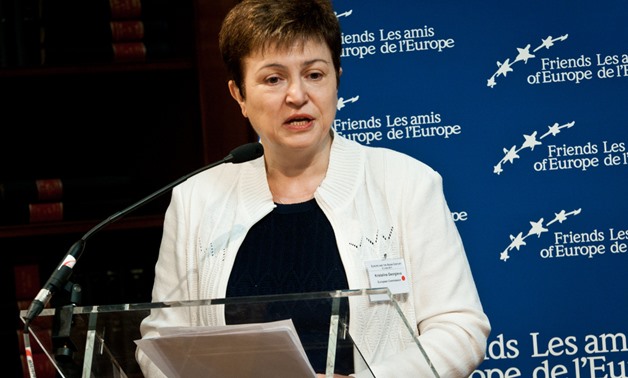
IMF Managing Director Kristalina Georgieva has commended Egypt for the progress it has made in expanding digitalization within its tax system, describing the reform as a key step toward improving efficiency and strengthening trust between governments and taxpayers.
Georgieva made the remarks during her address at the 10th Annual Arab Fiscal Forum, held in Dubai, which brought together senior policymakers, including finance ministers from Jordan, Libya, Lebanon, Somalia and Syria, as well as central bank governors from Bahrain, Egypt, Libya, Mauritania, Palestine, Tunisia, the United Arab Emirates and Yemen.
Egypt’s Minister of Finance, Ahmed Kouchouk, had previously said that the adoption of electronic tax systems has simplified procedures for taxpayers and contributed to broadening the tax base. He explained that automated systems have helped the state build stronger relationships based on trust, partnership and certainty with the tax community.
At the same event, Georgieva praised similar reform experiences in Jordan and Morocco, while also highlighting the application of value-added tax across Gulf Cooperation Council countries and the adoption of a minimum corporate income tax.
Looking at the regional outlook, the IMF chief projected economic growth in the Arab region at 3.7 percent this year. Oil-exporting countries are expected to benefit from higher production levels, while oil-importing economies are gaining from lower energy prices, increased remittances from overseas workers and a rebound in tourism.
She noted an overall improvement in fiscal conditions across the region, with several countries regaining access to international financial markets. Georgieva added that a number of Arab economies have taken concrete steps toward diversification and increased investment in digital infrastructure to unlock the potential of artificial intelligence.
The IMF, she said, continues to support entrepreneurship and encourage foreign direct investment, stressing the Fund’s readiness to assist countries in the region through technical assistance, financing and capacity-building programs.
On the global front, Georgieva forecast world economic growth of 3.3 percent this year and 3.2 percent in 2027, supported by private sector resilience, easing financial conditions and ongoing reforms, particularly in emerging markets. Global inflation is expected to ease to 3.8 percent this year and further to 3.4 percent by 2027, reflecting softer demand and lower energy prices.
However, she warned that escalating geopolitical tensions are heightening uncertainty, while protectionist trade policies risk weighing on investment and growth. She also cautioned that elevated and rising public debt levels in many countries could reach unprecedented levels in the coming years, potentially leading to higher global borrowing costs.








Comments
Leave a Comment