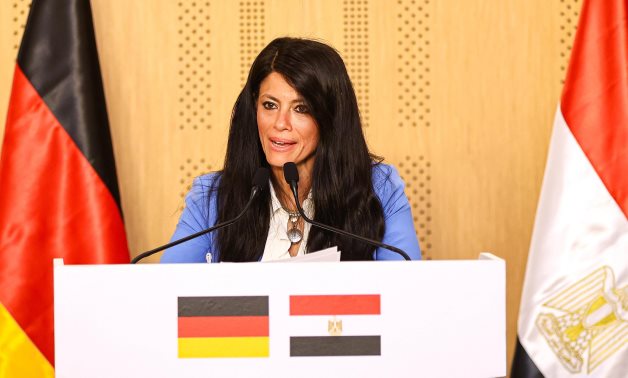




New Alamein - 20 July 2025: Egypt’s Minister of Planning, Economic Development and International Cooperation, Rania Al-Mashat, and Minister of Foreign Affairs and Egyptians Abroad, Badr Abdel Aty, held a joint press conference in New Alamein, with Germany’s Federal Minister for Economic Cooperation and Development, Reem Alabali-Radovan, during her first official visit to Egypt since assuming office in the new German government.
Al-Mashat emphasized that the visit sends a strong signal of the deep-rooted partnership between Egypt and Germany, particularly amid regional and global uncertainties.
“Germany is one of Egypt’s top European partners in development, trade, and investment. Our collaboration is based on mutual trust and a shared vision for sustainable growth,” she said.
Al-Mashat noted that around 1,600 German companies are currently operating in Egypt with investments exceeding €6 billion, primarily in energy, green transformation, and manufacturing. Major names include Siemens, Mercedes-Benz, Bosch, Duravit, and Bayer Sob. The volume of bilateral trade has reached €6.8 billion, making Germany a major commercial and investment partner for Egypt.
Both sides agreed to hold a new round of intergovernmental negotiations by the end of 2025 to determine the priorities of future financial cooperation.
A central pillar of Egypt-Germany cooperation is the Debt Swap Program for Development, which has reached a total value of €340 million. A new tranche worth €100 million will be activated in December 2025 and June 2026, funding projects in technical education, health, climate action, and sanitation.
Al-Mashat underlined that the program remains a flagship model of development finance, allowing Egypt to preempt global calls for debt-for-development mechanisms.
Germany has allocated €258 million in concessional financing, grants, and debt swaps to support Egypt’s NWFE program (“Nexus of Water, Food, and Energy”), focusing on renewable energy integration and grid enhancements.
In partnership with KfW, the German Development Bank, Germany also supported a €30 million green hydrogen project in Egypt’s Suez Canal Economic Zone, implemented by Scatec, Fertiglobe, Orascom Construction, the Sovereign Fund of Egypt, and the Egyptian Electricity Transmission Company. The project is expected to reduce 140,000 tons of CO₂ emissions annually and generate over 1,300 jobs.
The minister highlighted Egypt’s participation in the EU’s EFSD+ platform, which aims to unlock more private sector investments through guarantees and risk mitigation tools provided by European development institutions.
On another note, Vocational education remains a key focus of Egypt’s development strategy. She noted that Germany, through GIZ, has supported the establishment of the German-Egyptian Technical Academy (EGT Academy) in cooperation with Siemens Energy and Egypt’s Productivity and Vocational Training Department. The academy aims to upgrade technical skills in areas such as workplace safety, automation, and real-world simulations.
In May 2025, Egypt and Germany signed an annual financial cooperation agreement worth €118 million, including: €32 million to support the “Inclusive Technical Education” initiative through the establishment of 25 Centers of Excellence, and €86 million (comprising a €54 million loan and €32 million grant) for integrating Acwa Power’s wind energy projects into the national grid, contributing to the energy pillar of the NWFE program.
Al-Mashat revealed that discussions are underway with German institutions to expand development financing for Egypt’s private sector, building on recent momentum.
She also noted that Egypt’s economy is seeing notable improvements in growth indicators in the first nine months of FY2024/25, with the government committed to macroeconomic stability to attract more foreign direct investment.
The joint press conference underscored a shared commitment to deepening cooperation across development, trade, green energy, and private sector engagement—positioning Egypt-Germany relations as a model of strategic partnership in a complex global landscape.

Be Social



Comments
Leave a Comment