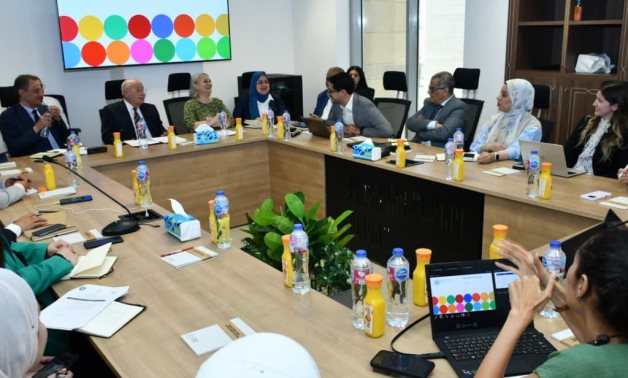
The Egyptian Ministry of Local Development and Environment hosted a meeting of the "Planet" group under the United Nations Sustainable Development Cooperation Framework (UNSDCF)




CAIRO - July 11, 2026: The Egyptian Ministry of Local Development and Environment hosted a meeting of the "Planet" group under the United Nations Sustainable Development Cooperation Framework (UNSDCF) to review achievements during 2025 and adopt priorities and an implementation plan for 2026.
The meeting supports the Egyptian government's efforts to promote the sustainable management of natural resources, strengthen climate change adaptation, advance the transition to a circular economy, and achieve sustainable urban development, the Ministry said in a statement on Saturday.
Dr. Manal Awad, Minister of Local Development and Environment, called for stronger coordination with development partners and international organizations to support national initiatives aimed at ensuring the sustainable management of natural resources and advancing climate action.
During the meeting, Ambassador Raouf Saad, Advisor to the Minister on Multilateral Agreements, emphasized that environmental and climate change issues are no longer isolated sectoral concerns but cross-cutting challenges affecting agriculture, water, energy, health, and the economy, while also impacting food security and regional stability. He stressed that the environmental and climate crises, coupled with the geopolitical challenges facing the region, require an integrated approach that enhances resilience and mitigates economic, social, and humanitarian impacts.
2025 Achievements
The meeting reviewed the Planet group's achievements during 2025. Its programs improved the efficiency of natural resource use for approximately 2.4 million citizens, reclaimed and restored 9,573 hectares of land, and enabled 181,000 smallholder farmers to adopt climate-smart agricultural practices.
Integrated land and water management systems were implemented in 12 governorates, helping reduce irrigation water consumption by up to 20 percent, increase crop productivity by 15 percent, and improve farmers' incomes by approximately 40 percent. The programs also supported initiatives to recycle agricultural waste into value-added products.
Participants also reviewed progress in climate change adaptation, including the development of 11 national policies and strategies for disaster risk reduction, the training of 752 officials and institutional representatives, and the extension of early warning services to more than 2.1 million citizens.
Climate risk assessments were carried out in Qena Governorate, while early warning systems and desert locust monitoring were strengthened in the Red Sea Governorate.
In the field of the circular economy, 17 national policies and regulatory instruments were developed. These efforts helped reduce more than 334,000 tons of pollutants, save 33.7 million megajoules of energy, treat 6.4 million cubic meters of wastewater, and support more than 18,000 beneficiaries and 271 institutions working in renewable energy and sustainable resource management.
In sustainable urban development, 14 national urban planning instruments were developed, more than 118 urban planners received training, and over 100 experts contributed to developing urban sustainability indicators and strategies for preserving heritage sites.
2026 Targets
The meeting concluded with extensive discussions among representatives of government ministries, national institutions, and UN agencies on priorities for the coming phase. Participants explored ways to strengthen coordination, accelerate the implementation of joint programs, and tailor interventions to the specific needs of different governorates.
They also reviewed mechanisms for monitoring progress toward the 2026 targets, improving performance measurement, mobilizing financial resources, addressing funding gaps, and exchanging best practices in sustainable land and water management, the circular economy, and sustainable urban development to maximize development outcomes and improve the quality of life for citizens across Egypt.

Be Social




Comments
Leave a Comment