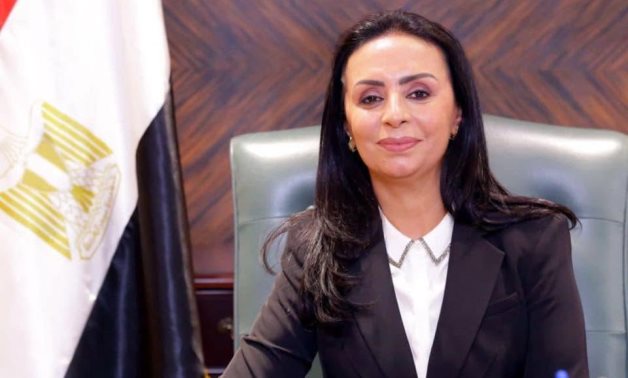




CAIRO – 8 July 2026: Egypt’s Minister of Social Solidarity and Supply, Maya Morsy, addressed the international community with a poignant message regarding the "double standards" and failure to uphold rules broken by the very institutions that created them.
Speaking about Egypt’s final match at the FIFA World Cup—held on Tuesday against Argentina at the Atlanta Stadium in Georgia, which ended 3-2 in favor of Argentina—Morsy highlighted the "No Racism" gesture raised by Egypt’s coach, Hossam Hassan, during the game. She noted that instead of immediately triggering the protocol FIFA itself established and approved, the action resulted in Hassan receiving a yellow card.
“The official 'No Racism' gesture was formally approved by FIFA at the 74th FIFA Congress in Bangkok, making it a mandatory global standard across all football matches," Minister Maya Morsy wrote on her Facebook page.
"By crossing their hands at the wrists and raising them clearly, players can alert the referee directly to racist abuse. Referees will also use this exact gesture to signal that the mandatory three-step protocol has been initiated.”
She added that FIFA maintains a “zero-tolerance policy towards all forms of racism and discrimination. This includes any verbal, physical, or symbolic acts of racism during matches, training sessions, or related events. In line with FIFA’s Global Stand Against Racism, players, coaches, and officials are empowered to use the 'No Racism' gesture—crossing their wrists—to signal incidents of racial abuse. This action prompts the referee to initiate the three-step procedure: Stop the match, Suspend the match, and finally, Abandon the match if the abuse persists.”
This protocol is mandatory and applies to all tournament activities, she emphasized.
A massive controversy swept the internet and social media platforms, drawing outrage not just from Egyptians, but from World Cup followers globally. A large majority of commentators expressed that Egypt "had been robbed"—pointing not only to the contentious on-field refereeing decisions that led to Egypt’s defeat, but most notably to the failure to properly handle the anti-racism protocol.
“It is not about who wins; it is about rules that international institutions are breaking one after another. Remember, the future is not on your side. The tools you have approved should be applied; this is what we have learned from international organizations,” the Egyptian official wrote.
“It is heartbreaking to look into our children's innocent eyes and try to explain why a world that promises equality so often fails to deliver it on its biggest stages," Morsy concluded.
"When international protocols designed to shield human dignity are openly disregarded, it shatters a piece of the fair and just world we desperately want our children to believe in... We tell our children that they are equal to all children in the world. We teach them to never look for their value in the eyes of those who refuse to see it, inspiring them to become the very change that the world's institutions are currently failing to be.”
Global praise for the pharaohs
Despite the exit, the Egyptian national team's performance earned widespread praise from social media users, media outlets, public figures, and global leaders, who remarked that the team "made history" and delivered an "honorable performance."
On Tuesday, President Abdel Fattah El-Sisi thanked the national football team for its "unprecedented achievement" and fighting spirit at the World Cup.
"Thank you to the heroes of the national football team for their honorable performance and for achieving an unprecedented milestone in the history of Egyptian football," President El-Sisi wrote on social media. "We are proud of you and your achievement, and the future holds even better things for you, God willing."
Sheikh Mohammed bin Rashid Al Maktoum, Vice President of the United Arab Emirates, Prime Minister, and Ruler of Dubai, also praised the team's display. In a post on his official X account, Sheikh Mohammed wrote:
"Today we witnessed a heroic Egyptian-Arab match. The Pharaohs of Egypt fought against the world champions until the very last minute. We are proud of their Egyptian spirit, and we thank them—and the world thanks them—for a wonderful and entertaining match. Hard luck. You will return as heroes to your Arab nation, and you will remain heroes in the eyes of all Arabs."
Understanding FIFA’s three-step anti-racism procedure
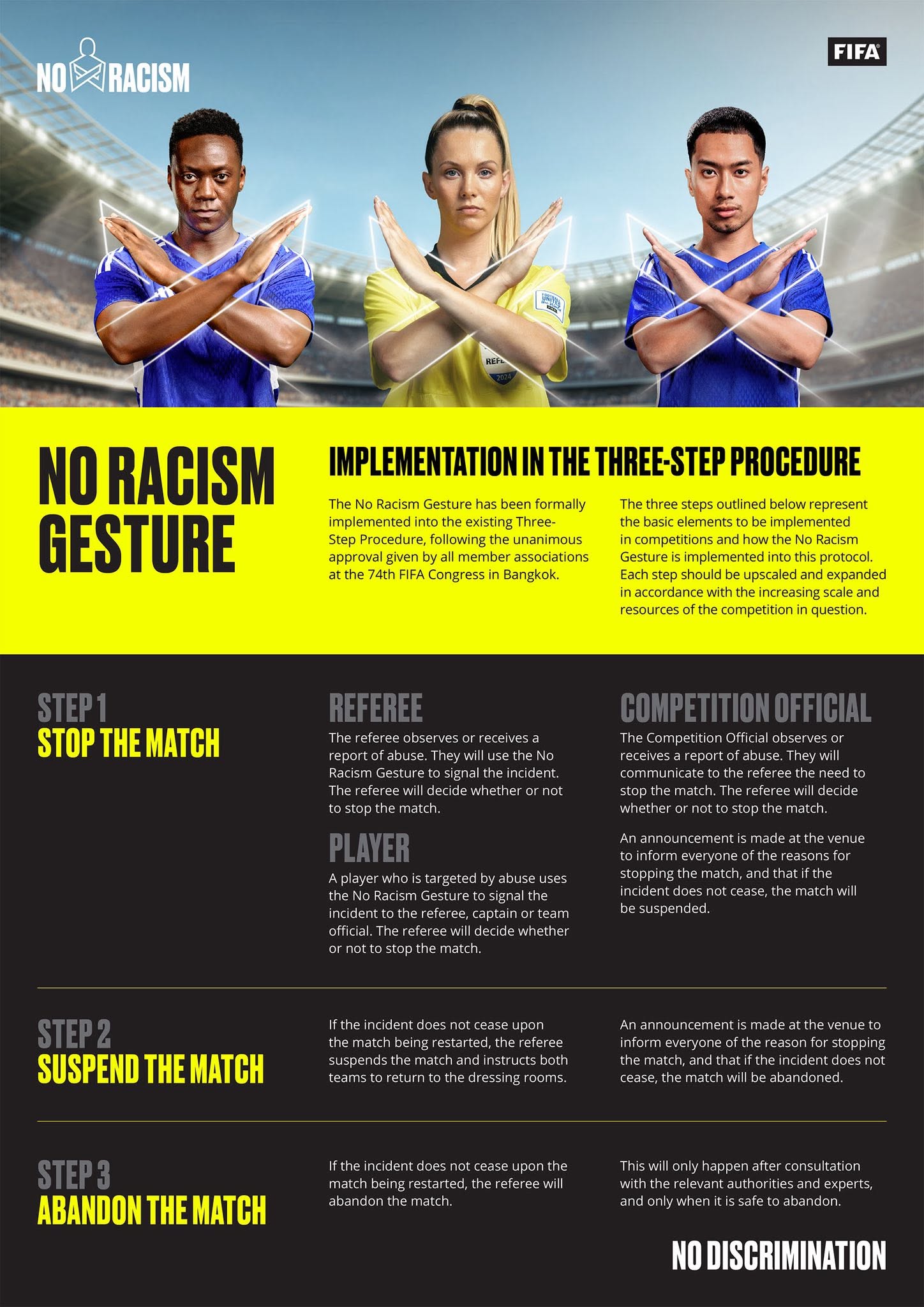
Following unanimous approval by all member associations at the 74th FIFA Congress in Bangkok, the "No Racism" Gesture—crossed arms at the wrists to form an "X"—has been formally integrated into football's existing Three-Step Procedure.
These three steps represent the baseline protocol for handling discriminatory abuse during competitions. The implementation of each step scales in accordance with the resources and infrastructure of the competition in question.
Step 1: Stop the Match
Role of the Referee: The referee either directly observes or receives a report of racist abuse. They will use the "No Racism" Gesture to officially signal the incident and retain ultimate authority on whether or not to halt play.
Role of the Player: A player targeted by abuse crosses their arms to make the "No Racism" Gesture, signaling the incident to the referee, team captain, or team officials.
Role of the Competition Official: The Competition Official observes or receives a report of abuse and communicates the necessity of stopping the match to the referee.
In-Stadium Action: An announcement is made over the venue's public address system to inform spectators of the reason for the stoppage. The announcement explicitly warns that if the abusive behavior does not cease, the match will be suspended.
Step 2: Suspend the Match
On-Field Action: If the racist abuse continues after the match has been restarted following Step 1, the referee will officially suspend the match. The referee will then instruct both teams to leave the pitch and return to their respective dressing rooms.
In-Stadium Action: A second venue announcement is made to inform the crowd why the match has been suspended. The announcement delivers a final warning: if the incident does not cease, the match will be permanently abandoned.
Step 3: Abandon the Match
On-Field Action: If the discriminatory behavior persists even after the second restart, the referee will definitively abandon the match.
Protocol and Safety: A match abandonment will only take place after thorough consultation with the relevant authorities and experts, and only when it is deemed entirely safe to do so.

Be Social




Comments
Leave a Comment