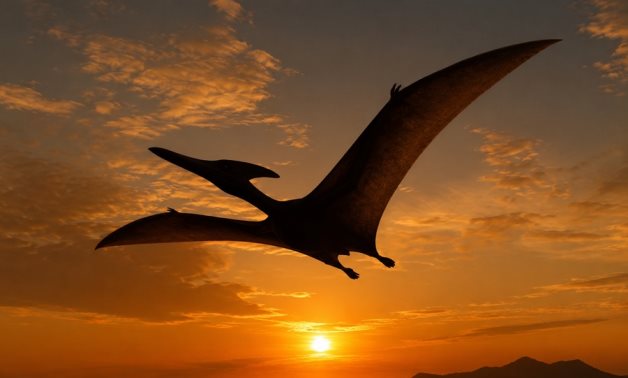
Illustrative image: An artistic rendering of a pterosaur soaring through the skies. The image is intended for visualisation purposes only and does not depict the fossil discovered in Egypt.




CAIRO – 6 July 2026: An international research team led by an Egyptian palaeontologist has announced the first confirmed discovery of a pterosaur fossil in Egypt, providing the earliest direct evidence that the flying reptiles inhabited what is now Egypt around 95 million years ago.
The discovery, published in the peer-reviewed journal Acta Palaeontologica Polonica, marks a significant addition to Egypt's fossil record and helps fill a longstanding geographical gap in scientists' understanding of the distribution of pterosaurs across northern Africa during the Late Cretaceous period.
The fossil is a nearly complete first wing phalanx—the first bone of the elongated fourth finger that supported the left wing, recovered from fluvial floodplain deposits of the Bahariya Formation in Egypt's Bahariya Oasis in the Western Desert.
The deposits date to the Cenomanian age, around 95 million years ago.
The study was led by Hesham Sallam, founder of the Mansoura University Vertebrate Paleontology (MUVP) center, with Egyptian Belal Salem serving as the study's lead author.
According to the researchers, the fossil belonged to a medium-sized pterosaur, an extinct group of flying reptiles that lived alongside dinosaurs but were not themselves dinosaurs.
Its anatomical features indicate it was part of the Ornithocheiromorpha, a group of pterosaurs known to have inhabited northern Africa and the Arabian Peninsula during the Late Cretaceous.
Until now, confirmed pterosaur fossils had been reported from countries including Morocco, Tunisia, Lebanon and Jordan, but none had been scientifically described from Egypt, leaving a major gap in the fossil record of the region.

Be Social




Comments
Leave a Comment