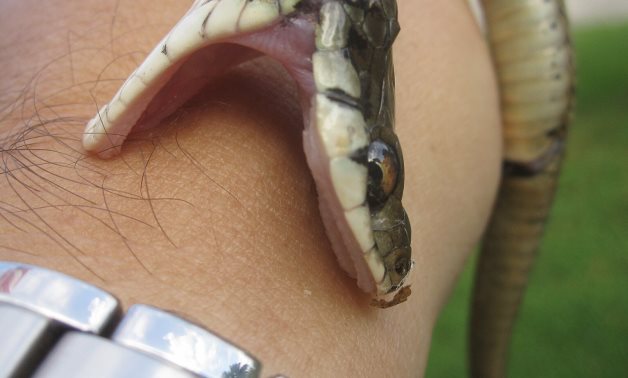
Snake bite- CC via Wikipedia/Giving It His Best




CAIRO – 3 July 2026: Every year from July to September, Egyptians are killed by venomous snake bites in parts of Egypt's Delta. Over the past ten days, two people- a 37-year-old woman and a 10-year-old child- were killed by venomous snakes in Al Qaraqrah village, Minya Al Qamh city, Al Sharqiyah governorate, 77.8 km from Cairo.
Egypt is home to about 36 types of snakes, of which only 9 are considered venomous and dangerous, such as the Egyptian cobra, which lives in agricultural lands and the Delta. This species is active during the summer due to rising temperatures, posing a serious threat to public health. Due to climate change and increasing temperatures, venomous snakes may leave their habitats and move to different environments in search of survival. A study published in Lancet Planetary Healthfound that areas to which snakes migrate could see significant losses by 2027, globally.
Dr. Marwa Ahmed Abbas, Professor of Clinical Toxicology and Head of the Forensic Medicine Department at the Faculty of Medicine at Zagazig University, warned of the dangers of working in agricultural fields, especially during the rice-planting season, which involves a continuous presence of water and creates a suitable environment for the spread of certain snake species, Youm7 reported.
Meanwhile, Hussein Abdel-Rahman Abu Saddam, an agricultural expert and head of both the Wafdi Farmers Union and the Farmers' Syndicate, said high temperatures force snakes to flee and hide among green grass and areas where water collects. He added that snake bites have caused distress and growing fear among farmers over the increasing spread of venomous snakes.
Abu Saddam noted that the spread of venomous snakes is linked to the absence of their natural predators, such as mongooses, cats, foxes, hawks, owls, and lynxes, as well as the lining and clearing of canals, which drives snakes to hide within agricultural crops. He called on the government to launch campaigns to control snake populations.
Absence of necessary antivenom in village hospitals
In an interview with Al-Masry Al-Youm, the father of the child killed by the snakebite said he could not save his child because the necessary antivenom was unavailable at either the village hospital or Minya Al Qamh General Hospital.
However, Ahmed Al-Baili, Undersecretary of the Ministry of Health in Al-Sharqiya, confirmed that anti-snake venom serum is available in all public, central, model, and specialized hospitals across Al-Sharqiya governorate.

Be Social




Comments
Leave a Comment