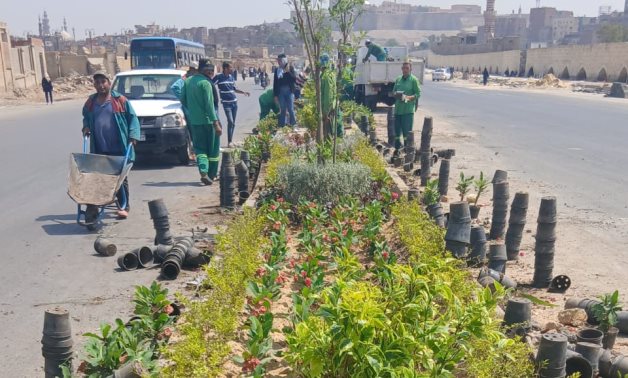
File- The 4th phase of "100 Million Trees" initiative for planting, supply, and afforestation of more than 200K trees across several governorates and along the Ring Road surrounding Greater Cairo




CAIRO – 3 July 2026: In celebration of the 13th anniversary of the June 30 Revolution, the Egyptian Cabinet's Media Center published infographics illustrating the most prominent challenges facing the environmental sector before the revolution and how the government has made progress in overcoming them.
The infographics show that the main challenges facing the environmental sector before the June 30 Revolution included escalating pollution problems and poor waste management, limited green investment, declining efficiency in protecting natural resources and biodiversity, and the need to develop ecotourism.
Since June 30, however, the state has achieved significant progress in reducing air pollution, the infographics highlighted. An integrated system was implemented to combat acute air pollution episodes - known as the "black cloud" - which helped prevent approximately 43,600 tons of emissions. Additionally, 97 industrial facilities were connected to the national network for monitoring industrial emissions.
The infographics also highlight efforts to develop the waste management system. The percentage of municipal solid waste recycled in an environmentally sound manner increased to 47% in 2025, compared to 21% in 2018. This coincided with the transformation of waste into an economic resource and a source of alternative energy, through doubling the use of alternative fuels in cement factories from 850,000 tons annually in 2023 to 1.9 million tons annually in 2025.
As part of efforts to develop nature reserves and protect natural resources, infrastructure and services were developed in 13 nature reserves, preparing them for investment and ecotourism. The entire Great Fringing Reef of Egypt in the Red Sea was declared a marine nature reserve, and Wadi El-Hitan (Valley of the Whales) was renewed on the IUCN Green List until 2031.
The infographics also track achievements in promoting ecotourism. Sharm El-Sheikh joined the International Council for Local Environmental Initiatives (ICLEI) Sustainable Cities Network as the first Egyptian city to do so, and the number of hotels awarded the "Green Star" rating increased significantly, with 70 hotels in Sharm El-Sheikh now certified. In addition, more than 40 diving centers received Green Fins certification - the largest number of such centers in any single country.
These indicators confirm that the June 30 Revolution marked a turning point toward comprehensive development of the environmental sector - one that has involved adopting policies and projects to strengthen the protection of natural resources, reduce pollution, improve waste management, and support ecotourism and the green economy, establishing a sustainable development path that balances development requirements with environmental preservation.

Be Social




Comments
Leave a Comment