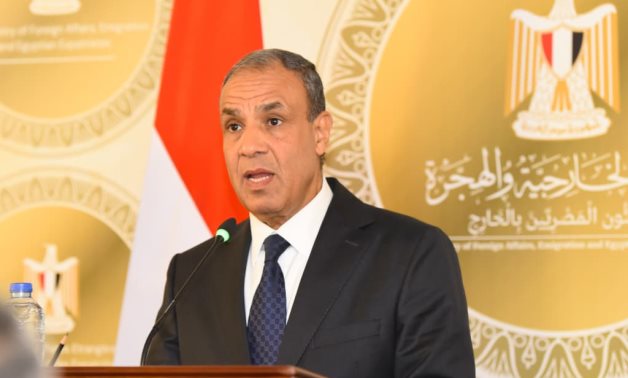
Abdelaaty




Minister of Foreign Affairs, International Cooperation and Egyptian Expatriates Badr Abdelatty affirmed that President Abdel Fattah El Sisi has given exceptional attention to diplomatic work, reflected in the strong and active revival of summit diplomacy.
This has been demonstrated through an unprecedented pace of presidential visits and international tours, repositioning Egypt at the heart of global affairs, particularly through the President's efforts to elevate Egypt's relations with its key international partners to the level of comprehensive strategic partnerships.
The minister made the remarks during a ceremony marking the 200th anniversary of the establishment of Egypt's Ministry of Foreign Affairs, attended by Prime Minister Moustafa Madbouly, a number of ministers, ambassadors, and prominent public figures.
Abdelatty said these diplomatic moves were not merely an unprecedented increase in high-level diplomatic activity but reflected a direct leadership approach aimed at rebuilding the modern Egyptian state, strengthening its regional and international role, restoring its influential presence in Africa, and reinforcing its status as a founding member of the international system and a pillar of stability in its regional environment.
He added that while summit diplomacy represents the dynamic executive face of this transformation, the principle of strategic balance constitutes its intellectual foundation. This balanced approach combines steadfast adherence to principles with flexibility in managing national interests, emphasizing respect for state sovereignty, non-interference in internal affairs, support for peace and stability, commitment to international law, diversification of external partnerships, and the firm defense of Egypt's national security and supreme interests.
Within this framework, he noted, Egypt's diplomatic agenda has expanded beyond traditional political issues to include advanced priority areas such as economic and development diplomacy, investment promotion, trade enhancement, market expansion, energy, water and climate issues, as well as revitalizing multilateral action and leveraging international partnerships to advance Egypt's national development goals.
He added that incorporating the International Cooperation portfolio into the Ministry of Foreign Affairs reflects this evolution and reinforces the integration between foreign policy and Egypt's development priorities, enabling the country to maximize the benefits of its international partnerships and support sustainable development efforts.
Abdelatty stressed that the Ministry of Foreign Affairs has also continued to fulfill its core responsibility toward Egyptians abroad by protecting their rights and interests, providing consular services, and strengthening their connection with their homeland, reflecting the state's commitment to ensuring that every Egyptian living abroad remains an integral part of the nation's progress and development.
The minister emphasized that Egypt's foreign policy has undergone a remarkable transformation over the past decade under President Sisi's leadership, restoring and strengthening Egypt's rightful regional and international standing and influence through a clear national vision aimed at rebuilding the country's role and global presence.
He explained that this diplomatic momentum has been characterized by clarity of vision, an expanded scope of engagement, and growing influence within a comprehensive national strategy focused on consolidating the state, enhancing its comprehensive national capabilities, and safeguarding its national security.
Abdelatty said Egypt's distinguished diplomatic school, under President Sisi's leadership and strategic vision, recognizes that balance does not mean hesitation, dialogue does not imply compromising national interests, and openness to the world is fully compatible with firmly safeguarding Egypt's national interests. Through the president's directives and active presidential diplomacy, reflected in his numerous foreign visits, Egyptian diplomacy has consolidated Egypt's prestigious standing among nations and witnessed exceptional momentum across all levels.
He added that this success stems from Egypt's ability to combine unwavering principles with flexible diplomatic tools, clear strategic vision with broad international engagement, thereby strengthening Egypt's regional and international role and reinforcing its reputation as a trusted partner and respected voice on the global stage.
The minister stressed that Egyptian diplomacy has not merely reacted to regional developments but has actively contributed to shaping a more balanced regional environment, containing crises and preventing escalation into open conflicts. This approach is based on Egypt's deep understanding of the close link between regional stability and its national security, as well as its long-standing role as a peacebuilder and pillar of regional stability.
Abdelatty expressed his pleasure at celebrating the bicentennial of the Ministry of Foreign Affairs at its fourth and current headquarters in the New Capital, describing the occasion as one of profound symbolic significance.
Over the past two centuries, he said, the ministry has embodied Egypt's awareness of its identity, its understanding of its international standing, and its ability to manage its regional and global relations effectively.
He noted that throughout its 200-year history, the ministry has maintained a foreign policy rooted in principles that reflect the essence and values of the Egyptian state, characterized by integrity, professionalism, and honesty, while drawing upon extensive diplomatic experience and modern expertise in development, economic, environmental, artificial intelligence, digital transformation, and emerging international issues.
The minister said the celebration commemorates not only one of the oldest institutions of the modern Egyptian state but also the long journey of Egyptian diplomacy as a cornerstone of national security and a key instrument for protecting Egypt's interests and enhancing its international standing.
Over the years, he added, Egypt has developed a distinguished diplomatic school known for its professionalism, balance, and careful assessment, recognizing that national security depends not only on military power but also on effective diplomacy, balanced international relations, and preventing crises before they escalate.
Abdelatty stressed that this long history would not have been possible without generations of Egyptian diplomats—both men and women—who represented Egypt around the world, helped establish regional and international organizations, confronted major challenges, and conducted complex negotiations, from the struggle for national independence to diplomatic and legal efforts to restore occupied territory.
Abdelatty expressed his sincere appreciation to President Sisi for his decision to include the martyrs of the Ministry of Foreign Affairs among the beneficiaries of the Martyrs, Victims and Missing Persons of Military and Terrorist Operations Honor Fund, describing the move as a reflection of the president's deep appreciation for those who sacrificed their lives in service of the nation.
He also thanked President Sisi for extending congratulations to the Ministry on the occasion of its bicentennial, describing the gesture as a clear expression of the president's appreciation for national institutions and their historic role in serving Egypt and protecting its interests.
He said the message was a source of pride for all ministry personnel and a strong endorsement of Egyptian diplomacy and its contributions to strengthening Egypt's regional and international standing over the past two centuries.
Concluding his remarks, Abdelatty expressed his appreciation for all state institutions that contribute to Egypt's development, affirming that Egyptian diplomacy will continue to serve as Egypt's voice in the world, the defender of its interests, the servant of its citizens and a bridge of communication with peoples across the globe, while upholding the traditions of a nation that values its history and remains confident in its ability to shape its future.

Be Social




Comments
Leave a Comment