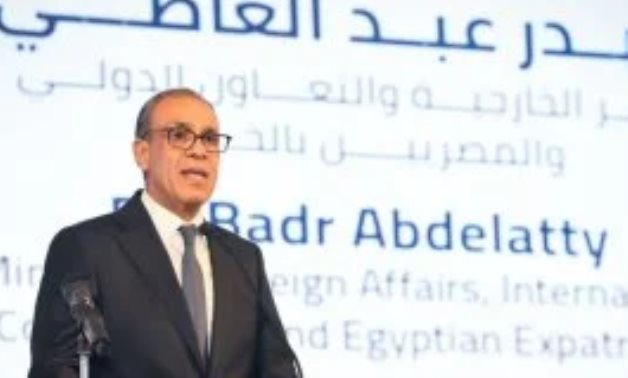




CAIRO - 23 June 2026: The landmark memorandum of understanding between the U.S. and Iran represents a critical opportunity that must be leveraged to launch a broader regional political dialogue, Egyptian Foreign Minister Badr Abdelatty announced in a Monday ministerial address.
Speaking at the consultative meeting of Arab foreign ministers in the Jordanian capital of Amman—convened on the sidelines of the 165th resumed ordinary session of the Arab League Ministerial Council—Abdelatty praised Arab mediation efforts and urged both Washington and Tehran to finalize their negotiations within the designated 60-day window.
However, he emphasized that any emerging regional arrangements must address Arab national security concerns. Chief among these are safeguarding Gulf Cooperation Council (GCC) security, guaranteeing freedom of navigation, respecting state sovereignty, and enforcing the universality of the Nuclear Non-Proliferation Treaty (NPT) in the Middle East.
While supporting the diplomatic track, Abdelatty strongly condemned past Iranian attacks targeting the security, sovereignty, and civilian infrastructure of sister Arab nations, reiterating Egypt's solidarity with all protective measures taken by these states.
He also condemned continuous Israeli aggression against Lebanon, demanding an immediate, total withdrawal and the non-selective implementation of UN Security Council Resolution 1701 to allow Lebanese state institutions to reclaim full national authority.
Abdelatty stressed that lasting regional stability cannot be achieved by settling the Iranian nuclear file alone while leaving the core conflict unresolved.
He stated that a just, comprehensive resolution to the Palestinian cause remains the baseline for Middle East peace, fiercely condemning systematic Israeli violations, unilateral actions, and accelerating settlement expansions in the occupied West Bank.
The Foreign Minister reaffirmed Egypt's total rejection of any schemes aimed at displacing the Palestinian people, separating the Gaza Strip from the West Bank, or compromising the unity of Palestinian territories, while pledging unwavering support for the Palestinian National Authority.
Concluding his address, Abdelatty highlighted Egypt’s steadfast backing of the historic Jordanian Hashemite Custodianship over Islamic and Christian holy sites in occupied East Jerusalem, rejecting any attempts to alter the city's legal or historical status quo.
He called for a unified Arab stance to harness current diplomatic momentum, urging a comprehensive regional security dialogue where Middle Eastern states act as the primary architects of their own collective stability.

Be Social




Comments
Leave a Comment