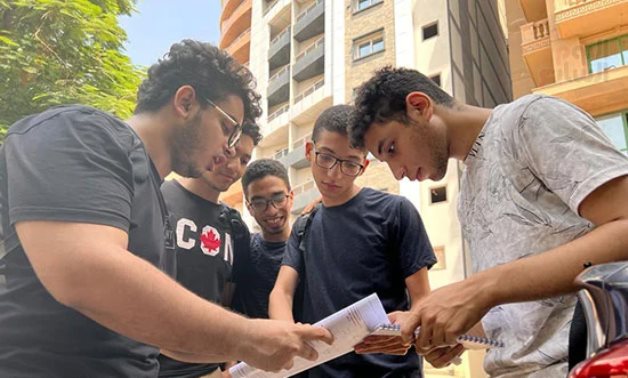
Students revise ahead of their Thanaweya Amma examinations in Egypt. (File photo: Youm7/Handout via Egypt Today)




CAIRO – 21 June 2026: More than 921,000 Egyptian students began the country's high school leaving examinations on Sunday, marking the start of a testing period that will play a decisive role in determining their university admissions and future academic paths.
Known locally as the Thanaweya Amma, the examinations are one of the most significant milestones in Egypt's education system.
Students are divided into academic streams, including science, mathematics and literature, with their final scores largely determining which university faculties they can enter, from medicine and engineering to economics, languages and law.
The 2026 examination cycle opened with non-core subjects, including religious education and national education.
Students must score at least 70% to pass these subjects, a higher threshold than the standard passing mark applied to other subjects.
The exams are being taken by 921,709 students under both the old and new education systems. Of those, 918,306 are sitting exams under the new system, while 3,403 students remain under the previous system.
One of the main differences is that the second foreign language (mostly French of German) remains a scored subject for students under the old system, while under the new system it is a pass-or-fail subject that does not contribute to the final total.
While subjects such as religious education, physical education and the second foreign language do not count toward the overall score, performance in some of them can still influence university admissions.
The grade achieved in the second foreign language, for example, may be considered by language-focused faculties.
Arabic remains the single most heavily weighted subject, accounting for 80 marks, or roughly a quarter of the total score.
The first foreign language also carries significant weight. Together, the two language subjects account for about 44% of the total marks.
Students are also tested in specialized subjects according to their academic stream, including history for literature students and biology for science students, with each subject carrying 60 marks.
For mathematics students, the subject is divided into two examinations, pure mathematics and applied mathematics, worth 30 marks each.
Examinations this year consist primarily of multiple-choice questions. In core subjects, 85% of questions are multiple-choice and 15% are essay-based, while non-core subjects are assessed entirely through multiple-choice answer sheets.
The Ministry of Education said the examinations are being held across 613 examination complexes containing 2,032 testing committees nationwide.
The system groups several schools within a single examination complex as part of efforts to strengthen security, monitoring and logistical management.
Education Minister Mohamed Abdel Latif instructed officials to ensure a calm and orderly environment for students, stressing the importance of maintaining discipline while providing appropriate support throughout the examination period.
Authorities said student screening procedures begin at 8:15 a.m., with all candidates required to be inside examination halls by 8:50 a.m. to ensure examinations start on time and under equal conditions across the country.

Be Social




Comments
Leave a Comment